
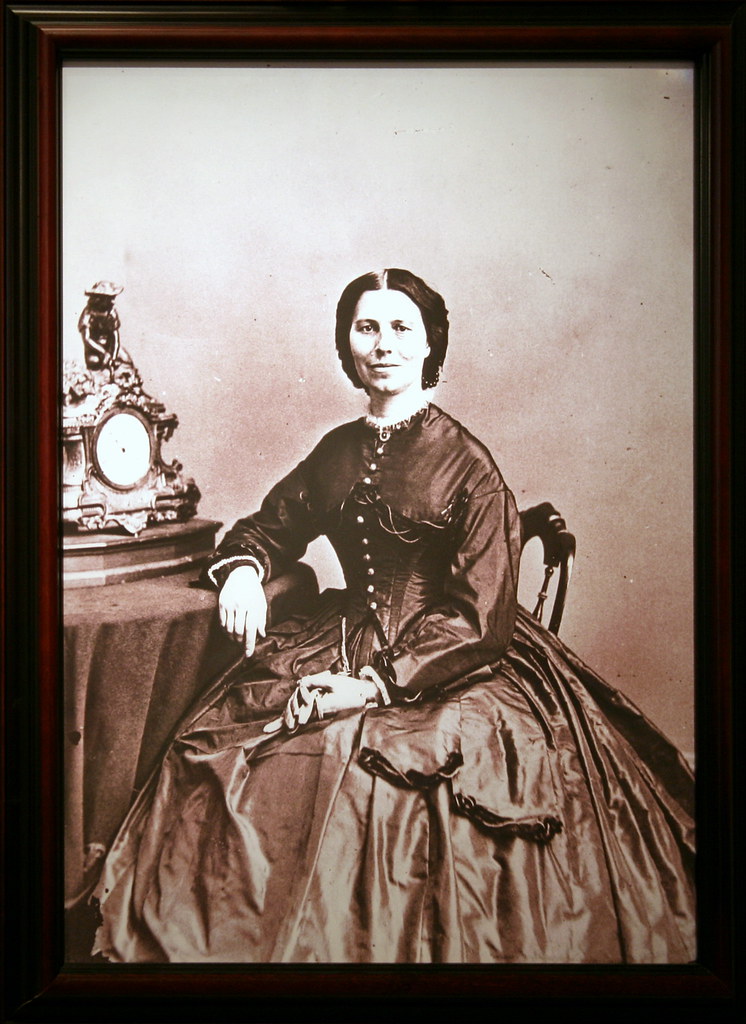
After a forest fire burned its way across Michigan in 1881, the Red Cross raised its flag for the first time in the United States, as its American founder, Clara Barton, appealed for money, clothes, and food for those affected by the natural disaster.
Clara Barton, the most important nurse in American history, should be celebrated by Hillsdale College with a statue.
Hillsdale’s campus is home to many statues of famous Americans, as well as Margaret Thatcher and Winston Churchill. James Madison is the most recent addition. Those memorialized through statues leave behind a common legacy. These politicians, founding fathers, and abolitionists greatly contributed to freedom and democracy, supporting the United States during its darkest days with passion and bravery.
Barton’s life and legacy, equally matched in service to the American people, also deserves recognition.
Barton was born in 1821 to a prosperous farming family in Oxford, Massachusetts. She first became a teacher, founding schools for poor students. Barton never received formal training as a nurse and her experience caring for a sick older brother was her only medical background. After the Civil War erupted in 1861, Barton’s nursing skills and affinity for charity aided millions of people across the country.
Barton encountered the war while working as a recording clerk in the U.S. Patent Office in Washington D.C. — the first woman to hold such a position. Barton began her work by bringing supplies to the men of the 6th Massachusetts Infantry, many of whom she knew. Her staunch support for abolition and love for the troops, inspired her organized effort to help the soldiers as they pursued liberty for all.
Barton’s resilience was a weapon for the Union. She gained access to field hospitals where she maintained a flow of supplies and medical assistance. According to the Red Cross’ biography of Barton, “following the battle of Cedar Mountain in northern Virginia in August 1862, she appeared at a field hospital at midnight with a wagon-load of supplies drawn by a four-mule team.”
Barton risked her life on the front lines of major battles including Fairfax Station, Harpers Ferry, Antietam, Fredericksburg, and Charleston among others. The Red Cross’ historical accounts note that “at Antietam, she ordered the drivers of her supply wagons to follow the cannon, and traveled all night actually pulling ahead of military medical units. While the battle raged, she and her associates dashed about bringing relief and hope to the field.”
Barton consistently put the soldiers’ wellbeing before her own.
She wrote: “I always tried . . . to succor the wounded until medical aid and supplies could come up — I could run the risk; it made no difference to anyone if I were shot or taken prisoner.”
After the war, Barton established the Office of Correspondence with Friends of the Missing Men of the United States Army, which answered 63,000 letters and identified 22,000 missing men, alive or deceased, over four years.
From the beginning of the war to the end, Barton cared for the living and dead troops. At Antietam she removed a bullet from a man’s face, though she was not a surgeon. She was also in charge of organizing the tent hospitals. After the war, she insisted upon the creation of a national cemetery in Georgia and through her efforts, 13,000 graves were identified and memorialized.
The end of the Civil War closed an extraordinary chapter in Barton’s humanitarian work, but she had much more to give. On a visit to Switzerland, she was impressed by the Red Cross organization for disaster relief and victims of war. She negotiated with three different presidents over five years to have her plans for an American branch approved. In 1881, the American Association of the Red Cross was formed, and Barton served as its first president until 1904.
Though she was a powerhouse of charity and unceasing devotion to her country during her life, Barton’s legacy continues to aid millions of Americans. Now in its 139th year, the American Red Cross administers to disaster victims, facilitates blood donation, and supports military families around the world. Most recently, they have aided those affected by the California wildfires.
Clara Barton’s purpose in life was the good of her country. Despite never having the right to vote, she was a hero of war, a negotiator with presidents, and the founder of an organization that supports people around the globe to this day. Barton’s exemplary dedication to freedom and charity more than qualifies her for residency on the Liberty Walk.
Lily McHale is a junior George Washington Fellow studying political economy.
