
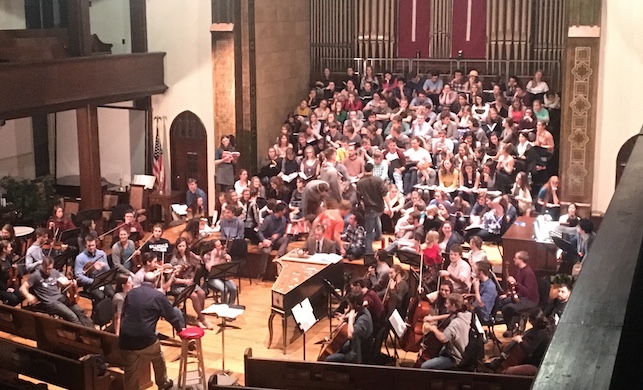
While Americans typically associate Handel’s “Messiah” with Christmas, Hillsdale students, staff, faculty and community members will have to wait a bit longer. The college has opted to move its long-anticipated performance to Easter, between April 9 and 11, due to COVID-19.
“It’s a big decision,” said Music Department Chairman James Holleman. “The college puts a lot of stock in the four-year cycle of Handel’s “Messiah” There’s a lot of build up, especially with the building of the chapel.”
The college choir performs “Messiah” every four years so that every class gets the chance to perform it once. Since Christ Chapel can seat 1,350 people, limiting capacity for two performances could turn away many, Holleman said.
“If we limit it to 300 people, we’re pushing out almost 2,000 people,” he said.
“Messiah” is a three piece oratorio composed by George Frideric Handel in 1741. The oratorio traces Christ’s time on earth from the Nativity, to the Passion, Resurrection and Ascension.
In place of performing Handel’s “Messiah” before Christmas, an orchestra concert will showcase different instrument groups and a choir concert with the normal choir, chamber choir, and the new chapel choir.
“Sunday will be choir without orchestra and then we’ll also feature the new chapel choir,” Holleman said. “The advantage to that is that we’re going to do some of the music they prepared last spring but didn’t get to perform because of the lockdown. We’ll add some sacred Christmas music. That will be less pressure on students.”
Holleman made the decision to delay the performance in coordination with the president’s office and after a long conversation with College President Larry Arnn.
“We had a very productive, supportive conversation,” Holleman said. “We vetted as many aspects and scenarios as we could and came to this conclusion together.”
The final decision came down to concerns about the mask wearing compromising the aesthetic experience, limiting capacity and thereby sending away almost 2,000 people, as well as a lack of cohesive preparation due to coronavirus precautions.
“I just couldn’t see December being as good due to capacity restrictions, chance of losing singers, the inability to have a full audience,” Holleman said. “I think wearing masks would not be a very authentic performance. I don’t think they did that in Handel’s day.”
Holleman said his greatest concern was the students ability to perform the oratorio to the best of their talents and abilities.
“The performance would involve a lot of students in very intense rehearsal -165 students on stage for two to two-and-a-half hours of rehearsal,” Holleman said. “It’s been a difficult semester for the students. I think they’ve soldiered on beautifully, but we’re not as effective in choir—we’re spread out, we’re wearing masks, and it’s hard to hear people. We take breaks outside throughout practice to allow the air inside to ventilate out.”
These restrictions, along with having to limit how many people attend the event in the chapel made moving the concert to Easter a more prudent and optimal decision, according to Holleman.
Students seem disappointed, but relieved and hopeful for the chance to improve their performance, according to Holleman.
For those seniors whose final year would be punctuated by performing the classic, the decision to move the event did not seem to create much angst.
“I wasn’t super surprised,” senior Gabe Kramer said. “I think it’s probably the right thing to do. The types of people who come to concerts are generally older, so it’s probably not smart to have that many types of people together for that long.”
Senior Michaela Stiles said she is grateful to have more time and a lighter load for the end of the fall semester.
“It gives us an opportunity to get the pieces down and time to rehearse,” she said. “Handel is such an iconic composer, and the “Messiah” is such an iconic piece, you want to be able to do it really well. I don’t think more time is necessarily a bad thing. I felt a little bit of relief because it lightens up the rest of our semester as we prepare for finals and projects. It’s one less thing we have to worry about.”
According to Holleman, Handel originally performed the “Messiah” around Easter.
“After Easter, the ‘Hallelujah’ chorus has more meaning,” Holleman said with a laugh.
