
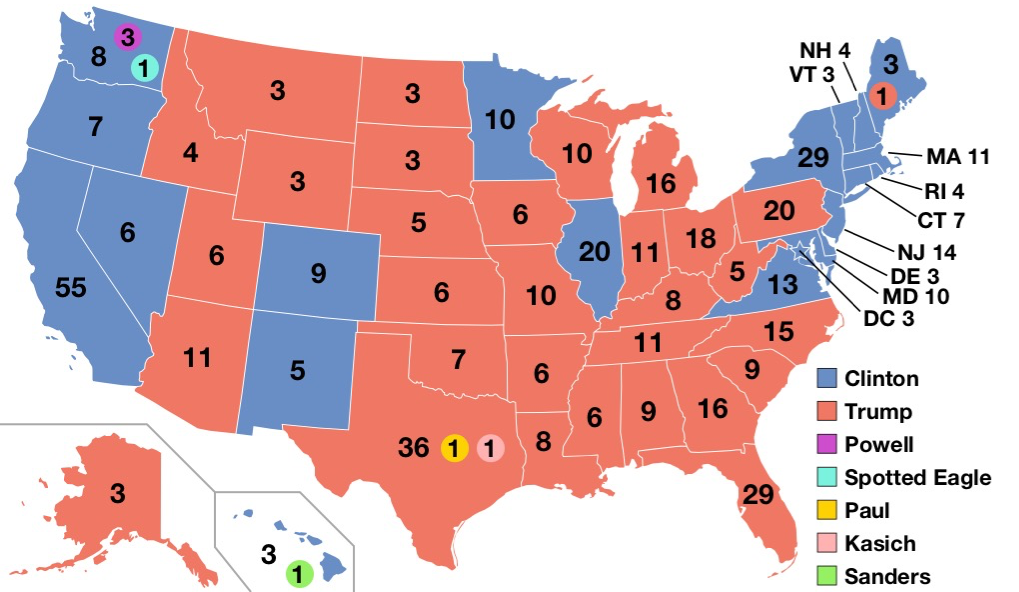
When James Madison wrote Federalist 68, he described the Electoral College as “almost the only part of the system, of any consequence, which has escaped without severe censure, or which has received the slightest mark of approbation from its opponents.” Now, according to a March 2020 Pew Research Poll, 58% of Americans support a popular vote as the mode of electing the president. This dramatic shift in public opinion is due to a sinister combination of media misinformation, partisan manipulation, and civic ignorance.
Those who wish to do away with the Electoral College attack the system for being “undemocratic.” But the framers who gave us this system would never view this allegation as a good reason to do away with it, and neither should we. Founding father and second United States President John Adams warned us, “There never was a democracy yet, that did not commit suicide.” Madison echoed Adams, calling democracy “the most vile form of government.” Indeed, America is not a democracy, it is a republic, and the Electoral College is one of the remaining safeguards that keep it so.
As democracy has become a sort of buzzword for good governance, it is worth considering why America’s founders reviled this form of government, and why the Electoral College serves as a practical and relevant method of avoiding the pitfalls of democracy and majority rule.
The United States was not always united. Under the Articles of Confederation, America essentially existed as a group of autonomous, loosely connected states with differing forms of government, most of which had some form of pure majority rule. Seeing that this system of government failed to protect the rights of the individuals in those states, the authors of the Federalist Papers — Alexander Hamilton, James Madison, and John Jay — advocated for a centralized national government as spelled out in the Constitution they defended.
Hamilton, Madison, and Jay also understood the potential for tyranny in a centralized national government, providing brilliant safeguards to liberty against both majority and minority rule. These safeguards take the form of federalism, separation of powers, direct and indirect elections, and bicameral legislature that represents the states both equally and based on population, and of course, the Electoral College.
Without the Electoral College, presidential candidates would face no incentive to appeal to a larger cross section of voters, instead focusing on the interests of elites in populous cities such as New York and Los Angeles. The needs and interests of regular voters in thinly populated rural areas would inevitably be overlooked in favor of majority interests and at the expense of legitimate minority interests.
Indeed, Hillary Clinton’s often-discussed win of the national popular vote and loss of the electoral vote in 2016 only had her winning one-sixth of the counties in the nation, with the counties she won confined mostly to “urban areas on both coasts,” according to the Heritage Foundation’s Hans Von Spakovsky.
Without the Electoral College, presidential candidates would not need to worry about the support of farmers in rural counties, blue-collar steel workers, or small business owners if they could only secure the support of the almost entirely left-leaning big cities such as New York, Los Angeles, Boston, or Chicago.
While the framers knew America could not exist as an adequate governing body for the securing of our rights without a strong national government, they admitted that ultimately America was a union of states, not a homogenous land mass. Therefore, in seeking to uphold the power of the states, the founders created a system in which Americans who vote for a president are not primarily voting as citizens of America, but as citizens of their state.
Madison understood the threatening force that a majority united against the cause of liberty could have. For the framers, majority support was no determinant of the validity of a cause. A concentrated majority could easily trample on that of a minority, and vice versa. In Federalist 10, Madison warns of the dangers of factions which “whether amounting to a majority or a minority of the whole,” still threaten to infringe on liberty through some “common impulse of passion.”
The founders showed an astounding amount of foresight in choosing our method of electing the president. These men understood how coalitions of elites could band together to oppress regular people — and they understood that regardless of whether these oppressors represented a majority or a minority of the people, they could threaten liberty.
The Electoral College stands as one of the last remaining safeguards to our liberty as Americans. While radical forces decide what is “politically correct” every five minutes, our presidential candidates are forced to reckon, at least to an extent, with the interests of everyday Americans. We have the Electoral College to thank for that. It may not be a perfect system, and we still must remain vigilant protectors of our own and our fellow citizens’ liberty, but we would do away with the Electoral College at our own peril.
The question of whether or not to scrap the Electoral College is a question of choosing democracy or liberty. Common sense and a love for America support our choosing the latter.
Sarah Weaver is pursuing a master’s degree in the Van Andel Graduate School of Statesmanship.
