
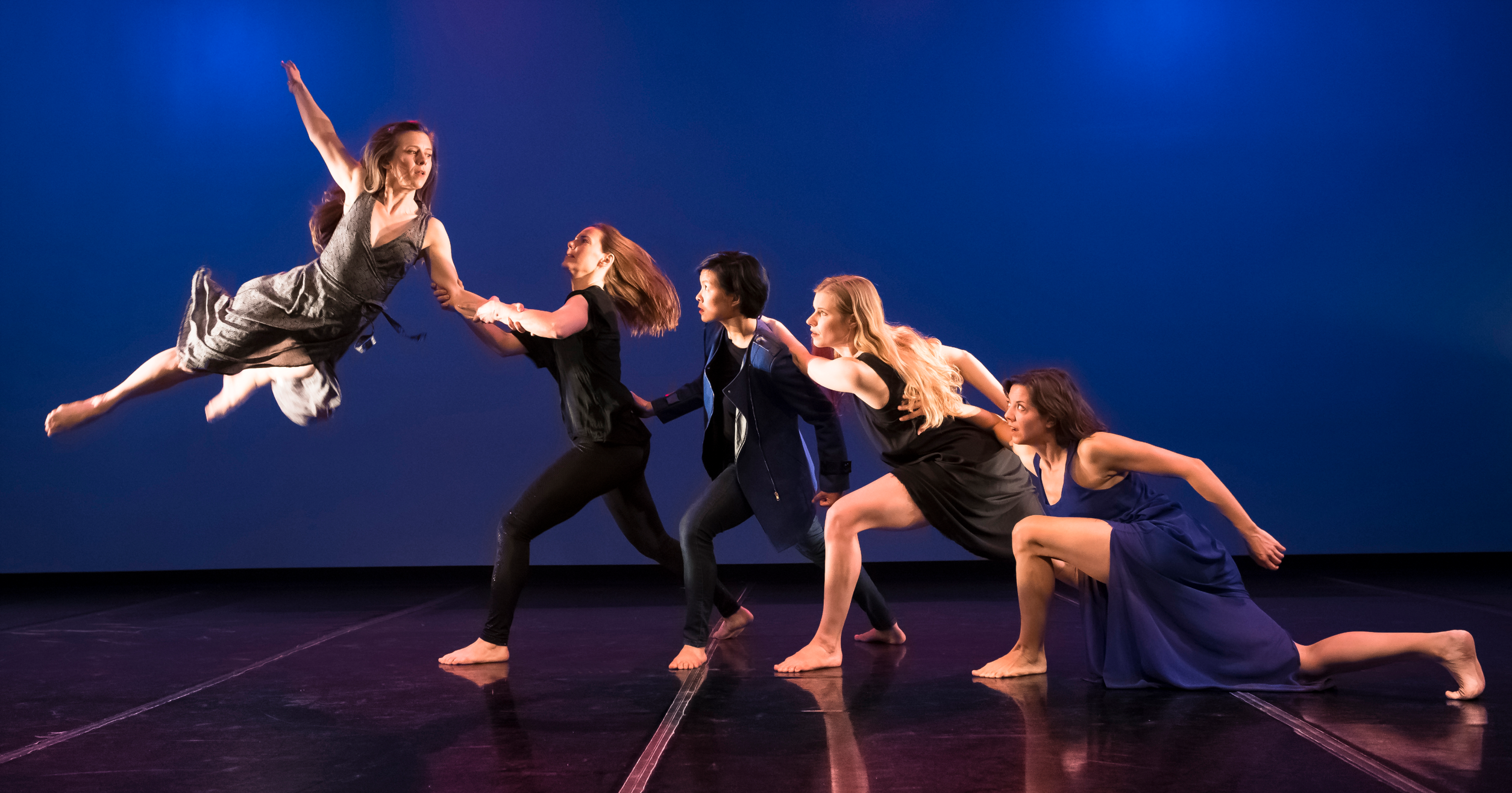
Memories of the day Megan Bascom decided she wanted to be a dancer flashed back in an instant.
She was wearing a forest green leotard and black jazz pants. She stood in a wide-leg hamstring stretch. Soft ’90s electronic music played in the background, and it was in that moment Bascom knew that she would pursue dance for life.
“I remember when I realized that I could choose dance as a path, a career, thinking, ‘I am the happiest right now, I want this everyday,’” Bascom said. “I realized you can do with your life what you want. You just have to figure out how.”
That moment was more than 20 years ago. After starting her own dance company, Megan Bascom & Dancers, in New York City, and completing her MFA in dance from the University of Michigan, Bascom is now the newest adjunct dance professor in Hillsdale’s Department of Theatre and Dance.
Beginnings
She’s a Floridian, born and raised. Fishing, camping, beach trips, and scraping knees were her regular activities on the weekend growing up.
“I remember the feel of the Florida sun on my skin and being able to run out in the grass. At any age, the outdoors were always accessible,” Bascom said. “And, I was always an athletic child.”
As a little girl, Bascom was kind, determined, and competitive. She started off twirling batons on Wednesday afternoons — and getting the occasional black eye, Bascom recalled. After envying her friend who went to dance classes on the weekend, Bascom joined her local dance studio.
“I was like, ‘Wait a second, you can dance without a stick in your hand?’ Bascom said, laughing. “I was learning that dance could simply be performative and didn’t have to include competitions, which were starting to stress me out because I had to win. I clearly had a lot of drive, even as a kid.”
“I don’t know why but it took me almost a year to have the courage to ask my parents to take me to dance class,” she continued. “I was about nine when I started dancing.”
The start of dance classes meant the end of baton-twirling competitions, and the beginning of what would eventually become a career as a professional dancer. From performing at arts festivals to retirement homes, to hospitals, Bascom’s first memories as a dancer include performing in front of little kids plugged into ventilators. Instead of medals and accolades, it was these moments of giving to others that pushed Bascom to follow her passion professionally.
“I was too young to realize that those kids are probably not with us now,” she said. “And yet, those sorts of performative experiences really started to give me more of a sense of the joy that dance can bring people, and how visceral the dance-watching experience can be.”
New York City lights
With her parents as her biggest cheerleaders, Bascom headed to New York City in 2003. She had a one-way ticket, three suitcases, and $500 in her bank account.
“I even missed my flight that morning,” Bascom said.
She crashed on her friends’ couch for two weeks, and when her time was up she moved into the cheapest apartment she could find. She sold iPods for a living in the flagship Apple store to pay the bills and even ran into some of the biggest names in New York City’s phone book.
“Calvin Klein once told me I had beautiful eyes when he came in to buy an iPod,” she said.
Stevie Wonder and the Bush twins were among the other stars who stopped into the shop.
The long days at Apple were temporary, Bascom told herself. For nine seasons, she danced for Brooklyn-based dance company, white road Dance Media, and took studio classes around the city, all while continuing to seek additional performance opportunities. She even became a certified Pilates instructor.
The balance was hard to find, though, she said. Should she ditch work to go to an audition? It was a question Bascom asked herself everyday. Sometimes, she said, she wonders whether she made the right choice.
“Sometimes I think, ‘Should I have gambled?’ Should I have said, ‘I’m going to just not go to that job today, but I am going to go to that audition.’ But I didn’t, instead, I always tried to find bosses who understood the arts. And soon found ways to be my own boss and solve that problem!” she said.
When she couldn’t find work as a dancer, Bascom began to create it for herself — and for other dancers. In 2009, Megan Bascom & Dancers was born. Modern dance would be the company’s specialty, and her dream was to assemble a core community of dancers.
The beginning was incredible, said Bascom, but a lot of work. At first, it was just Bascom and a couple of her professional peers dancing together. But friends kept telling friends, who kept telling friends. The company went from two dancers up to 18 in one of her projects, with 5-8 dance artists working for the company in a typical season.
Thomas Ciccone was one of the dancers who joined the company. At the beginning of 2016, Ciccone jumped into the world of modern dance after dancing at night-clubs and focusing on Cabaret and Burlesque dancing. Bascom was Ciccone’s encourager and challenger.

“She’s a beautiful mover, and she always has a surprise factor of doing things,” said Ciccone, who is still a professional dancer. “There would be times in rehearsals when she would demonstrate the effort that she was looking for and sometimes I would be so wowed, and I’d say, ‘Wait, I have to do that?’”
“At the same time, Megan wanted everything to be organic. She didn’t want anything to be forced,” Ciccone continued. “If something was not working, she would say, ‘Let’s move on to the next thing.’”
The company danced all over the city. Megan Bascom & Dancers joined comedians, live musicians, and poets at loft parties. They traveled around the country, including to the historic Dance Complex in Cambridge, Massachusetts, an arts building which has stood since 1884. And they continued to foster community through public dance events.
Through all of this, Bascom was dealing with a long-term relationship coming to a close. When it was time to move on, Bascom moved back from Southern Connecticut to the heart of New York City and fully immersed herself in work with her company.
She met her husband, Giuseppe Hammer, in 2014. After he won a coffee basket at one of her company fundraisers, she delivered it to the 20th floor of his office building, and their friendship began.
“One night, he was walking me back to my car and we both agreed, ‘We should go on a date,’” she said. “And then he called me and he said, ‘This is a date.’ And then I yelled to my roommate, ‘I’ve got to find a dress.’”
He was the partner who would support Bascom in all her endeavors; from watching shows all over New York with her, to integrating his entrepreneurial ideas to help her company succeed. And it was evident to everyone.
“He was bringing support to her at a time when she needed that the most, and being an example of a partner who cares, loves you, and provides that support to your artistry,” Ciccone said. “He was the partner you wished you had.”
The journey to Hillsdale
It was an accident that took Bascom out of the city in 2014.
In the Bronx, Bascom suddenly found her car slammed in between two vehicles. The wreck totaled her car, and she was immediately rushed to the hospital.
“There were a lot of sounds that night,” she said.
So many sounds, she said, that an undiagnosed concussion and whiplash resulted in her five-year recovery from the 2014 accident.
“It shifted my mentality about the city,” Bascom said. “I thought, ‘OK, I’m in pain, it’s hard to keep up the pace in New York. I think I need a shift.’”
Graduate school became one of the most viable options. When Bascom learned that the University of Michigan offered full-ride scholarships to students pursuing a Master of Fine Arts in dance, she applied.
She was one of the four recipients who received the scholarship.
“I thought, ‘wow, this is really happening. This means they recognize that I’ve accomplished enough to deserve this,’” she said. “But then I realized, ‘I’m leaving New York.’ That was the moment this big decision hit me and I knew things were going to change.”
In 2017, Bascom began graduate school and could finally integrate her interest in kinesthetic awareness with empathy. This relationship became the focus of her research. How the two work together ultimately affects how humans relate to one another, Bascom said.
Memories from New York City came back when researching, Bascom said, smiling. When choreographing the dance for 18 dancers back in New York, she focused on the poignant transitions people make in life.
Like many of her endeavors, Bascom’s research was rewarded.
In 2018, she received the Meta Weiser EXCELerator Grant through the School of Music, Theatre and Dance for this research in conjunction with the entrepreneurial work she was doing to design ways for her company to bring this research to medical students participating in the University of Michigan’s Medical Arts Program.
Through her research, medical students could become more aware of their body language when interacting with their patients—and in turn, develop more empathy toward them.
Following her graduation from the two-year program in 2019, she was hired by the University of Michigan Department of Dance as an Intermittent Lecturer. She continues to teach there now.

Shea Carptoner-Broderic, a student of Bascom’s while she was completing her MFA, danced in two of Bascom’s works. Though Bascom was her instructor and professor, she was also a friend.
“When I came to college I felt a little bit lost and everyone came from a different background than I did,” said Carptoner-Broderic. “When Megan came, we had such similar minds and we have similar interests in movement and anatomy and I felt really validated dancing. I think that really helped me be confident in what I wanted to do.”
Bascom was always unapologetically herself—a non-conformist, Carptoner-Broderic said. If she didn’t like something, she wouldn’t do it. And if she really enjoyed something, she did it shamelessly.
Though Carptoner-Broderic didn’t finish her senior year in person due to the pandemic, Bascom left her with a lasting memory from their final class together.
“The end combination we did was super high energy,” she said. “The last combination we were throwing ourselves in the air, and even though we were going across the floor in separate groups, we were all on the same wavelength.”
“There was this community feeling which I think Megan is really good at creating,” she continued. “She’s really good at making everyone feel comfortable in her classroom and making everyone feel like we can take risks.”
Now also teaching at Hillsdale, Bascom comes prepared after playing almost every role possible: a performer, an artistic director, a student, and a professor.
Unlike most schools, Bascom described, Hillsdale welcomes students from all different levels of dance, something not celebrated at most schools.
“Plenty of schools can make dancing an incredibly intimidating pathway, but some schools make it more approachable,” Bascom said. “We offer a minor to students who really love dance, and I think that’s what’s been most satisfying about my experience here.”
Her teaching style is refreshing, said senior Kailey Andrews. Instead of just teaching a dance, Bascom teaches her students the history behind each one. She cares for students’ pain, and incorporates daily stretches to alleviate it. And rather than discard human contact all together, Andrews said Bascom has found ways to create human connection in all her choreography.
“Her usual style of choreography is very contact based, and focuses on how bodies can work together in a space,” said Andrews. “Choreographing in a pandemic is hard and I admire how she’s creatively adapted that. She’s figured out a way how we can interact on stage without ever coming in contact together.”
Though Bascom has integrated a new type of modern dance with the contemporary dance already taught at Hillsdale, she says she still wants her dancers to find their own style.
“I don’t want them to dance like me,” Bascom said. “I want them to find a better sense of their bodies as expressive dancers, and I think that’s most important.”
When Bascom finishes the choreography, she passes the baton, said Andrews.
“Once she choreographs, she always gives the movement to the dancers. She says, ‘It’s no longer mine. It’s yours.’ And I can’t imagine a more beautiful way for someone to pass it on.”
