
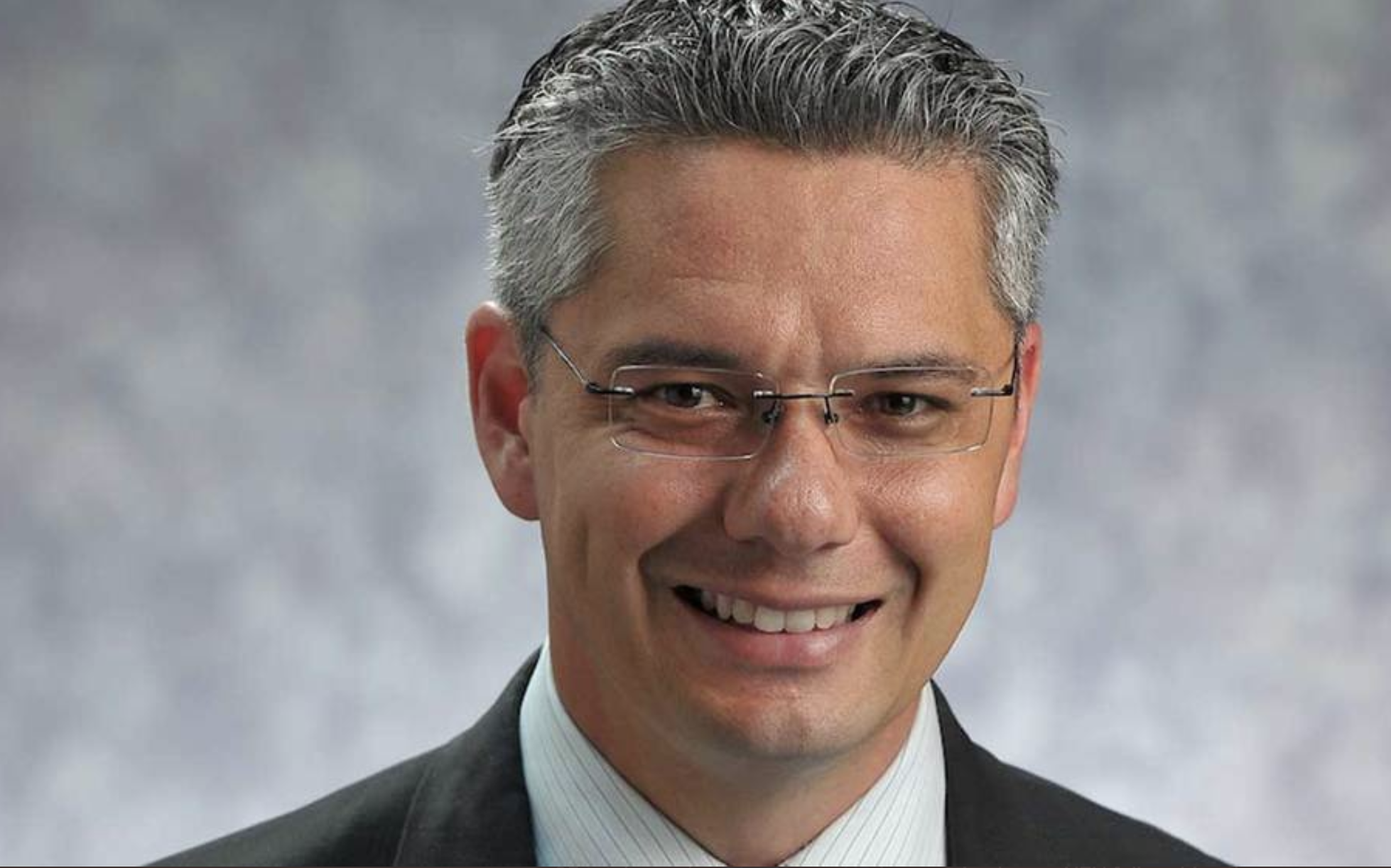
The jurisprudence of the late Supreme Court Justice Antonin Scalia is almost universally praised within conservative circles, save one infamous decision. In an event hosted by the Van Andel Graduate School of Statesmanship Tuesday, Sept. 15, Vincent Phillip Munoz defended that decision.
Munoz, an Associate Professor of Political Science and Law at Notre Dame University, explained that Scalia’s controversial perspective on the free exercise clause of the First Amendment is actually consistent with the justice’s staunch originalism.
In the case of Oregon v. Smith, Scalia authored an opinion which held that the First Amendment does not exempt religious practices from being subject to the law.
“Conservatives right away are appalled by this decision,” Munoz said in his lecture. “Justice Scalia’s opinion was met with harsh criticism as soon as it was issued.”
As Munoz explained in his lecture, most conservatives believe that the purpose of the free exercise clause is to do exactly what Scalia said it does not: exempt religious activities from generally applicable laws.
“I’m going to offer an interpretation that is different from many leading conservatives,” Munoz told his audience early on.
Munoz provided an analysis of the founders’ natural right theory and social contract constitutionalism. Inalienable rights, such as the right to freely exercise religion, cannot be subjected to the regulation of the political community.
Consequently, according to natural law theory, the state may not prohibit religious exercise on account of its religious character. Thus, the free exercise clause prohibits state actions that directly target religious exercise, he said.
However, this does not mean that the Constitution provides any exemptions to generally applicable laws that, in their application, happen to be burdensome upon religious practices.
If a generally-applicable law violates natural rights, fighting for a religious exemption to it preserves the bad law while making religious communities more obedient to oppressive government.
Fully subjecting religions to the law could possibly do more good for the cause of liberty in the long run, Munoz said, as this would prompt religious communities to actually oppose bad laws.
“Justice Scalia’s non-exemptionist reading of the free exercise clause is the only construction consistent with the founders’ natural rights political philosophy and their social compact constitutionalism,” he said.
Hillsdale College graduate school student and class of ’20 graduate, Brian Friemuth attended the lecture and found Munoz’s points spot on, especially as it related to the recent lockdowns across the country.
“The one thing I certainly agree with Munoz on is, he’s right about this——what pastors and priests across the country did is say, ‘oh, don’t complain about these clear encroachments on your rights, because the government gave us a handout,” Friemuth said.
Without the exemptions from state lockdowns that churches received, Friemuth said they would have fought much more fiercely against such oppressive restrictions. He believed Munoz demonstrated this during his talk.
The event was organized by Ronald Pestritto, Dean of the Van Andel Graduate School and Professor of Politics at Hillsdale College. Pestritto met Munoz when they were both undergraduate students at Claremont McKenna College.
“We’ve remained friends for years, and I’ve followed his scholarly career with great interest,” Pestritto said.
Pestritto invited Munoz to speak largely because of how religious communities have been complicit in overbearing lockdown executive orders, relying on religious exemptions instead of pushing back.
“Because of all the current questions about how religious liberty has come under threat in the lockdown era, I thought it would be good for people to hear an originalist perspective on the restriction on religious freedom,” Pestritto said.
Ultimately, Pestritto said he was happy with how the event turned out and the reception of Hillsdale students.
“We had a full capacity crowd and had some good questions, and so I think that’s evident of how well it went,” he said.
