
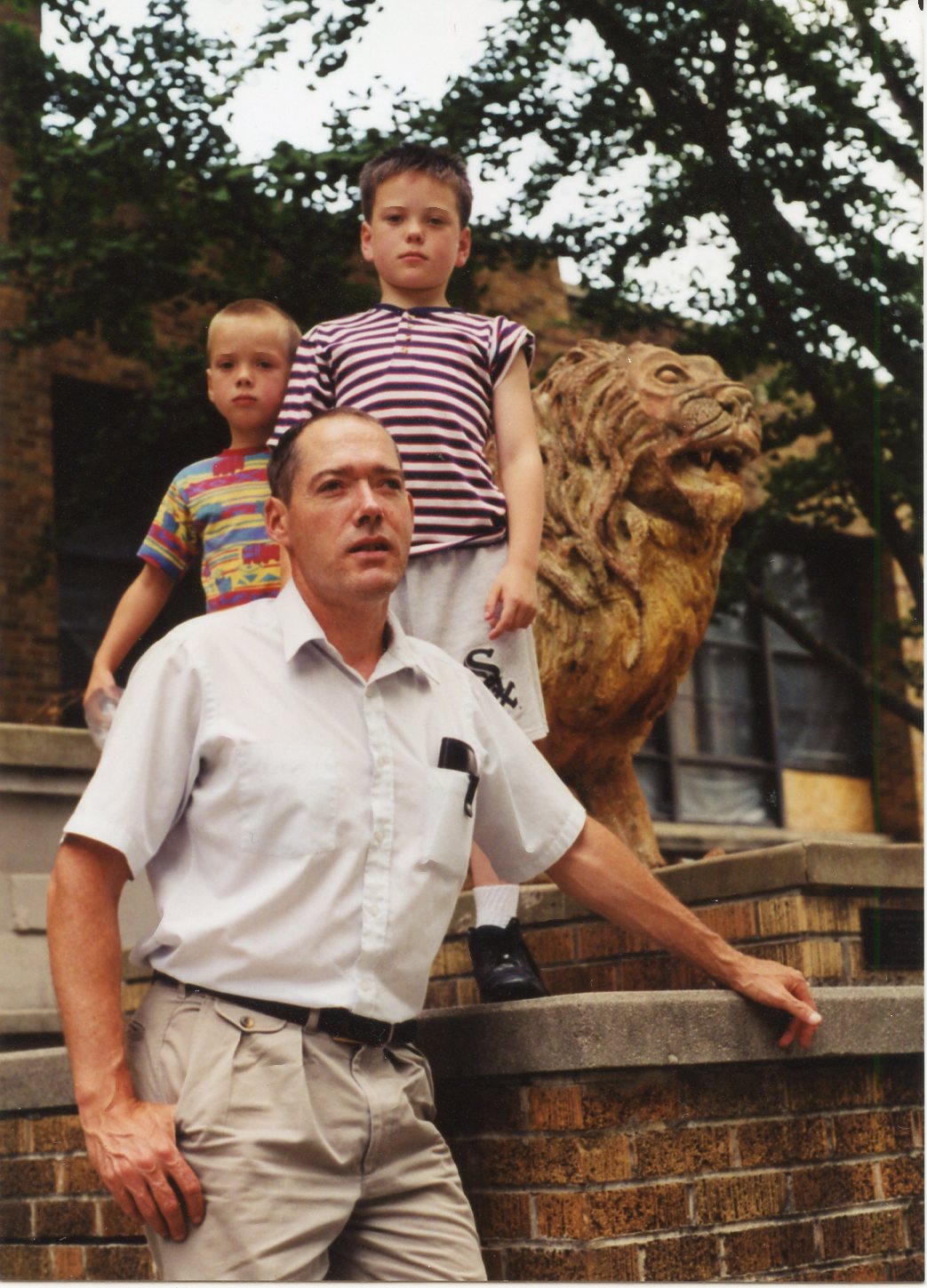
After he suffered a stroke in class on Sept. 2, Professor of English Michael Jordan announced a week later he would retire the next day.
A mainstay of the English department for the past 29 years, Jordan first joined Hillsdale’s faculty in 1991 as an assistant professor. After being promoted to associate professor, Jordan became the chair of the English department in 2004, staying in the post until 2015.
Jordan was a fixture at the doors of Delp Hall, where students could spot him wearing his trademark brown fedora, occasionally a bolo tie, and smoking a hand-rolled cigarette.
“Yes, I did quit smoking,” Jordan said as we sat on the white porch of his home. “And I’m not going to pick it back up, God willing. And I know he’s willing!”
Jordan’s mild-mannered leadership of the English department is largely responsible for its ongoing collegiality, talent, productiveness, and beauty, according to his colleagues.
“His excellence is the quiet kind that too often goes unnoticed,” Professor of English David Whalen said.
When the college underwent significant changes in the early 2000s, Jordan was a leader in the English department’s transition and the implementation of the updated English major in 2004, according to Justin Jackson, chair of the English department.
“He represented and then guided the department through the changes to the core curriculum and the changes we made to our own core courses therein,” Jackson said in an email. “He demonstrated a steady hand throughout all of this.”
In particular, Jordan focused the department’s attention on improving student writing by reducing the course load borne by each professor and capping classes at 25 students. Jordan’s legacy as department chair also includes the seven current faculty members whom he hired, including Justin Jackson, Patricia Bart, Kelly Franklin, Dutton Kearney, Dwight Lindley, Lorraine Murphy, and Benedict Whalen. He led by consensus, encouraged good cheer and charity, and never imposed his view according to his colleagues.
“He has been a steady friend, colleague, and leader in our department,” Professor Christopher Busch said. “I and many others will feel his absence. We have been blessed to know him.”
Yet, for all of his accomplishments, one cannot truly appreciate Jordan without hearing his stories. Between sips of apple cider, Jordan recalled his childhood education in western North Carolina.
“The high-point of every day was coming home from lunch to hear my teacher read ‘Tom Sawyer,’” Jordan said.
Despite his adolescent love for reading, Jordan believes he “wasted” his high school education and forgot about literature. After graduation, he hopped a bus to Florida and worked at Disney World. His Floridian escapades include buying a used ’65 Ford Cortina—a real bucket of bolts, he recalls—from NBA Hall of Famer Rick Barry. But then after one summer, homesickness for the mountains of western North Carolina crept in, so Jordan packed up and drove his clattering Ford back home.
“Once, I was in a little town called Morley, Michigan, a town of about 500 people, and I went into a cafe,” Jordan said. “And the waitress said, ‘what’ll you have?’ And I said, ‘cawww-fee.’ And she shouts to the back, ‘Hey mama, we got a western North Carolina boy in here!’ Just that one word told her.”
Indeed, Jordan’s Tar Heel style of speech is unusual in Michigan, which adds to his understated charm. But Jordan’s localism is more than the accent; it’s the lens through which he reads literature, and ultimately, the heart of what he teaches to students: to love and celebrate one’s culture and tradition.
He is saddened by the “brain-drain” from rural America, typified by college students who take high-paying jobs in cities rather than reinvesting in their communities, and the homogeneity of urbanization. Fortunately, Jordan said he believes the town of Hillsdale has largely been saved from that; he loves the scenic countryside, weekend farmers’ market, and local Catholic parish, St. Anthony’s. In fact, according to Jordan, the only bad thing about Hillsdale is that it’s not in western North Carolina.
After his brief stint at Disney World, Jordan returned to the mountains of Marion, North Carolina, and spent several years working in both a cotton mill and carpet factory. This made him reconsider college. It was during his sophomore year that he discovered a love of literature, and in 1977, Jordan graduated with a bachelor’s degree in English from Bryan College in Dayton, Tennessee.
Three years later, an encounter with Russell Kirk gave Jordan’s studies purpose and direction. After hearing the conservative intellectual give a lecture hosted by the Intercollegiate Studies Institute, Jordan wrote to Kirk for advice. Kirk replied with an invitation to study at his home in Mecosta, Michigan.
“I don’t think he knew what he was getting himself into,” Jordan said with a laugh. “Now, I was never a very snazzy or snappy dresser. But I didn’t even know how to tie a tie when I went to work with Dr. Kirk. I think there was a bit of a culture shock for this crude redneck who showed up in a tank top and gym shorts.”
Those two years at Kirk’s home, called Piety Hill, were difficult. He studied under Kirk, cut firewood, and served as Kirk’s chauffeur. Jordan also edited the University Bookman, a publication Kirk oversaw. Jordan admits that he looks back at his first published article, “Man is Moral Choice,” with embarrassment. Nevertheless, he completed his master’s thesis on Nathaniel Hawthorne under Kirk’s mentorship and received his “introduction to a life of letters.” Most importantly, Jordan met his wife of 34 years, Lindy, during a seminar at Kirk’s home.
The stories Jordan recalls of Kirk’s generosity—how he would sneak by his wife, Annette, to give Jordan a cigar or a slice of cake—parallel the same kind-heartedness Jordan has shown to students and colleagues at Hillsdale. Many times, students visited Jordan’s office to chat about a burgeoning interest and left his office with a stack of related books. He was generous in lending wrenches and ladders, dropping off homemade sweets from his wife, Lindy, and even opening his home up to share his family’s Easter dinner table with students.
“My first year at the college I lived with the Jordans—at their invitation—while my wife and I tried desperately to sell our home in South Carolina,” David Whalen recalled. “It took a full year for that to happen, and so all that time I lived here in Hillsdale with the Jordans while my family was in Carolina. The Jordans warmly welcomed me into their home. Theirs was not the ‘one-and-done’ good deed of conventional charity, but nine months of sustained help for the Whalens.”
After Mecosta, Jordan taught high-school boys at a boarding school in Bell Buckle, Tennessee. Much like the lessons learned at the cotton mill, however, Jordan found that his vocation laid elsewhere. He finished his Ph.D. at the University of Georgia under the mentorship of Marion Montgomery and began to teach there. Jordan’s first visit to Hillsdale was with Kirk during a Center for Constructive Alternatives lecture series; his first recollection of the college is stumbling upon a debate in the hallway of Phillips Auditorium between two female students over the doctrine of predestination.
English professors John Somerville and Busch were hired in 1991 along with Jordan. The three have taught nearly a third of a century together.
“I can’t think of a better companion,” Somerville said.
In addition to his teaching duties, Jordan took special pride in establishing an annual American Studies lecture and serving as the faculty sponsor for the Students for Life, the LIT literary honorary, and One-On-One, which mentors at-risk youth. Still, he says his favorite part of his 29 years at Hillsdale has been working with the students who have become “better prepared, better focused, and more bright” as the years went on.
Sophomore Sean Hoeft said he found his final Great Books class this fall with Jordan sentimental.
“You could tell that he loved what he was doing, which made his last day bittersweet,” Hoeft said. “While finishing his lecture on ‘The Parson’s Tale’ in Canterbury Tales, Dr. Jordan threw in his own sort of sermon, telling us students, ‘“You should love love, you should love joy, and you should love peace.’”
In the past week, the English department has rushed to fill in for Jordan’s absence. Professors Whalen the elder and Whalen the younger have assumed responsibility for his Great Books classes, and professors Cline and Franklin have taken on his American Literature 1890-Present class.
“We all know he’d certainly have done it for any of us; indeed, he has done so repeatedly,” Jackson said.
Though Jordan hasn’t decided what he’ll do in retirement, he likes the idea of spending his summers in Hillsdale and his winters at his lake house in western North Carolina. Wherever he decides to go, however, you’ll find him hiking, cutting wood, and doing some much-deserved pleasure reading.
As Jordan puts it, “The liberal arts can translate to a good life in another place.”
