
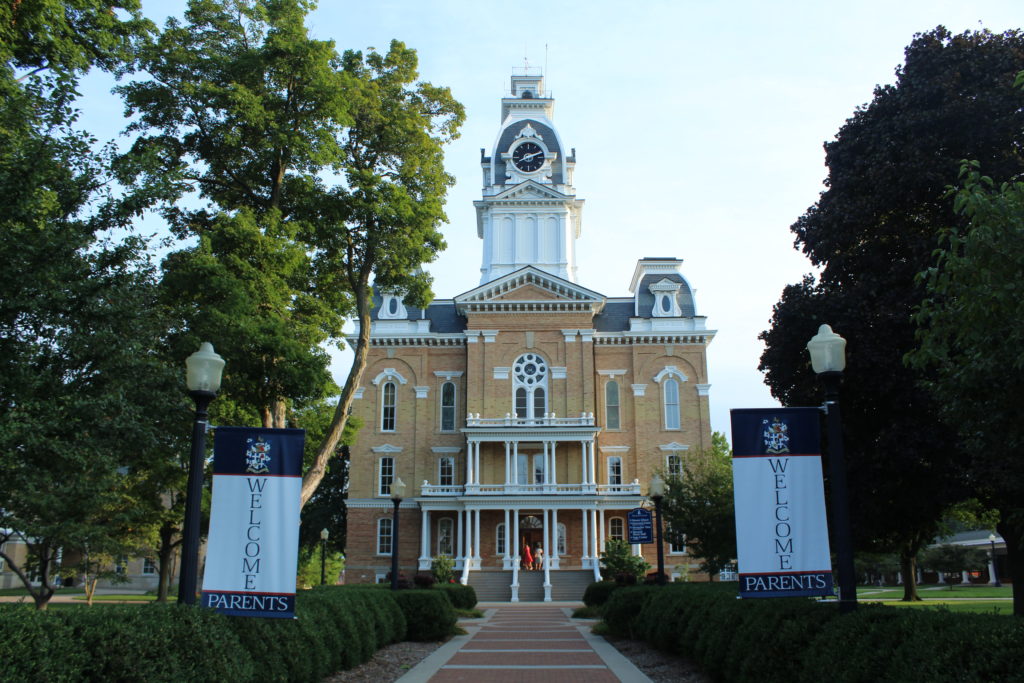
When I tell outsiders that I go to Hillsdale, I’m convinced I will always get one of two responses: either an exclamation of joy because of youth involvement in movement conservatism or a blank stare.
For the blank stares, I usually spit out a rendition of “small liberal arts college,” combined with “south central Michigan” and accompanied by an awkward hand gesture. I refrain from political dialogue in an effort to give the college a fair shake. After all, our mission statement tells us that “by training the young in the liberal arts [and not necessarily politics], Hillsdale College prepares students to become leaders worthy of that [Western] legacy.”
Our mission statement begs the question: what does it mean to be trained in the liberal arts, anyways? While our mission does not define liberal arts, it states that our “Western philosophical and theological inheritance” traces to “Athens and Jerusalem.” Hillsdale considers itself a trustee of this heritage, which finds its “clearest expression in the American experiment.” Thus, one can conclude that a liberal arts education relates intimately to the Western tradition.
In my experience, however, my quest to study the liberal arts at Hillsdale as they relate to the Western tradition has been unsuccessful.
As a freshman, I intended Hillsdale to be a resume item that would grant me access to prestigious jobs in Washington, D.C. My paradigm shift came when I took The Liberal Arts Tradition, a one-credit course for Hillsdale’s Collegiate Scholars Program. We read The Great Tradition, a collection of works about education that was edited by Professor of History Richard Gamble. Despite writing across different time periods, the authors of the collected works tended to mention the same transcendent ideas.
The course taught me that our learning occurs within a coherent tradition; this Western canon is ancient, but we encounter it everyday at Hillsdale. In part, Hillsdale is a liberal arts college because we read primary sources from the Western tradition. We do it in the Western Heritage, U.S. Constitution, Great Books, and many others (even the core science classes).
Now, the question I came to: how do I study the Western canon when it’s diluted by specialization within majors? My first solution was to create my own major. I scoured Hillsdale’s course catalog, examining the classes in each department that related most to the Western tradition. My initial draft was about 90 credits beyond the core. I had my bases covered, but I couldn’t finish it in four years.
After eight months of drafts, professor meetings, and conversations with my classically-educated peers, I finalized a course list. It consisted of required classics and education courses, balanced by electives from politics, philosophy, history, and the fine arts, plus a senior thesis to make a total of 36 credits.
Unfortunately, the hard truth hit me in December of my sophomore year: my proposal did not fulfill the ends for which it was created to pursue. Hillsdale’s upper-level courses are designed to work with other courses in the same major to create a coherent understanding of that discipline. Thus, you can take Ancient Philosophy, but it’s designed to work with other philosophy major courses to teach you about philosophy. Even though philosophers belong to the Western tradition, philosophy alone does not necessarily teach you about it. The same goes for every discipline. For my major that cherry-picked courses from half of our departments, this was a problem. Instead of building a major that would teach me how to be a Western man in the modern age, I collected courses more likely to render me a dilettante.
My narrative does not concern itself with my perspective on the major system, but rather to make this point: the Western tradition works across the disciplines, and it’s not limited by academic departments. The breadth offered by a proper liberal education isn’t provided by any collection of individual courses, but by an academic tradition which transcends disciplines. Bacon, Newton, and Locke belong in conversation with one another, not isolated by their respective disciplines.
What does all of this mean? I’m not here to tell you that your education is defective or that Hillsdale needs an overhaul. On the contrary, I’m in love with Hillsdale. I love the ideas we learn about and the “why” behind them. After all, Hillsdale’s learned faculty with specialized knowledge taught me about the Western tradition and they’re the reason I love it.
Even so, there’s undeniable value in understanding our tradition as a unified canon and we need this perspective too. We will all have our own moments when we realize, regardless of major, that the canon belongs together; indeed, Jefferson dubbed Bacon, Newton, and Locke his “trinity of the three greatest men.” While philosophy, science, and politics, respectively, might claim these men, they’re all staples of the Western tradition.
That’s just it: when we come to Hillsdale, we’re not here to study just philosophy, science, or politics. We’re here to study the Western tradition, and our major is a particular perspective on that tradition. I’m majoring in history because I believe it gives me the best opportunity to study the tradition’s contents, but I think each department contains a piece of the Western tradition that brings the liberal arts to life at Hillsdale. To offer this perspective, I would love to see Hillsdale offer more courses like The Liberal Arts Tradition (and Artes Liberales) so that more students will understand how our majors work together as a coherent tradition.
Brandt Siegfried is a junior studying the liberal arts.
