
Students may have to continue wearing masks, getting temperature checks, and following distancing guidelines after the second week of school if there’s an outbreak of COVID-19 cases on Hillsdale’s campus, according to Hillsdale College President Larry Arnn.
Arnn added that he plans to reduce restrictions as soon as possible, as they interfere with the purpose of the college.
“We’ll stop the extra restrictions on the first day we can — anything that interferes with the purpose of this college,” Arnn said. “What are we waiting for? We’re waiting to see if we have an outbreak of the virus. We half expect we will. We expect students will get it, and it will spread to some, but hopefully not many, and hopefully none will be harmed. We’re waiting to see how many cases we get. If we get a lot, then we’ll extend the protocols.”
Hillsdale College released its official return-to-campus protocols for students, staff, and faculty on Aug. 5. Among some of the biggest changes: mandatory masks indoors, daily temperature checks, and newly-installed anti-viral technology in campus air filtration systems. The complete plan is posted at returnplan.hillsdale.edu
In early August, Arnn addressed students in an email, saying freshman convocation and the first day of classes would “occur as scheduled” on Aug. 23 and 26, respectively. He stressed the college is doing everything in its power to resume normal activities in a safe and legal manner.
“Right now there are no legal impediments to our resuming,” Arnn wrote. He said the college consulted with three leading public health and epidemiology experts to craft its reopening plan.
More than 260 Hillsdale College staff members from across campus worked throughout the spring and summer to contribute to the fall reopening plan, according to Arnn. The college spent a combined total of more than $500,000 on new ionization equipment, a four-person on-call nursing team, quarantine locations for students, and extra sanitizing and disinfectant equipment, Chief Administrative Officer Rich Péwé said.
“Like its Commencement activities, the college is committed both to having college and to doing it in a safe and legal manner,” Péwé said. “As Dr. Arnn reminds us, the work and study that happens here is important and we must not surrender it willingly.”
In the original email, Arnn emphasized that the college was also taking many steps to ensure the safety of those in vulnerable groups.
“You will see that they are far-reaching,” Arnn said in the email.
In an interview with the Collegian on Aug. 25, Arnn said the college’s key concern is the students’ health.
“I don’t pretend to be an epidemiologist, but I am responsible for this, so I’ve read up on it quite a bit,” said Arnn, who noted that he spoke to Ambassador Deborah Birx, coordinator of the U.S. Government Effort to Combat AIDS and member of the White House Coronavirus Task Force. “My key question is, ‘is it dangerous to the young?’ I asked her that, directly. And what she said was ‘no.’ That was in a Zoom call with a bunch of people about colleges reopening. Well, there’s your answer.”
In addition to mandating masks indoors and daily health screenings until Sept. 5, the college will have four nurses on call after hours, and dining hall capacity reduced to 50% with two new grab-and-go food locations for students, one in Strosacker Science Center and one in Lane Hall. The college will also reserve four apartments in the College Park Townhouses to quarantine any students who may contract COVID-19.
“These steps comply with the law as it exists today, and will be adjusted as necessary,” Arnn said in the email. “Also it complies with the best evidence about the nature and course of the virus, insofar as we can determine what that is.”
In addition to these protocols, equipment has been installed across campus to help reduce the rate of virus transmission indoors.
All campus buildings have been equipped with modular ionization technology ”documented to neutralize and eliminate COVID-19.” High-efficiency particulate absorbing (HEPA) air filters will also be installed in high-traffic areas, and four Clorox 360 machines—electrostatic disinfectant sprayers—will be used to disinfect large rooms in “an average of five minutes.”
Arnn concluded the email with an exhortation to the Hillsdale community not to shrink from this challenge, nor neglect its work as a college.
“We should proceed about that work intensely, as always we do,” Arnn said. “We should be cautious about anything that spreads the coronavirus, but we should not forget the joy of being together.”
This joy of being together is something Vice President of Student Affairs Diane Philipp does not want the college to lose sight of.
“We’re trying so hard to keep this momentum going of the typical, fun Hillsdale atmosphere,” Philipp said. “It’s going to be a challenge. So we’re going to try to get everybody to partner with us to keep that momentum and joy happening.”
Philipp eyes the Class of 2020’s graduation, which took place the weekend of July 18, as the model for a successful semester.
“We’re really trying to create that same culture that occurred during graduation. We had 2,700 on campus,” Philipp said.
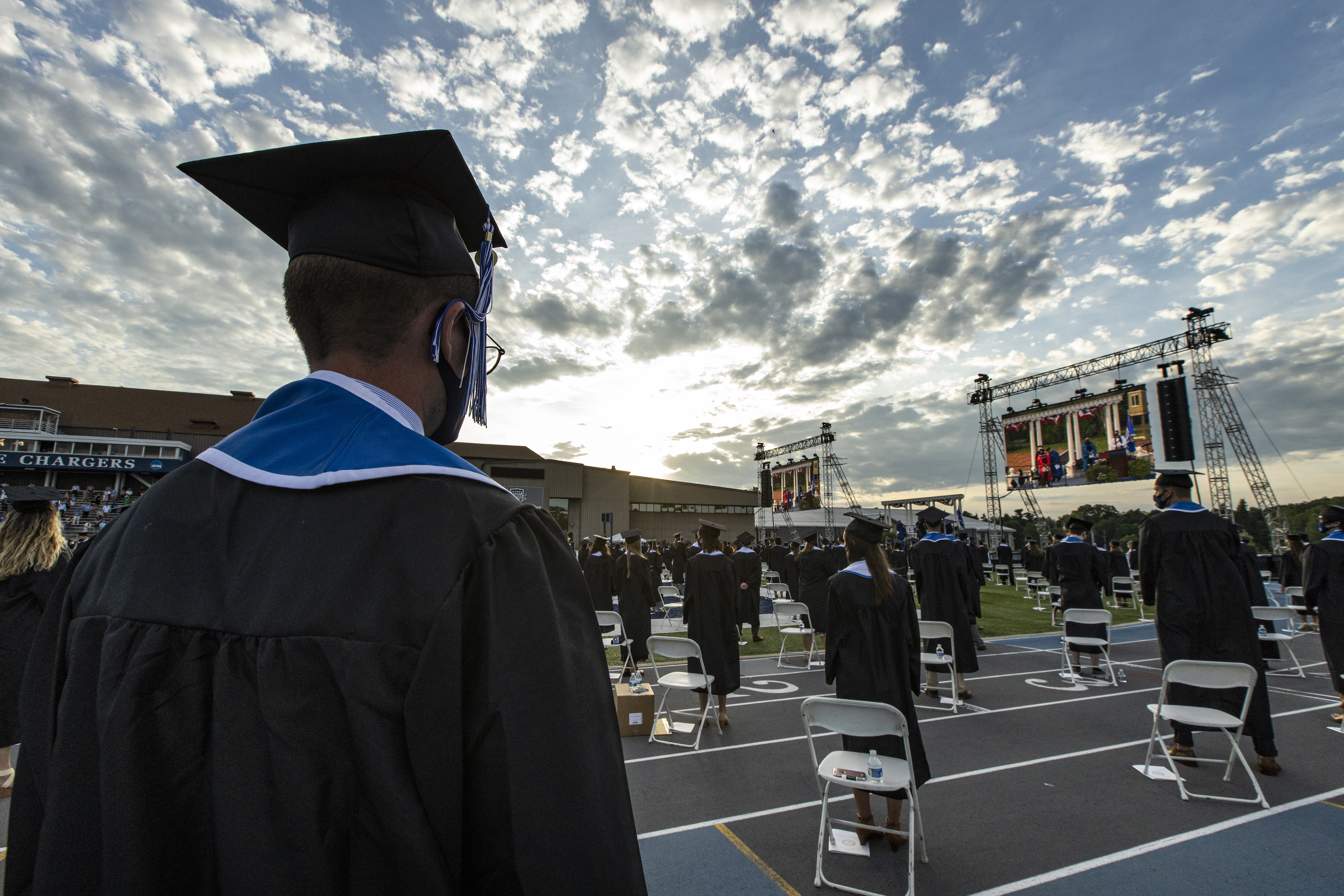
During the weekend, graduates and their guests were required to wear masks indoors and were subject to daily temperature checks. The commencement ceremony took place outside at Frank “Muddy” Waters Football Stadium, where everyone sat six feet apart. There are no known coronavirus cases connected to the event.
Students may have to continue wearing masks, getting temperature checks, and following distancing guidelines after the second week of school if there’s an outbreak of COVID-19 cases on Hillsdale’s campus, according to Hillsdale College President Larry Arnn.
Arnn added that he plans to reduce restrictions as soon as possible, as they interfere with the purpose of the college.
“We’ll stop the extra restrictions on the first day we can — anything that interferes with the purpose of this college,” Arnn said. “What are we waiting for? We’re waiting to see if we have an outbreak of the virus. We half expect we will. We expect students will get it, and it will spread to some, but hopefully not many, and hopefully none will be harmed. We’re waiting to see how many cases we get. If we get a lot, then we’ll extend the protocols.”
Hillsdale College released its official return-to-campus protocols for students, staff, and faculty on Aug. 5. Among some of the biggest changes: mandatory masks indoors, daily temperature checks, and newly-installed anti-viral technology in campus air filtration systems. The complete plan is posted at returnplan.hillsdale.edu
In early August, Arnn addressed students in an email, saying freshman convocation and the first day of classes would “occur as scheduled” on Aug. 23 and 26, respectively. He stressed the college is doing everything in its power to resume normal activities in a safe and legal manner.
“Right now there are no legal impediments to our resuming,” Arnn wrote. He said the college consulted with three leading public health and epidemiology experts to craft its reopening plan.
More than 260 Hillsdale College staff members from across campus worked throughout the spring and summer to contribute to the fall reopening plan, according to Arnn. The college spent a combined total of more than $500,000 on new ionization equipment, a four-person on-call nursing team, quarantine locations for students, and extra sanitizing and disinfectant equipment, Chief Administrative Officer Rich Péwé said.
“Like its Commencement activities, the college is committed both to having college and to doing it in a safe and legal manner,” Péwé said. “As Dr. Arnn reminds us, the work and study that happens here is important and we must not surrender it willingly.”
In the original email, Arnn emphasized that the college was also taking many steps to ensure the safety of those in vulnerable groups.
“You will see that they are far-reaching,” Arnn said in the email.
In an interview with the Collegian on Aug. 25, Arnn said the college’s key concern is the students’ health.
“I don’t pretend to be an epidemiologist, but I am responsible for this, so I’ve read up on it quite a bit,” said Arnn, who noted that he spoke to Ambassador Deborah Birx, coordinator of the U.S. Government Effort to Combat AIDS and member of the White House Coronavirus Task Force. “My key question is, ‘is it dangerous to the young?’ I asked her that, directly. And what she said was ‘no.’ That was in a Zoom call with a bunch of people about colleges reopening. Well, there’s your answer.”
In addition to mandating masks indoors and daily health screenings until Sept. 5, the college will have four nurses on call after hours, and dining hall capacity reduced to 50% with two new grab-and-go food locations for students, one in Strosacker Science Center and one in Lane Hall. The college will also reserve four apartments in the College Park Townhouses to quarantine any students who may contract COVID-19.
“These steps comply with the law as it exists today, and will be adjusted as necessary,” Arnn said in the email. “Also it complies with the best evidence about the nature and course of the virus, insofar as we can determine what that is.”
In addition to these protocols, equipment has been installed across campus to help reduce the rate of virus transmission indoors.
All campus buildings have been equipped with modular ionization technology ”documented to neutralize and eliminate COVID-19.” High-efficiency particulate absorbing (HEPA) air filters will also be installed in high-traffic areas, and four Clorox 360 machines—electrostatic disinfectant sprayers—will be used to disinfect large rooms in “an average of five minutes.”
Arnn concluded the email with an exhortation to the Hillsdale community not to shrink from this challenge, nor neglect its work as a college.
“We should proceed about that work intensely, as always we do,” Arnn said. “We should be cautious about anything that spreads the coronavirus, but we should not forget the joy of being together.”
This joy of being together is something Vice President of Student Affairs Diane Philipp does not want the college to lose sight of.
“We’re trying so hard to keep this momentum going of the typical, fun Hillsdale atmosphere,” Philipp said. “It’s going to be a challenge. So we’re going to try to get everybody to partner with us to keep that momentum and joy happening.”
Philipp eyes the Class of 2020’s graduation, which took place the weekend of July 18, as the model for a successful semester.
“We’re really trying to create that same culture that occurred during graduation. We had 2,700 on campus,” Philipp said.
During the weekend, graduates and their guests were required to wear masks indoors and were subject to daily temperature checks. The commencement ceremony took place outside at Frank “Muddy” Waters Football Stadium, where everyone sat six feet apart. There are no known coronavirus cases connected to the event.
