
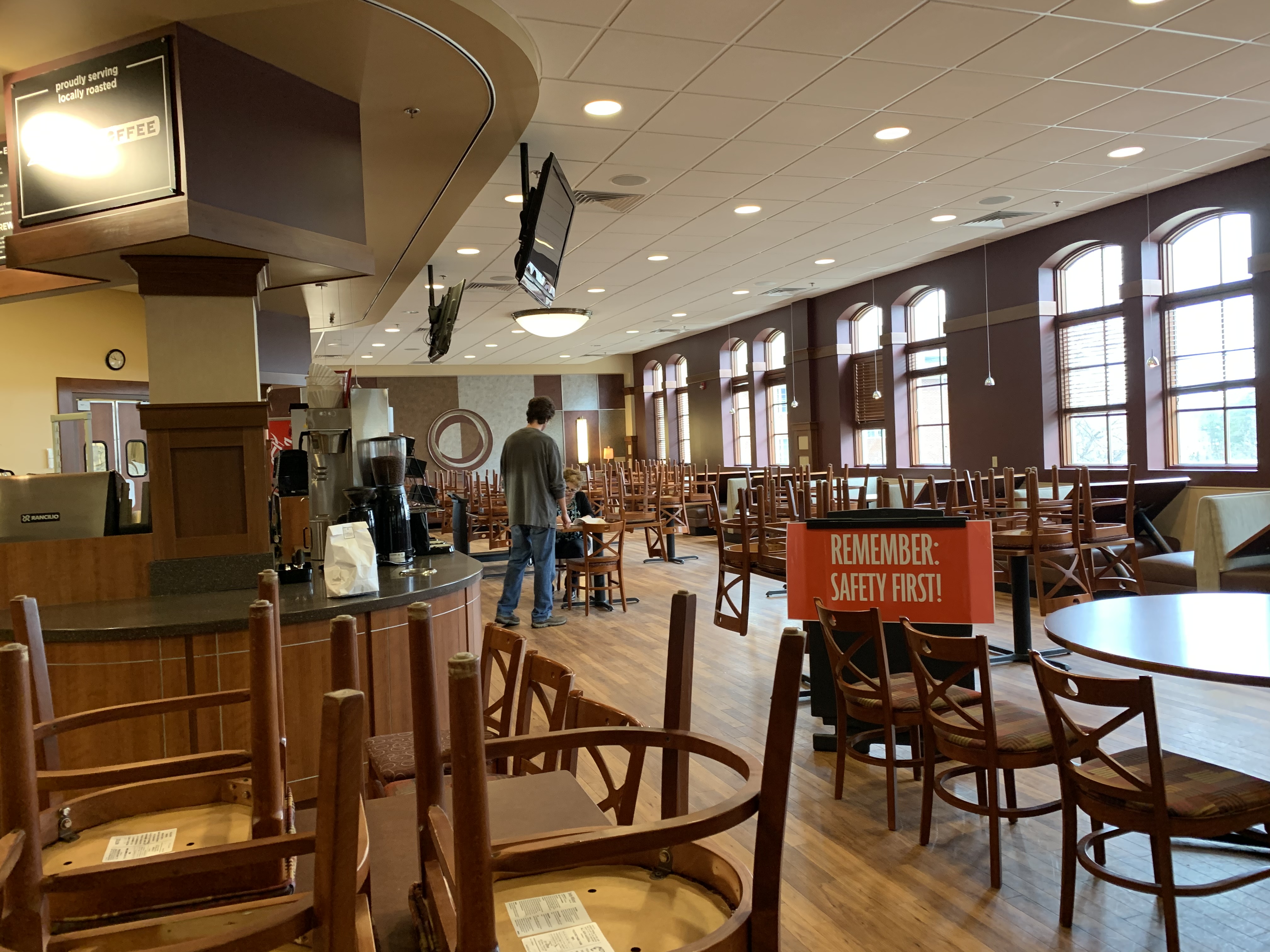
After most colleges and universities have been shut down or shifted online due to the COVID-19 outbreak, students and faculty across the country are adjusting to their new life after mandatory social-distancing.
As of Saturday morning, the U.S. had more than 19,900 confirmed coronavirus cases, with at least 275 deaths. The global death toll is at 11,900, with 4,000 of those deaths from Italy, the country with the highest number of deaths. According to Johns Hopkins University data, there are 287,000 cases of coronavirus around the globe.
In its own response to the coronavirus crisis, Hillsdale College has postponed the return date of students to campus after spring break until March 29, with in-person classes set to start March 30. The college, like many others, has also taken steps to move classes online, beginning March 23.
When in-person classes resume, students and faculty who are not comfortable meeting in person may remain at home and finish the semester online.
“Students who prefer to remain at home while the coronavirus is pandemic may do so. Faculty members who prefer to teach their classes remotely, even when in-person classes begin, may do so,” Hillsdale College President Larry Arnn said in the email announcing the postponement of classes on March 12.
Even students who live off-campus were ordered to refrain from staying in or moving back into their off-campus houses and were asked to return home.
“Hillsdale College’s campus is closed to students until Sunday, March 29. No students are to return to campus: neither students who live on-campus nor students who live off-campus,” Executive Secretary to the Dean of Women Carolyn Milligan said in a follow-up email regarding logistics of students returning to campus.
In his announcement postponing classes, Arnn said the college will do everything possible to get life back to normal for students, faculty, and staff.
“We like to be the most reluctant people on earth to give in to pressure,” Arnn wrote. “Unwilling to surrender, we will do two things: 1) Begin online courses on March 23, after a week for faculty to better figure out how to do it. We will do this in all possible cases. This we think will liberate us later to have in-person classes for those who can and wish. 2) Everything in our power to resume regular classes on March 30. We will know a lot more by then.”
Arnn stressed the two priorities of the college: graduating seniors and the health of staff and faculty. He said the staff seek to serve students, “even at risk of illness to themselves.”
“Of course, their health is our fundamental importance and we and they will do all we can to protect it,” he said.
In a video posted online by the college on March 20, Arnn also emphasized his desire to bring students back to campus as early as possible.
“This is a test of character and intellect of the kind that shapes human souls and portrays them in their excellence,” Arnn said. “It will be easy — won’t it? — to sink into some kind of lassitude while you’re away. Not everybody’s here; you don’t see people in person. There are plenty of distractions. And yet it’s true nobody ever learned any serious thing except by intensity.”
Arnn addressed the turbulent events of the past week, including the stock market dropping. He noted that motion grabs our attention and makes us look for “a theme or rule in the middle of it,” causing us to ask questions about the purpose of life.
“It’s a new kind of test. It’s a shameful thing to waste a day of your life, especially if you’re young and talented because what you do today will affect all the days to come — and you have many to come.”
https://www.facebook.com/hillsdalecollegemichigan/videos/203429231071753/
A Student Activities Office email sent on March 20 announced that a decision will be made on March 24 about whether students will return to campus.
“We will announce plans, if any, on Tuesday (March 24) regarding students returning to campus (no decision has yet been made); professors will be in touch about details and instructions for their online courses,” the email said.
Transitioning to classes online
With the college starting online classes on Monday, the administration has taken steps to ensure the transition to an online-only format is smooth.
Associate Professor of Spanish Todd Mack helped lead a series of training sessions early in the week to ensure faculty are confident teaching their classes online.
Mack was approached by Instructional Technologies and Applications Manager Heidi Bargerhuff about leading the sessions, as he has experience teaching online classes.
“I have done a little bit of research on online education and its effectiveness, and I just thought about it in the context of Hillsdale College,” Mack said. “We had four sessions over three days where I just gave professors broad, high-level thoughts about how to approach moving your class online. The basic idea was keep things simple and use tools that you already know how to use.”
Mack stressed that online classes can be a positive experience for all.
“We can use these tools to make the best of the situation and our classes,” Mack said. We don’t have to just assume that our classes are going to be a bust because we have to move online. We just need to work hard to continue to communicate with our students to engage in dialogue.”
Mack said most professors are pessimistic about whether in-person classes will resume.
“Our instructions have been: prepare to teach online for the rest of the semester,” Mack said. “I do know that many students and professors are just planning on teaching online for the rest of the semester. There are some that are still holding out hope that students will come back. But even if they come back, we still have to provide some online alternatives to students who don’t decide to come.”
Mack said professors are hard at work in making the online transition successful.
“This is a big change for a lot of us, but learning and engagement are about communication. We still have good tools that can help us communicate,” Mack said. “Students can learn the things that they need to learn and get through the end of the semester. We’re going to be alright.”
Study-abroad trips canceled
As the coronavirus’ epicenter has moved to Europe, and with Italy’s death toll surpassing that of China, the college decided to cancel the Collegiate Scholars Program’s summer study-abroad trip to Greece from May 12 to May 25.
“This is very sad, but it is the right call,” Associate Professor of Classics Eric Hutchinson said in an email. “The college has done an outstanding job with its response to the coronavirus.”
The CSP trip to Greece is an experience offered to rising seniors the summer before their final year at Hillsdale. The trip alternates between Greece and Turkey.
Junior Dominic Bulger was scheduled to go on the trip this summer. Bulger said he still has the opportunity to attend next year’s trip the summer after he graduates from Hillsdale.
“At the time we received the email saying the trip was canceled, I still hadn’t quite emotionally grappled with the fact that I was going to go to Greece,” Bulger said. “I also wasn’t that surprised that the trip was canceled. And as Hutchinson pointed out, we all have the chance to go next year, so hopefully I’ll be able to do that. All of those factors softened what might have been more disappointing news. At this point I’m mostly just hoping the money we put down for flights doesn’t go down the drain — I know Hutchinson is working on getting that back for us.”
The German department’s annual trip to Wurzburg was also canceled. The trip, for German majors and minors, was originally scheduled for July 21-Aug. 21.
Junior Sabrie Dalton said Assistant Professor of German Stephen Naumann emailed students on Tuesday of spring break to announce its cancellation. Although the college has plans to postpone the trip to next summer and give priority to students registered to attend this summer, Dalton says she will be unable to attend.
“With my plans to join the Air Force directly after graduation, I will most likely be unable to attend the trip at that time,” Dalton said. “This was supposed to be how I got the minor and is why I took German classes last summer. Now I’m not quite sure if I will be able to earn the minor before I graduate next spring.”
Students studying abroad this semester had to choose between staying in their respective foreign countries or going back home to the United States.
Junior Madi Vandegrift is remaining in Germany for the time being as she waits for the crisis to recede.
“The German intensive month-long course I was taking has been canceled, but they are allowing us to complete exercises online and potentially taking the exam online as well,” Vandegrift said.
Vandergrift plans to stay in Germany because, she said, there is a chance classes at the University of Saarland could begin in May.
“It is important to me to at least try and stay here to see what happens so that I do not have to add another semester on later,” she said.
Vandegrift also cited safety precautions as another reason for staying in Germany.
“The first couple of days — right after Trump announced the first travel ban — were very scary, and I had a lot of phone conversations with my parents about what the best decision would be,” she said. “We decided that it was less of a risk for me to stay here rather than travel 11 hours in an airplane and then have to be quarantined for two weeks, instead of a self-quarantine here,” Vandegrift said.
She also noted that she didn’t want to risk the chance of her grandparents picking up any illness from her if she returned.
Vandegrift lives with other international students who have given her more perspective on the global crisis.
“I’m living with two students from Italy, a girl from a small island off of Greece, and a girl from Montenegro — which has definitely opened my eyes to the situations in other countries. My one friend is from Bergamo, Italy, and it’s very interesting to hear some of the stories her family has been telling her about their experience during this epidemic,” Vandegrift said. “It’s brought a lot of the international students together here because many of us cannot go home due to lack of flights, or it’s safer in Germany at the moment than in the home country.”
Junior Madeline Aherin flew home to the United States on March 16 from Seville, Spain, and is currently in quarantine. She decided to come back to the U.S. as the program she was a part of — the Center for Cross-Cultural Studies — moved its classes online.
“Everyone was starting to shut down in Spain and things were moving toward a nationwide ‘shelter in place.’ Therefore, I would be stuck in my home in Spain indefinitely,” Aherin said. “I knew the same would eventually happen in the states as well, so I figured I would rather be stuck inside my house in America than in Spain for an indefinite amount of time.
As a foreigner, the fear was getting stuck in Spain because of border closings. Thankfully, I was able to make it home pretty easily. Overall, it was really strange to see the city of Seville completely shutdown in a matter of days. It is such a lively city, so seeing the streets empty was almost apocalyptic.”
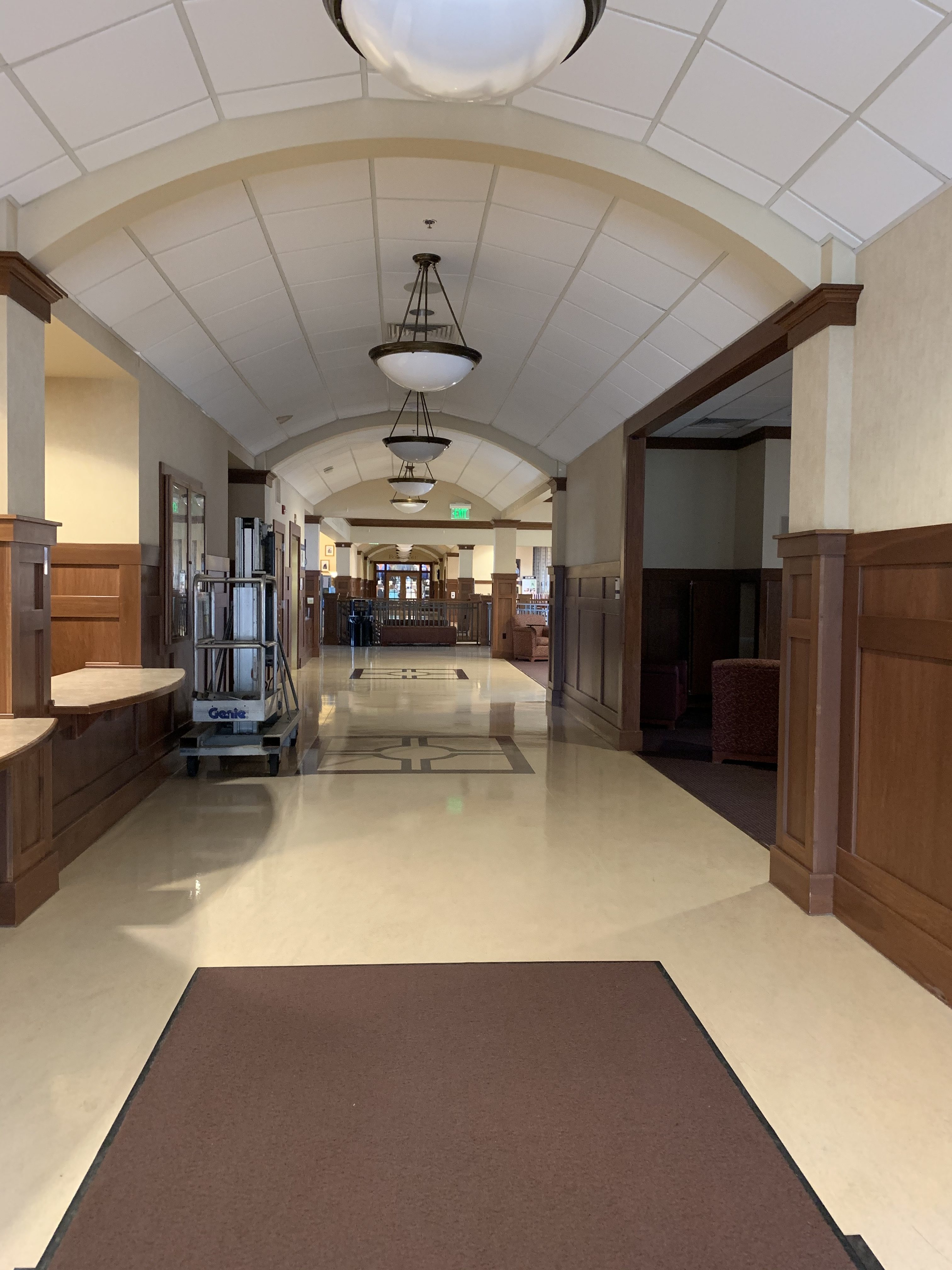
Dining hall closed, Bon Appetit providing bagged meals
On campus, Bon Appetit management has been trying to make the best of the situation and plan ahead. David Apthorpe, general manager, said the current plan is to offer prepackaged meals for the next two weeks, using A.J.’s Cafe as a distribution hub.
They continue to feed about 80 students on campus, including those who stayed on campus for a mission trip, as well as members of sports teams and international students.
March 16 was the first day Bon Appetit served meals this way, so Apthorpe said there is still a learning curve.
“Right now, we have almost all the management team putting the meals together,” Apthorpe said. “We have nine acting managers. We think if numbers stay similar, that will be sufficient. We’ll have to see when we come to the 30th.”
As of now, Apthorpe said, Bon Appetit is not currently keeping track of meal swipes.
“Our main goal is to make sure everybody who wants to be fed will get food.”
Apthorpe said plans are changing constantly, and he’s getting updates from the corporate Bon Appetit office, planning the best way to serve students. He said the management team is preparing for how to run meals if students return for classes on March 30 as planned.
“We’ve talked about how it would look to shuttle food from the dining hall to residences, whether that’s sack lunches or bulk meals,” he said. “We’ll play it by ear as to what the limits are.”
Faculty and staff working on campus are able to purchase the to-go meals.
WHIP students head home
Many students were in the middle of their semester with the Washington-Hillsdale Internship Program when the college announced its plans regarding the coronavirus. Most of those students have since left D.C. and returned home.
Matthew Spalding, vice president of Washington operations for Hillsdale and dean of the Van Andel Graduate School of Government, called meetings with the WHIP students last week to discuss and address plans for responding to the coronavirus. Spalding said that based on the potential for high demands on the D.C. healthcare infrastructure, the limited ability to support self-quarantine and illness, and the likelihood that internships would be canceled, he strongly advised students to go home or return to campus. Hillsdale D.C. classes were immediately shifted to an online format.
Junior Brady Helwig was interning with the Heritage Foundation and will continue to do some work remotely from his home in Wisconsin. He said Hillsdale in D.C.’s recommendation to students was a prudent decision.
“I’ve been really impressed by how Hillsdale in D.C. has handled the situation,” Helwig said. “The Kirby Center staff helped us relocate. They followed up with us and made sure we got home safely.”
Helwig said he appreciated the college leaving the decision to relocate or not up to students, while also providing a strong recommendation to leave.
The whole situation, he said, was surreal.
“It probably shouldn’t have been as unexpected as it was,” Helwig added.
Helwig said he decided to return home after hearing rumors about the possibility of domestic travel bans.
“I packed up my stuff on Friday and drove back to Wisconsin — 13 hours — on Saturday,” Helwig said. “It was really wild. I’m still adjusting to being home. It’s strange; I’m glad I’ll be staying busy.”
As part of his internship, Helwig has been researching the coronavirus since mid-January. He spent six to seven weeks on the subject. It’s been strange, he said, to watch the COVID-19 disease develop and spread across the world.
Junior Carl Miller was interning in the office of Sen. Tom Cotton (R-AR). At first, Miller said, the WHIP students were in high spirits.
“We were hoping internships would continue, and we would stick it out,” he said. “By Thursday morning, Sen. Cotton’s office had closed. Given that and then the college’s announcement of campus being closed for a little while, I got the impression that it was a matter of when, not if, the Hillsdale House would close entirely.”
Miller had been planning on traveling to the Midwest for a wedding anyway, so he brought his belongings in the event he wouldn’t return to D.C. He’s currently taking WHIP classes online through Google Hangouts. He said WHIP classes “didn’t miss a beat.”
“It’s nothing like being there in person. There’s no substitute for that,” Miller said. “But I was really pleasantly surprised with how good the platform was. It’s not a seamless transition — it’s a professor and a group of students learning for the first time, so there are hurdles.”
Miller said he is still optimistic that he might be able to return in a couple of weeks to continue his internship in person. He is able to do some remote work for Sen. Cotton, he said, though not as much.
Reed Lawe, a junior WHIP student, has been interning with a venture-backed start-up called WhyHotel, where he is working for a Hillsdale alumnus. When Spalding initially met with the students, they thought they might try to wait out the situation. But things changed quickly.
“Almost half of the WHIP internships were canceled,” Lawe said. “We understood the gravity of the situation and were making plans to leave since travel restrictions were looking likely.”
Lawe is working remotely full time from his home in Florida. He said being in D.C. gave him a unique perspective on the effects of COVID-19.
“You see the scale of how people react,” he said. “Some people in the grocery store were completely stocking up and wearing masks. Some people were taking public transportation like it’s no big deal.”
He also noted that in his traveling he saw how empty planes are right now.
Lawe said he thinks the probability of returning to D.C. is low and that he doesn’t plan to return to campus if in-person classes resume as planned.
“A lot of us plan to go back for the summer in D.C. program, so hopefully that will be a good compensation,” he said.
Lawe said he appreciated Hillsdale’s “unified and clear approach,” which has reassured him.
Reporter Nolan Ryan contributed to this report.
