
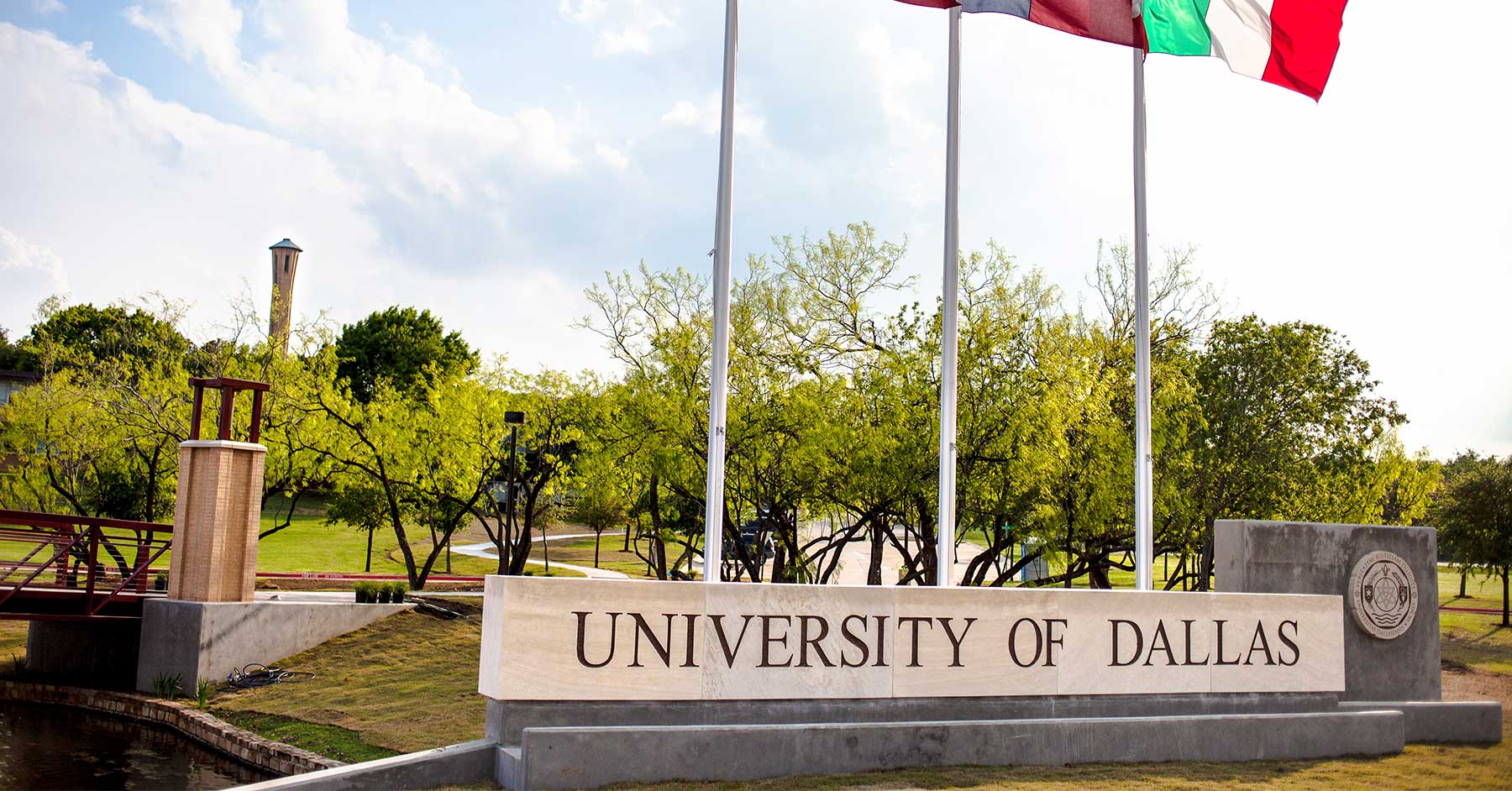
Arguing that theoretical liberalism is impossible to translate exactly into real life, Daniel Burns, associate professor of politics at the University of Dallas, spoke to a group of Hillsdale students and faculty on Tuesday, Feb. 25. In fact, Burns said that the modified, imperfect version of liberalism in America is actually preferable to its pure, theoretical form.
At the beginning of his talk, Burns clarified that his use of “liberalism” was “not New Deal liberalism, not Democratic liberalism or anything like that, but something more general, the kind of liberalism that both FDR and Ronald Reagan were both basically united in favor of.”
Burns said that liberalism can be thought about in two ways: theoretically and practically.
“When we talk about liberalism we sometimes mean a political idea that you can read about in books, and each describes a particular version of liberalism, but those versions clearly all have something in common, from Locke to Spinoza to Montesquieu to Kant to Mill and Rawls,” he said. “On the other hand, by liberalism we sometimes mean a set of liberal practices that are appreciated by millions of people who know nothing about the political theory behind them.”
Burns came down firmly in favor of the practical application of liberalism.
“Everything that’s good about our liberal institutions can be defended without any help from liberal theory,” he said. “And if we ever seriously tried to put into practice the dictates of liberal theory, we would have to get rid of many of the most valuable institutions of liberal practice.”
According to Burns, American political theorist Patrick Deneen and a handful of conservatives are beginning to think that many of the problems that we find in modern society are not actually due to “progressives”, but actually to issues rooted in liberal theory itself.
“The stuff that conservatives and progressives thought they agreed on — individual rights, limited government, and at least some separation of church and state — our whole American political philosophy is what got us into trouble,” Burns said. “What we’re seeing today is a playing out of mistakes made by our founders who spent too much time reading Locke when they should have been reading Cicero and Aquinas.”
Burns said that the issues with liberal theory begin with flawed assumptions that philosophers make about human nature.
“They imagine human beings in a state no one has ever seen, sometimes called a state of nature. In this imaginary state, human beings are supposed to be completely autonomous and have no meaningful obligations to other human beings, even to their own parents,” Burns said. “I think we all know that nobody is like this, and they would be barely recognizable as human if they were.”
According to Burns, American liberal theory as crafted by the Founders is inconsistent.
“The Founders were not political philosophers. Theoretical coherence just wasn’t their strong suit,” he said. “American liberal practice is much better than liberal theory and we should make sure not to interpret liberal practice through the lens of liberal theory.”
In fact, Burns said that he doesn’t think Americans need any sort of ideology at all.
“I’m not aware of anyone in the Western tradition before Hobbes who thought that political philosophy required this kind of comprehensive ideology of human political life,” he said.
According to Burns, the political philosophy of Aristotle can “direct and update” our American political traditions and provide answers for modern social problems that “the Founders, for all their wisdom, just couldn’t have anticipated.”
In the Q&A session after the talk, Hillsdale professor of politics Thomas West told Burns “I don’t recognize anything you just said about liberalism. Every liberalism has a coherent theory.”
West disagreed with Burns’ broad categorizing of liberalism, especially with the fact that Burns lumped Rawls in with thinkers like Locke.
Under Rawls’ theory, West said “There is no liberalism. There is no freedom of speech.”
Senior Brian Freimuth, who attended the talk, said that he didn’t agree with Burns because his ideas were not academically rigorous.
“He didn’t treat Locke in any meaningful academic way,” Freimuth said. “He made a huge umbrella category that he called ‘liberal theory’ which he said is responsible for the radical individualism of today, and then under that umbrella he placed people like Rawls and Locke. Okay, great. You just made the biggest umbrella ever.”
Freimuth said that Burns attributed ideas to philosophers that they didn’t actually believe.
“Burns said that Locke is for radical individualism,” Freimuth said. “But the longest chapter in Locke’s Second Treatise of Government is on the family.”
Burns’ talk caused quite the stir in the audience, and he acknowledged it at the end of the lecture. “That’s my view. I know I haven’t persuaded everybody,” he said.
