
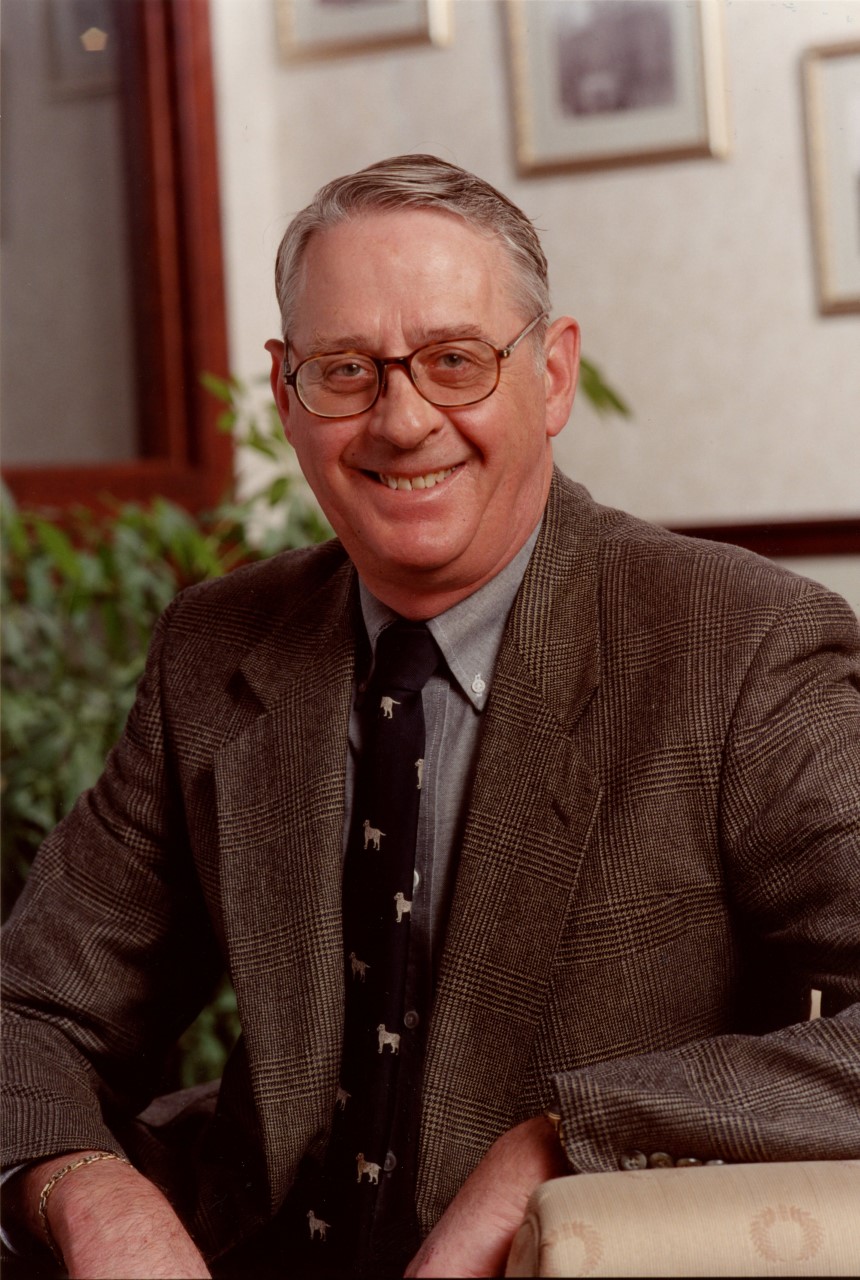
Donald Heckenlively always looked for ways to combine his career as a biologist with his interests in the arts and computers. This served him well, for instance, when he had to illustrate the mating habits of frogs for his class, much to the amusement of his students.
Colleagues and students remember Heckenlively, a former biology professor, for his humility and humor. He died after a brief illness on Jan. 27 at the age of 78 in Kalamazoo, Michigan. During almost 30 years of teaching at Hillsdale College, Heckenlively directed the biology department and served as vice president for academic affairs, similar to the provost role before that position had been created. And while he loved teaching his students, Heckenlively’s family said he also had a deep-seated passion for the arts and photography.
‘He did whatever he needed to support his family’
One of Heckenlively’s sons, Patrick, said he admired his father’s humility. Their family first moved to Hillsdale in the early 1970s, and after a year of filling in at the college, Heckenlively found a variety of ways to provide for his family. No job was too menial for his father, Patrick Heckenlively said.
“When he was still completing his degree, he would go work in the factories in town just to put food on the table,” Patrick Heckenlively said. “He also worked as a substitute teacher for a while in the local schools. He did whatever he needed to support his family.”
During this time, Patrick Heckenlively was in elementary school. But as he got older, he began to understand how much his father valued work and how amazing it was for his father to get jobs outside of higher education to take care of the family. He remembers his father as being “very quietly capable,” and someone who didn’t have an overinflated opinion of himself.
“For someone who’s highly educated to work in the factories, that shows a level of humility that I don’t think too many people have.”
He said one of his father’s neighbors came to him at the visitation and remembered Heckenlively’s humility.
“My dad’s neighbor didn’t have a lot of book learning, but my dad told him, ‘You know a lot of things I don’t, and I know a lot of things you don’t,’” Patrick Heckenlively said. “Even though he was highly educated, he didn’t really look down on people.”
Similarly, Professor of Biology Frank Steiner remembers Heckenlively being a calm and composed colleague. He said it was easy to get along with him.
“He never seemed to get bent out of shape. He had a level head,” Steiner said. “And he was a team player. He valued everybody’s expertise and was willing to cooperate with other faculty members and students on research projects.”
Bringing Hillsdale into the age of computers
Heckenlively, who primarily taught biostatistics, was known for being handy with computers. Heckenlively, Wes Kelly of ITS, and Cal Jerret, a math professor, worked together to create the college’s first computer network. Patrick Heckenlively said his father played a critical role in moving the college into a computer-centric world at a time when most work was still done on typewriters.
“They made our first computer network by daisy-chaining all the little Macintosh computers,” Steiner said. “They did that in a couple of weekends.There were wires above on the ceilings in Strosacker.”
Patrick Heckenlively said that before this, his father would even use one of the school’s early mainframes to work on his dissertation. Beyond that, Heckenlively also used computers to his advantage as a teacher.
He created a program, according to Patrick Heckenlively, which was a game to teach students about the thalamus and what it does.
“At the time, the graphics were pretty primitive, but he made the most of them,” Patrick Heckenlively said.
Heckenlively also wrote, from scratch, an enzyme program called Simzyme, which he had published, Steiner said. The program focused on the enzyme responsible for the browning of fruit.
“It was an enzyme simulation program that we ran for many years. I loved it; it was a great program. We had all our intro major classes do it as one of their labs,” Steiner said. “Afterward, I had it redone so we could continue to use it on more modern computers.”
While the program is no longer updated for current computer software, Steiner said he appreciates that the biology department was able to use Heckenlively’s program for so long.
Excellence, care interacting with students, colleagues
Steiner and Professor of History Kenneth Calvert agreed that Heckenlively’s personality made him an excellent teacher and a delightful colleague.
“He was well-versed in his field,” Steiner said. “He got students to look at things from a real analytical perspective. He got students to approach things from a scientific perspective rather than from a touchy-feely way.”
Calvert met Heckenlively in 1996 when he was applying to teach at Hillsdale. He recalls getting a phone call from Heckenlively on March 1 at 5:30 p.m., when he offered Calvert the job. Every year since then, including last year, Calvert has either spoken in person with or emailed Heckenlively thanking him for the professorship. A couple of years ago, Heckenlively said to Calvert, jokingly, “Well, let’s just hope it works out well.” Calvert still laughs at the instance, pointing out that it was more than 20 years after he was hired.
“He was not only very welcoming and encouraging through the whole hiring process, but once I arrived, he reached out to me and was immensely encouraging,” Calvert said. “Whenever I stopped to talk with him, he would always ask me how classes were going, how students were doing, and how I was doing personally. He had a sense of the whole nature of being a professor, what it took.”
Professor of Physics Jim Peters said the college owes a lot to Heckenlively, especially in his efforts to make Hillsdale a place that ran with personal computers. Peters said that Heckenlively even got faculty backpacks which allowed them to take heavy computers home.
Peters also said his and Heckenlively’s families were good friends.
“One day, Don brought a milkweed plant over to our backyard with a caterpillar on it so our children could watch it turn into a Monarch butterfly,” he said in an email.
Mark Kalthoff, professor and chair of history, was both a student and colleague of Heckenlively. He met Heckenlively during a campus visit in high school. It was the personal interaction with professors like Heckenlively that played a large role in bringing Kalthoff to campus as a student.
When he was put into an advisee group as a freshman, Kalthoff’s adviser was Heckenlively. The group of freshmen had dinner at the Heckenlively home. A few years later, during his senior year, Kalthoff ended up renting the family’s garage, which had been converted to a studio apartment.
“Their house was the bookends,” Kalthoff said. “It was the first house I went to off-campus when I arrived as a freshman, and I ended up living in that house as a senior. I knew their family and knew their sons pretty well.”
Kalthoff remembers Heckenlively being matter-of-fact when they met to talk, an approach which worked for Kalthoff in his own academics.
Biology on the homefront
Heckenlively’s work as a biologist was not confined to the classroom. Patrick Heckenlively said living in a biologist’s household had some interesting dynamics. He said one time the family was sitting down to dinner when someone went to get the bread.
“Someone said, ‘Ew, the bread’s moldy,’ to which my dad responded, ‘Ooh, bread mold! I’ve been trying to grow some in the lab all week.’ He took it to the office the next day,” Patrick Heckenlively said.
Another time, Heckenlively was working with a professor at Michigan Technological University, and the two were studying the temperature properties inside chicken heads. They created a system where they would, according to Patrick Heckenlively, “snake through the blood vessels of the chicken head while it was alive” and collect data. But before that, they needed a map of the blood vessels. So Heckenlively injected a deceased chicken’s head with a plastic that would map out the arteries and veins.
“We had this dead chicken head boiling on a back burner for a weekend,” Patrick Heckenlively said. “It was in the family kitchen.”
An artist ‘in his heart of hearts’
Throughout his life, Heckenlively was an avid photographer, musician, and supporter of the arts. After his retirement in 2003, he became much more involved in community arts, even having a hand in starting Gallery 49, a local arts venue.
When he went to college, Heckenlively originally wanted to be an artist, according to his son. But his grandfather offered to pay for his education if he majored in something else. So Heckenlively chose biology and eventually got his Ph.D. in the field.
“But in his heart of hearts, I really think he was an artist,” Patrick Heckenlively said.
As a photographer, Heckenlively mainly took photos of architecture and flowers. Patrick Heckenlively said he liked to mess with filters and almost approach the art as a painter might.
When it came to music, he was an accomplished musician, and he served as the organist at Holy Trinity Parish. But not in the way one would expect.
Patrick Heckenlively pointed out that his father — while he played instruments like clarinet and could read music — was not a keyboard player. He ended up controlling the organ’s notes through the MIDI interface, a computer system used with musical instruments. He would just hit a button, and the organ played the notes.
“He joked he was the only organist in town who would make the same mistakes each time,” Patrick Heckenlively said.
Kalthoff said that Heckenlively’s diverse interests proved he was a good fit to teach at a liberal arts school. But whatever field of study or hobby Heckenlively was interested in, Calvert said he always showed a real care for people with whom he interacted.
“I remember being interviewed by him. What was clear to me is that he was looking for professors who were quality, that knew their stuff. And that they fit the mission of the school,” Calvert said. “The way he spoke to me about that was genuine and caring. He was playing the role of a shepherd for a young professor.”
