
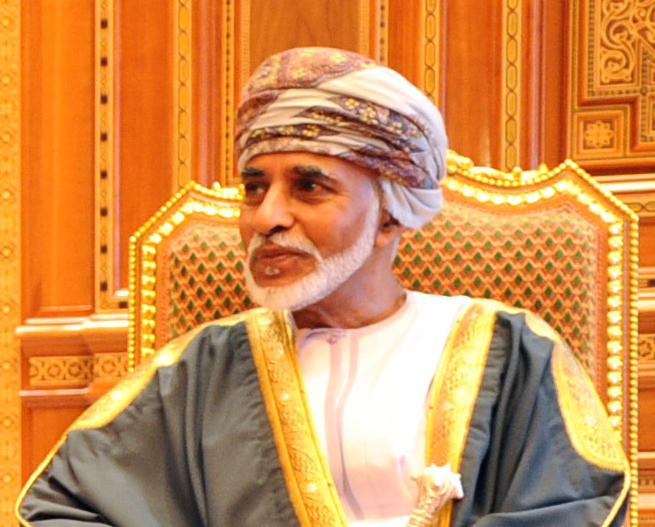
Iran’s antics have largely distracted everyone from the death of another more important military leader: Sultan Qaboos bin Said al-Said of Oman.
After a slew of events, including the killing of Iranian General Qassem Soleimani and Iran knocking Ukraine International Airlines flight 752 out of the sky and firing missiles into Iraq, many overlooked Qaboos’ death, which is a crucial development in Middle Eastern affairs.
Washington’s response to the situation should have been much faster, and Oman should be central to the United States’ Middle Eastern policies at the moment.
In the 50 years that Qaboos sat on the throne, Oman didn’t make international headlines very often. Of all the chaotic Middle Eastern states, it is one of the quietest, thanks to Qaboos’ firm hand. Though he kept a low profile, Qaboos was the only stable Arab ruler and a valuable friend to the United States and the Western World.
After a bloodless coup in which he took the throne from his father in 1970, Qaboos modernized and developed Oman to make it an important regional player. His diplomacy in the region was broad-ranging and helped keep peace in the Gulf region. Throughout his reign, he was a key advocate for Israeli-Palestinian peace talks, and while other Arab leaders were secret about their dealings with Jerusalem, Qaboos was open and friendly with Israel. He even welcomed former Israeli Prime Minister Yitzhak Rabin in 1994 and Prime Minister Benjamin Netanyahu in 2018 to Muscat, the capital city of Oman.
Most importantly, Qaboos simultaneously fostered close relations with Iran and the United States, carefully making himself a neutral intermediary as he balanced relations between the two hostile states. Over five decades, he proved himself a valuable friend to the United States, and the key to diplomatic relations between America and Iran.
In 1980, after the American embassy takeover in Tehran, though he had close ties with Iran, Qaboos allowed the United States use the island of Masirah to stage the unsuccessful rescue mission for the 53 hostages from the U.S. embassy whom Iran captured. In 2011, because of his leverage and ties with Iran, he facilitated the release of American hikers held by Iran. Qaboos even paid $1 million for their freedom. And in 2013, Qaboos was the middle man for former president Barack Obama’s nuclear deal with Iran, the Joint Comprehensive Plan of Action. He allowed diplomats from the United States and Iran to secretly meet in Oman to lay the groundwork for the deal that was signed in 2015.
Though the JCPOA was a terrible deal, which Trump withdrew from in 2018, deeply upsetting Qaboos, the sultan wisely kept balancing the relations between the United States and Iran, remaining America’s most valuable friend in the region.
After his death, however, Washington seems to have forgotten Qaboos’ crucial friendship, assistance, and alliance in a tumultuous corner of the globe.
Caught up in Iran’s shenanigans, the United States failed to account for the importance of Qaboos’ death. Secretary of State Mike Pompeo spoke on the phone to his Omani counterpart, Yusuf bin Alawi bin Abdullah, after Qaboos’ passing. Then, the White House announced that “A senior U.S. delegation will travel to Oman to pay our respects.” This is not enough.
In contrast, the U.K. appropriately responded to Qaboos’ death, immediately sending Prince Charles and Prime Minister Boris Johnson to offer condolences. Johnson’s appearance in Oman highlighted that the UK was paying respects not just to a fellow monarch, but to a trusted friend of the West. The UK rightly showed their support for Oman as a key ally in the Middle East.
In light of events over the past two weeks events and the kerfuffle with Iran, relations with Oman should be forefront in American foreign policy. Not only has Oman been a friend to the United States, but Oman holds the key port of Duqm on the Arabian Sea. This port facilitates visiting American aircraft carriers and nuclear submarines, which gives the United States the ability to deal with any Iranian naval threats and guard Gulf oil exports.
With Iran’s unrest and the endless instability throughout the region, this is not the time for the United States to devalue Oman and the importance of Qaboos’ reign.
With Qaboos’ death, the throne passed to his cousin, now Sultan Haitham bin Tariq al-Said. Washington’s late and flippant response to Qaboos death was inexcusable. America still needs Oman. With a new and untested sultan on the throne, regional players will most likely begin to test Oman’s strength to see where Haitham’s loyalties lie.
It is crucial for the United States to start healthy relations with Haitham so as to continue Qaboos legacy and Oman’s key friendship with the West.
Abby Liebing is the associate editor of The Collegian and a columnist on Middle Eastern politics. She is a senior studying history.
