
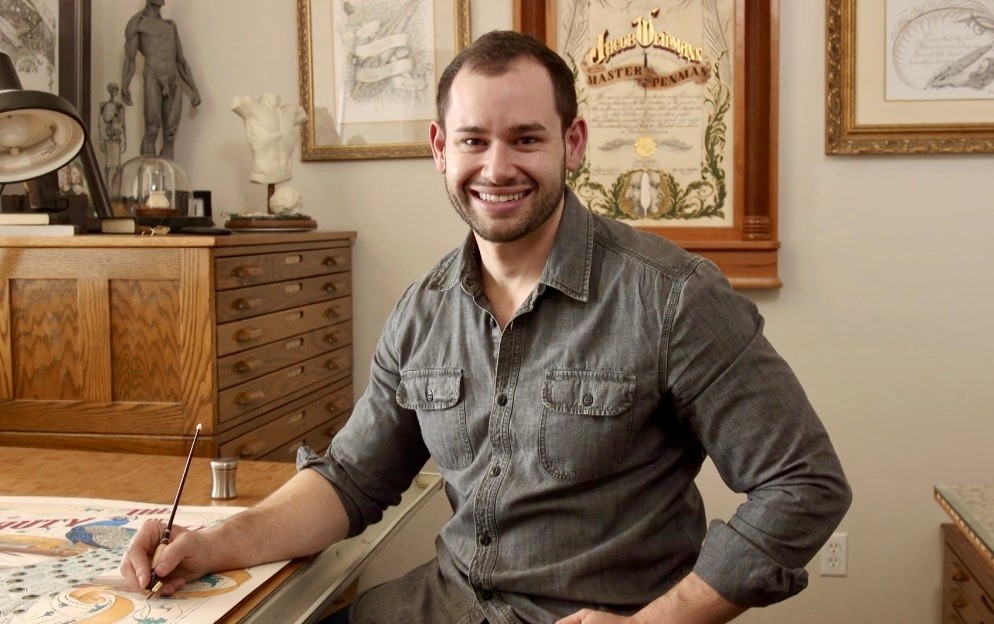
At age 26, Jake Weidmann became the youngest person to earn the title “master penman,” and today, he is one of 11 people in the world who currently hold this prestigious title. He was also one of the first artists during his time to carve his own pens, make his own ink, and carve his own frames.
Weidmann’s artwork has been on display in the Hillsdale College Fine Arts Building’s Daughtrey Gallery since Jan. 22 and will continue to hang in the gallery until Wednesday, Feb. 19. He has brought 26 pieces to the gallery –– 24 originals and two prints.
Weidmann practices several artforms, such as carving, and he works his calligraphy into his drawings, paintings, and sculptures to create pieces that tell viewers a story.
“That’s one of the greatest abilities that the artist has that I think is too often abdicated or just flat out neglected,” Weidmann said. “I think that the ability to tell a story, the ability to point to something higher is the real power that art has. And I love to do that and incorporate symbolism and story into a piece that really wraps the viewer up in the piece and gives them a good starting point.”
Weidmann said there is a stigma around modern art that isolates the viewer from understanding the piece or the artist’s intention, but he said this doesn’t help the art, the artist, nor the viewer to better understand one another on a human level.
“I think bringing people back in to be able to engage with art means humbly holding their hand and giving them a starting off point because art was always used, historically, as a universal language,” Weidimann said. “That’s why art was commissioned by so many of the churches during the Medieval and Renaissance period was to tell the stories within the Bible to the illiterate, and not only can you convey some of the facts of this story that you can wrap it up in this beautiful romance and the way that it is conveyed through the hand of the artist.”
Wedimann said he is trying to use his own art to get back to using classical methods and having a classical ethos of using symbolism and trying to convey something much higher to his readers.
Teren Sechrist said she and her son, junior Tyler Sechrist, have been following Weidmann since Tyler Sechrist was in elementary school. She said she appreciates Weidmann and his art because he does walk the viewer through a piece.
“I’m not trained in art, so I don’t know all that art symbolism, but he helps you cross that bridge into the visual world and makes you feel like you’re not a stranger there and that you actually belong,” Teren Sechrist said. “He translates for you, which I think is a gift because a lot of times, artists don’t like to do that. They think you should understand their language, and you should be able to look at the pictures and read the symbols, but Jake, with humility, understands that we don’t all get it.”
Teren Sechrist said her personal favorite piece of art is “Crown of Script,” which dictates Isaiah 53:4-5 in one continuous trajectory that creates a crown of thorns from the words.
Although this is her favorite piece, Teren Sechrist said her heart is “all wrapped up” around Weidmann’s piece “The Little Sparrow,” which he created after the tragedy at Sandy Hook Elementary in 2012 to convey a message of hope. This piece shows that every life is precious in the eyes of God, and the calligraphic flourishing off the wingtips shows the impact of just one, small life.
“I just absolutely love that one –– not a little sparrow falls to the ground without the Lord knowing it,” Teren Sechrist said. “I do a lot of work in one of the Barney Charter School Initiative schools here in Michigan, and I think about that all the time. I want one of those in our teacher’s lounge because every child matters.”
While viewers will respond differently to each piece, Weidmann said he anticipates that “Sojourner’s Rose Bronze” and “C.S. Lewis and the Untamed Lion” will resonate with members of the Hillsdale Community.
“The ‘Bronze Sojourner’s Rose’ has a lot of profound symbolism behind it and required such a great deal of technical execution –– it’s the result of years of process and work to get it to that point,” Weidmann said. “‘Sojourners Rose’ is a very special piece to me, and I’m excited to see that and how it’s received on this campus, especially with the obvious love of this classical school for bronze sculpture.”
Tyler Sechrist, who is an art and theatre major, said this is the first time Weidmann’s original artwork has crossed the Mississippi River –– as Weidmann’s home studio sits in the foothills of the Colorado Rockies. He added that “Sojourner’s Rose Bronze” is 200 pounds, requring its own custom hanger and three people to lift the piece onto the wall.
Weidmann said some viewers may miss the portrait of C.S. Lewis because many people are not familiar with the author’s face. “C.S. Lewis and the Untamed Lion” is the moment when Lewis conceived of Aslan and meets him face to face, according to Weidmann.
This piece, along with “Mightier,” are two of Tyler Sechrist’s favorite works. Tyler Sechrist met Weidmann for the first time in the spring of 2018 when Weidmann came to visit Livingston Classical Academy near Brighton, Michigan.
Tyler Sechrist stepped in to run the audio visual components of Weidmann’s presentation. After Weidmann found out it was Tyler Sechrist’s birthday, they went to dinner and Weidmann said he would send him a signed print of any piece Tyler Sechrist chose. After Weidmann forgot to send the single print, Tyler Sechrist said he ended up sending him two signed prints.
“I got those around Christmas last year and when they came in the mail, it kind of dawned on me: ‘I’m the manager of the art gallery, I should probably at least invite him to come to the College,’” Tyler Sechrist said. “I sent him a text and asked him if he was interested in coming to the college to do an art show, and he was thrilled.”
During Weidmann’s time on campus, he taught several masterclasses, gave a public lecture, and talked with guests at his reception. Tyler Sechrist said Weidmann has taught him to be more patient while creating his own art. Outside of art, however, Tyler Sechrist said he enjoyed spending time with Weidmann.
“One of the biggest things about Jake is his humility and being down to earth,” Tyler Sechrist said. “I took him around campus, and he was blown away by the Chapel and the Heritage Room. He was willing to spend the afternoon just hanging out. Sometimes I feel like you get an idea of some artists that are pretentious and better than everybody else, and he is not that in any way.”
Weidmann was a psychology major and biblical studies minor at Biola University in California. Although he does not actively practice a career in psychology, Weidmann said his background in the study has helped him create art that builds a connection between himself and the viewer.
“Psychology has helped in my approach to fine art, to really see and understand art as a bid for connection between the artist and the viewer,” Weidmann said. “And it’s helped effectiveness of my art with the understanding that I’m essentially trying to have some kind of relationship with the viewer, I’m trying to relate with them on some level, and essentially, spark an emotion, invoke a reaction within them.”
