
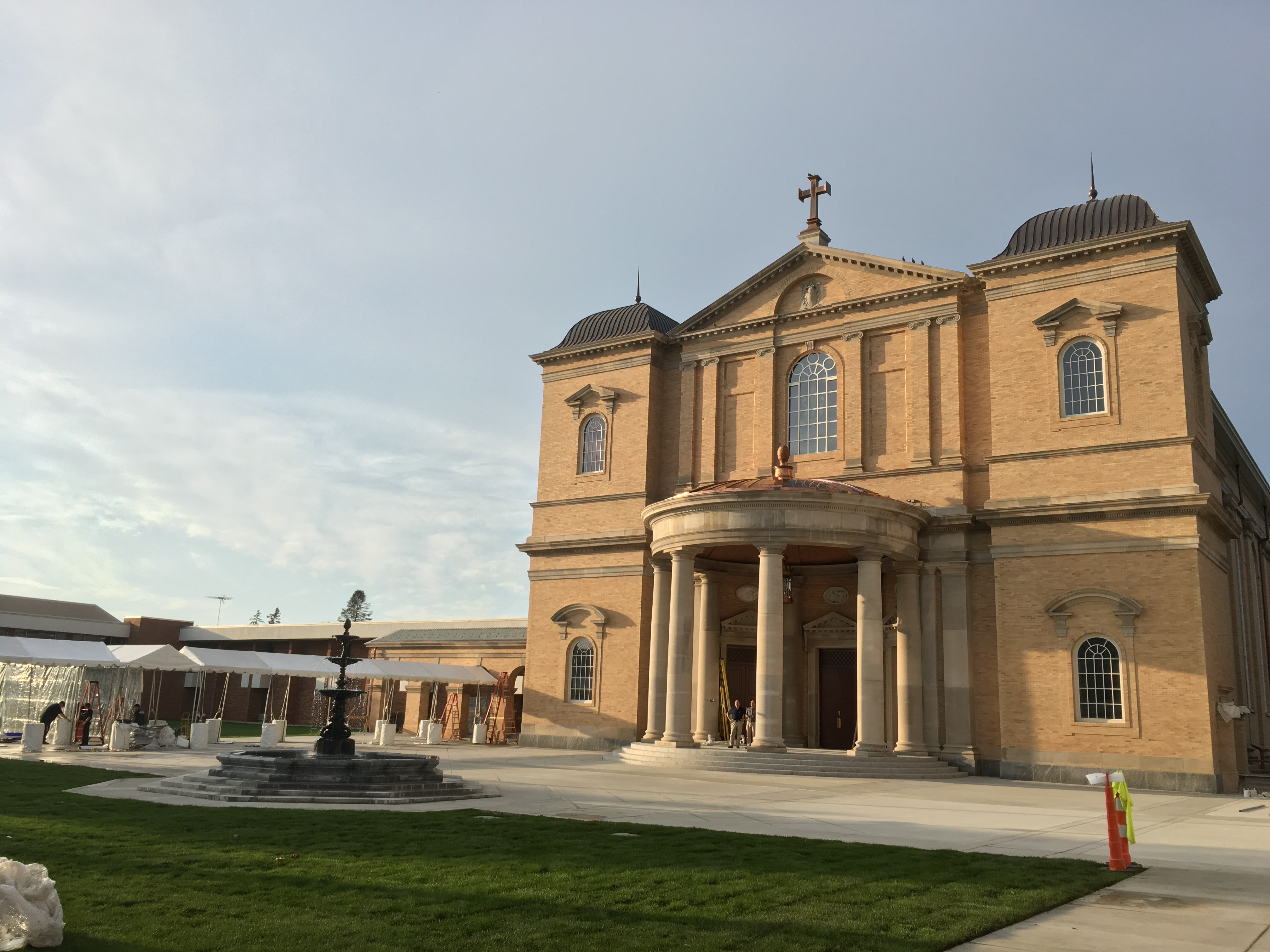
Behind the two-and-a-half-year project of building Christ Chapel lay a countless number of creative decisions, from where to place it on campus to what it should look like inside and out, said architect Duncan Stroik, who gave a talk on the project on Nov. 25 in Plaster Auditorium.
The first question, before thinking about design, was the location of the chapel. Two possibilities included beside Howard Music Hall and in what is now the large parking lot next to Simpson Residence.
“We made the radical proposal to put the chapel at the center of campus on the main axis behind Central Hall in the hopes that this project would lead to the creation of a new quadrangle,” said Stroik, a nationally-renowned architect whose firm is in South Bend, Ind.
Stroik said his architectural inspiration came from Christ Church in Philadelphia and St. Martin in the Fields in London. Stroik drew from Christ Church’s classical architecture with its balconies and big windows. St. Martin in the Fields, designed by architect James Gibbs, combined the portico from antiquity and early Christian churches, with the medieval spire.
The architecture aimed to be classical as well as symbolic.
He called Hillsdale’s Christ Chapel “much more simple than England but as substantial as Philadelphia. Christ Church was where the founding fathers met when they had the Continental Congress. We’re connecting two buildings and two events.”
The size of the chapel was an issue.
“The College wanted a chapel that would seat 1400 but should feel comfortable for 600.”
Stroik fulfilled this request by making it possible to fit 600 people in the nave — the central part of the building, between the pillars—and more elsewhere.
“The big columns separate the nave from the aisles and balconies, and the back balcony. You don’t have to use the balconies or the side aisles. But when you need them, we can pack people in.”
Christ Chapel’s chancel, the area surrounding the altar, is also unique.
“The college wanted a full symphony to be able to fit in the chancel, and 100 voices. The chancel is probably bigger than most cathedral chancels in America,” Stroik said.
Unlike St. Martin of the Fields, Christ Chapel does not have a tower, because Stroik and others didn’t want it to compete with Central Hall.
“Symmetry is great, but you also want dialogue, you want difference, you want interconnectedness,” said Stroik.
Stroik expressed his eagerness to work with the college again, possibly on a new library.
“All great college campuses have great library buildings. Someday hopefully Hillsdale will build a beautiful library,” Stroik said.
Sophomore Francis Lucchetti said he enjoyed Stroik’s talk about his vision.
“The thoughtfulness behind his design makes me hope that the administration puts him in charge of redoing the hotel and library, in addition to whatever else the college is planning on doing construction-wise,” Lucchetti said.
David Whalen, former provost of the college and English professor as well as associate vice president for curriculum, attended the talk and said in an email that he found it interesting.
“The lecture made clear, without boasting, how exacting and rigorous the project was in its thinking and execution,” Whalen said. “Mine certainly was a minor role, with Dr. Arnn and Rich Péwé being much more involved. I consulted where I thought I could be helpful, both as regards design and the potential use of the Chapel. It was probably more fun than is strictly proper for so noble and grand a project.”
