
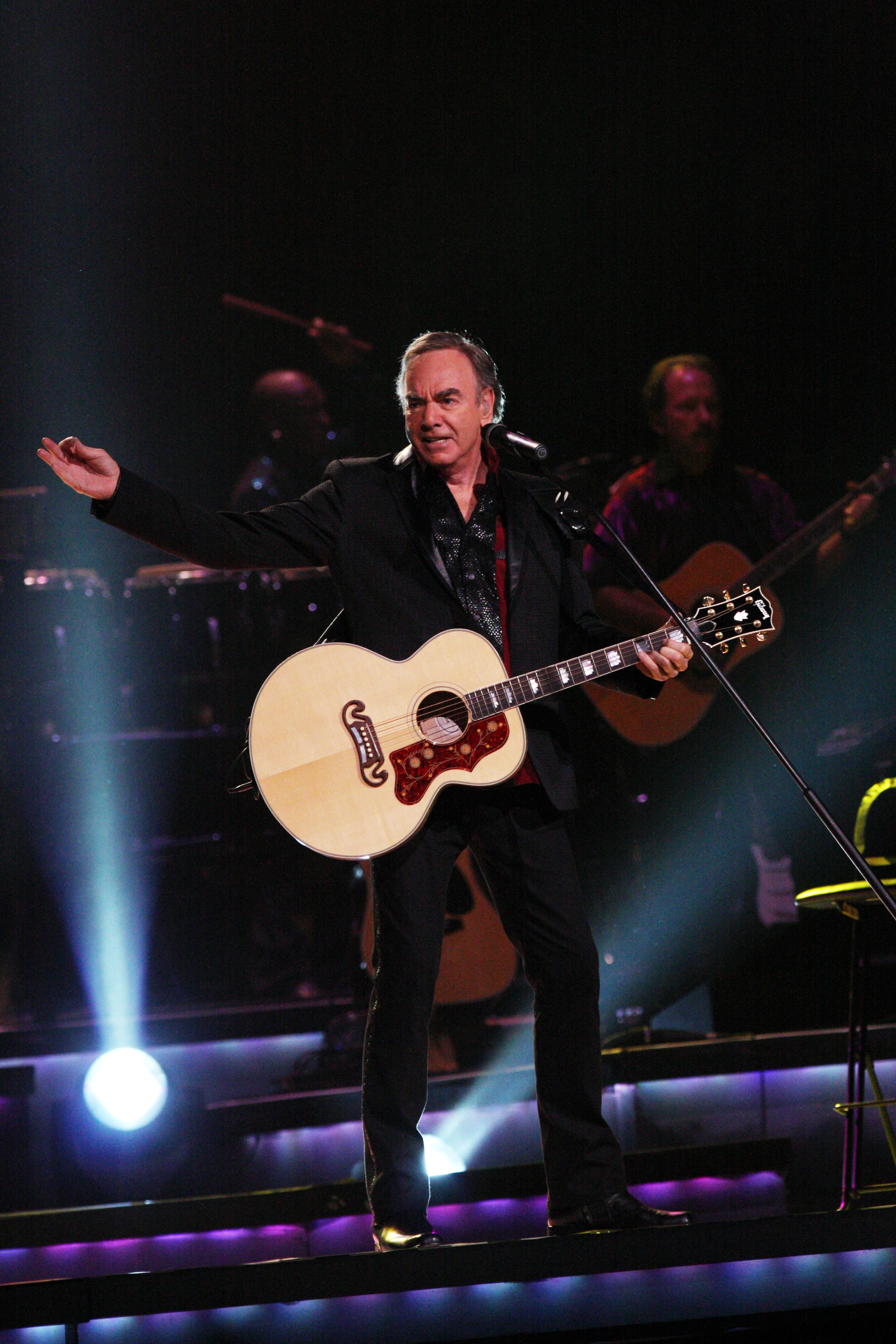
When I was 8 years old, I went to a Red Sox baseball game at Fenway Park in Boston. I don’t remember if the Sox won the game that evening, but I do remember two things distinctly: The sky over the ballpark was colored like a baby’s gender-reveal party, and the whole stadium sang along to Neil Diamond’s “Sweet Caroline” at the seventh-inning stretch.
It was several years before I realized how many other sports teams claim “Sweet Caroline” as their song besides the Red Sox. Just like the great American pastime, Neil Diamond is as quintessential a part of American culture as the smell of cheap beer in Boston on a hot Friday night. He’s the loverboy of the rock ‘n’ roll era, embodying the romantic concept of the American dream.
Diamond was an artist whose reputation preceded him — literally. His two best-known songs — “I’m A Believer” and “Red, Red Wine” — were made popular by other artists (The Monkees and UB40 respectively) and Diamond’s own renditions of these tracks, released several years later, were never as well-known. Still, he became one of the best-selling musicians of all time.
Ironically, his lyrics often deprecated this market value. Diamond gave voice to a distinctly American problem: the conflicting desires for a simple life and commercial success.
He opens his 1978 album “You Don’t Bring Me Flowers” with satire: it’s “The American Popular Song,” and “it means business.”
“It’s a popular song/An American popular song/And there’s something about it/Can’t live without it/It’s the tune of the day/Somehow it takes you away/And it grabs you/And it holds you/Feel it control you,” Diamond sings.
We live in the commercial era, and it’s as undeniable and all-consuming as a bubblegum pop song, Diamond suggests.
Track two sets up the opposite desire. In “Forever In Blue Jeans,” Diamond uses the familiar symbol like a literal pair of blue jeans, wrapping the listener in a love ballad as familiar and just-plain-good as a pair of Levi’s.
“Money talks/But it don’t sing and dance/And it don’t walk/And long as I can have you here with me/I’d much rather be/Forever in blue jeans, babe,” he sings.
Diamond’s blue jeans aren’t Springsteen’s, and this isn’t a song about tire grease and fireworks; his song alludes to a simpler time of high hopes and low voices to combat the loud reverb of materialism redefining American pop culture at the time.
Ever the romantic, Diamond wrote love songs almost exclusively, with a style at once unique and familiar. Familiar, that is, because he was a master borrower, weaving together rock, crooner, and sometimes even gospel, with an incredibly diverse range of instruments, to create an all-star cast of American sounds. It plucks at something in us because he plucked from all over the place the elements that distinguished American music.
Diamond definitely had a favorite era, and he points to it often. Even in his funky songs — “The Dancing Bumble Bee/Bumble Boogie” is like an early-80s-rock take on swing music — Diamond is taking a trip back to the era his nostalgia idolizes most, the 1950s.
In “Memphis Flyer,” he dreams of returning to “a point down south,” where he and his baby are “gonna play house.” The message is the same: Those were the golden days, they’re gone, he wishes he could get back. Unlike many artists, however, Diamond rarely tries to answer the next question, “What now?” Instead, he sticks to singing love songs — love songs to an era gone by.
He ends the album with “Diamond Girls,” another sly jab at materialism to join the first track like satirical bookends. Diamond spars playfully with Seals & Crofts’ 1972 song “Diamond Girl,” a simple, feel-good tune about a girl “like a shinin’ star.” Diamond’s own girl is a “hometown girl,” whose laugh is a “lonely sound,” and who “[spends] her soul on a one night stand.”
“Diamond girl/Is there anybody there at the end of the night?” Diamond asks. “Is it worth what you pay with your soul?/When you look in the mirror, do you see it right?/Diamond girls aren’t made to grow old,” he sings.
At the end of the night, one desire stands — one image of the American dream — and it’s not the commercial one.
