
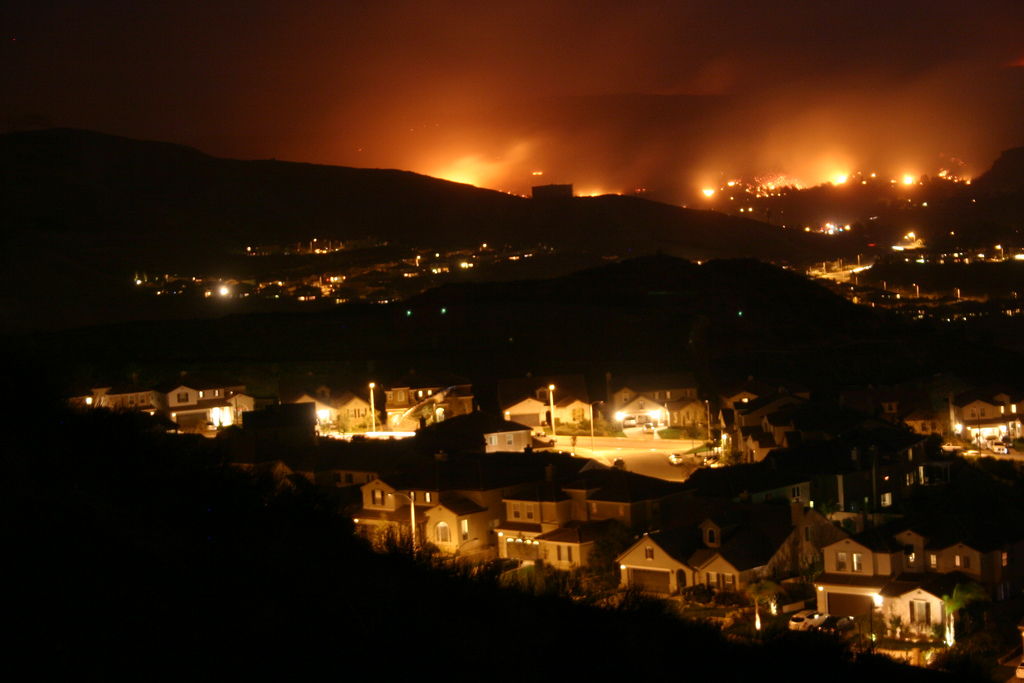
Hundreds of thousands are at risk of loss of their homes, injury, or death with the raging wildfires in California. The amount of wildfires have increased significantly in recent years, and the state government of California’s heavy hand is only amplifying the problem.
The California Federal Emergency Management Agency’s insurance policies, which only encourage people to move to dangerous areas with little risk of losing money, have not helped to end their problem with wildfires but instead has made them worse.
CNN reported there were at least 13 wildfires burning in California as of Friday, Nov. 1, after a long season of wildfires. The majority of wildfires take place in drier months and after periods of dryness, typically ending in early October.
California’s population in 1963 was around 20 million. Today, it’s almost 40 million.
As people and houses replace the natural land where the fires used to plow through, it becomes harder for firefighters to implement techniques such as fire-burning and backfiring as their spaces are smaller.
Not only were the winds naturally lower years ago, but Professor of Economics Gary Wolfram said that firefighters enlisted techniques they can’t use today. One of these is backfiring, for example, in which firefighters burn the fuel in the wildfire’s path to stop it from spreading.
Another technique they used to contain fires is control-burning, which involves surrounding the fire and lighting the brush from the outside so the heat will suck the fire into the center, preventing the fire from expanding.
The forests where these fires once burned are now flooded with people, homes, and infrastructure. Firefighters can’t light backfire, or use control-burning to stop wildfires from growing, if there are people in the middle.
Adding to the magnitude of the fires is the increased use of wind power. California Gov. Gavin Newsom declared a state of emergency last week, claiming “historic” high winds. When wildfires meet high winds, the wind carries it higher and further, consuming more and growing the fire. With conditions like these, these techniques are more necessary than ever.
Additionally, the focus used to be on stopping fires from growing, but now time is spent spraying houses down to prevent casualties. The top priority of saving lives didn’t used to be a concern as there often weren’t people around.
California is lighting up while other states are staying cool. The increased population, combined with the state’s fire-encouraging climate, doesn’t make for a safe investment for homeowners. Just as coastal homeowners have to act with caution on how they set up their houses by providing proper protection and buying insurance, Californians know their risks.
The trouble with thoughtful, cautious decision-making comes when the government provides insurance for natural disasters.
The government eliminates any need for caution when they limit the risk in moving out to areas at-risk for wildfires, and people become confident to move and the population doubles.
Larry Larson, director emeritus of the Association of State Floodplain Managers, said that people are receiving generous disaster relief assistance when devastation occurs. He also said the federal government typically pays for “about three-quarters of disaster assistance and over 90% after the most destructive storms,” according to Governing.com.
The state of California, instead of encouraging fewer people to face potential disaster by moving to fire-rife areas, is busy replacing all homes suffering from the result of their decision.
FEMA is only adding to the wildfires. By offering extensive reimbursement, including rebuilding houses lost in the flames, FEMA increases the incentive for homeowners to move to at-risk areas.
The population then goes up, and the cycle continues.
California is a beautiful state, but their wildfires are plowing through much of that beauty and, with it, many people’s houses.
Although winds are partly responsible, there is nothing we can do to change the natural climate. What we can do is combat the human causes.
If California hopes to contain the destruction, FEMA needs to step back to discourage people from moving to these dangerous locations. Once people make less risky decisions, firefighters can get back to the techniques that once proved effective.
Allison Schuster is a junior studying politics and is the features editor for The Collegian.
