
It’s no secret our generation is obsessed with our parents’ generation, but it’s more than mom’s old Levi jeans selling for $150 on Ebay. You can get a Beatles T-shirt at Target just as easily today as you may have gotten one at Two Guys 50 years ago. Thanks to Stranger Things, 13-year-olds everywhere know the lyrics to the Police’s “Every Breath You Take.”
Decades later, we’re still being influenced by our parents’ music: rock ‘n’ roll.
The phase of comic-book character movies is fading. Meanwhile, our box office bestsellers are bringing back the great rock ‘n’ roll legends, like “Bohemian Rhapsody,” about Queen, or the 2019 movie “Blinded by the Light,” about a Pakistani boy finding identity in the great American classics of Bruce Springsteen.
Perhaps they never left.
While rap dominates the Top 100 every week, rock ‘n’ roll, is still just as formative as when it was brand new — even if few popular musicians produce it anymore. It continues to influence the clothes we wear, the films and TV shows we produce, the aesthetic of our Instagram feeds. As the trailer to “Blinded by the Light” would suggest, if there’s one thing that unifies American culture across the board, it’s the spirit of rock ‘n’ roll.
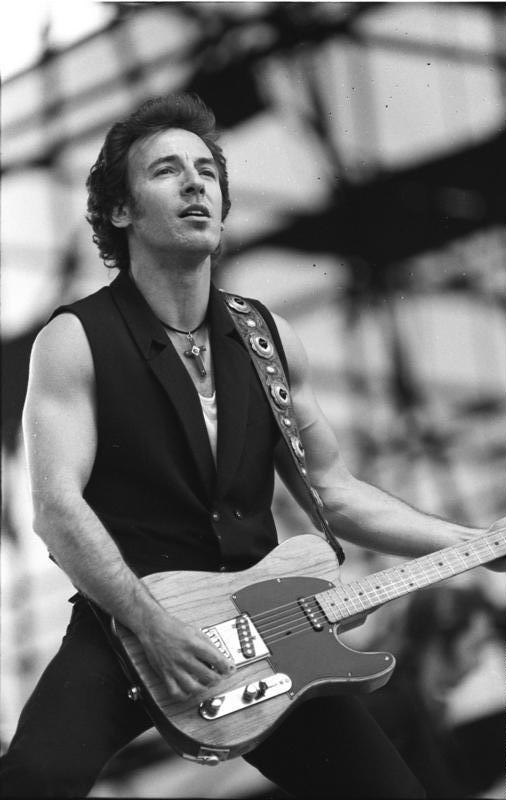
In that spirit — and in the interest of understanding what that American culture is — we’re road-tripping back into those formative decades. Where better to start than with The Boss himself, Bruce Springsteen?
As the opening track to his iconic 1984 album of the same name, “Born in the U.S.A.” hit American culture right in the middle of the Reagan years. If the song is any representation of its time, American spirit was strong — and confusing. Springsteen wrestles with the Vietnam War almost 10 years later; it’s cultural influence on the ’80s is unmissable. Particularly, he seems struck by the void left in American culture as a result of the war’s massive casualties.
“I had a brother at Khe Sanh fighting off the Viet Cong/They’re still there, he’s all gone/He had a woman he loved in Saigon/I got a picture of him in her arms now,” Springsteen sings.
By contrast, the upbeat tune and guitar-banging speak to Springsteen’s optimism and make this song an Independence Day classic. Whatever hurt he feels he takes in stride; after all, he was born in the U.S.A.
Collectively, the album idealizes the decade and leaves a strong nostalgic taste, like the smell of beer at a baseball game. And in “Glory Days,” Springsteen sings about baseball, drinks, and the good old days — working on an assembly line. The rear-window view may be a warped one, but Springsteen has on rose-colored sunglasses.
“No Surrender” bursts into the middle of the album as Springsteen bursts out of class, singing about getting away from “those fools.”
“We learned more from a three-minute record, baby/Than we ever learned in school,” he sings, a reflection not simply of ’80s optimism, but also of teen invincibility: rock ‘n’ roll was your education. What more did you need?
“Bobby Jean,” about a girl who likes the same music, the same bands, the same clothes, as Springsteen, alludes to the cultural unity of the day — or maybe just to really good blue jeans.
But it’s “My Hometown,” the last track of the album, that can be traced as the precursor to many modern country pop songs. It’s a portrait of modern American history, synthesized through one story: a picture-perfect hometown, torn by “troubled times.”
What starts off as “my hometown” becomes “your hometown.”
“Now Main Street’s whitewashed windows and vacant stores/Seems like there ain’t nobody wants to come down here no more/They’re closing down the textile mill across the railroad tracks/Foreman says these jobs are going boys and they ain’t coming back/To your hometown.”
Springsteen speaks to Middle America, before “Middle America” became a political term that economists and New York Times reporters studied. It’s the original “Hillbilly Elegy,” and J.D. Vance hadn’t even picked up a pen yet.
It’s called rock ‘n’ roll.
