
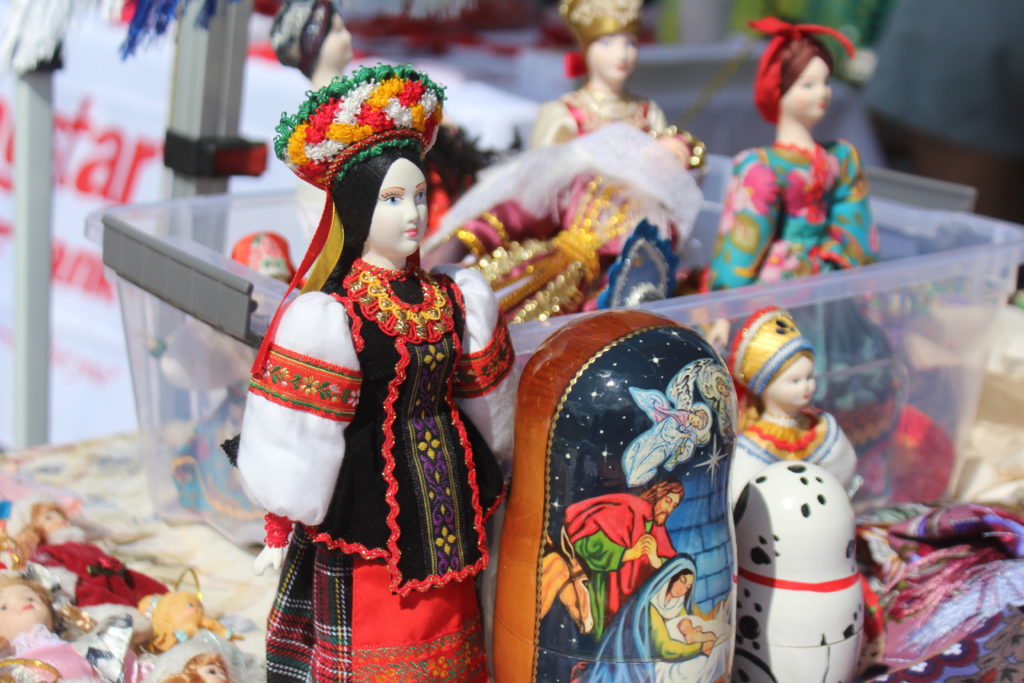
 Amid Russian doll sales, internationally-renowned song-and-dance performances, authentic Russian blini pancakes, and a showing of the Borzoi dog breed, Michigan locals immersed themselves in Eastern European culture at the sixth annual Russian Festival in Ann Arbor on Saturday.
A group of parishioners from St. Vladimir Russian Orthodox Church, Ann Arbor’s local Eastern Orthodox Church, hosted the festival as a fundraising event on Sept. 14. For the past six years, the Eastern Orthodox Church, which denomination makes up approximately 43% of Russian population, has fundraised for a Christian academy in Ann Arbor they hope to eventually build.
Some people attended in period costume, with women wearing floor-length dresses in bright colors. Men paired their basic pants and boots with tunics, vests, and hats, layered with intricate designs. Dancers wore the most ostentatious outfits, intensively embroidered. According to LoveToKnow.com, the best Russian artists of the 19th and 20th centuries brought new attention to fashion by creating stage costumes and everyday women’s clothing.
In January of 1903, the exhibition “Contemporary Art” opened in the First International Exhibition of Historical and Contemporary Dress and its Accessories in Saint Petersburg, Russia. This brought fashion to the forefront of Russian pop culture and inspired its lasting impact today.
Nina Tritenichenko, owner of Bayanina Slavic Shop, sold her hand-crafted clothes and other Eastern European-native souvenirs at the festival. Many of her embroidered dresses are considered “casual attire,” which she said was the common style in Ukraine in the late 19th century. Tritencichenko, who is from Ukraine, said the country had a strong influence on Russian culture as many people immigrated from there to Russia.
“Not everything was made in Russia,” she said, describing the kinds of dresses women wear in old Russian photographs and paintings. “But it looks Slavic, so it would have been worn in Russia.”
Another embroidery vendor Natasha Domsic said her cross-stitched pillows were her biggest sale. A David’s Bridal seamstress by day, Domsic said that she makes cross-stitched pillows at night while her husband watches TV. She said she especially enjoys designing the color schemes for the cross-stitch designs.
“I see so much white fabric at work so when I embroider I just want to see color,” Domsic said.
Domsic said she spends about three months on each pillow, and her work paid off because she sold out in the first half hour of the festival.
Ludmila Picnugena also sold art — in the form of Russian dolls, traditionally called Matryoshkas. The Matryoshka originated in the 1890s in a monastery outside of Moscow. Sergey Malyutin, a Russian painter, produced the doll for his daughter, who was later killed in a car crash. It has since come to be a major symbol of Russian culture.
Picnugena’s business, “Anastasia’s Russian Treasures,” is named after Picnugena’s daughter, and sells dolls from more than sixty artists from Moscow.
Vendors also sold traditional Russian food such as Borscht, a Russian-style beet soup; Pirozhki, a puff pastry with either a sweet or savory filling; cucumber and cabbage salads; Pelmeni meat dumplings; Blinis, or Russian pancakes; and chicken and pork shish kabobs.
Festival attendees ate food as they watched musical performances in a tented area next to the “бар,”or bar.
Each performance began with an upbeat set of dances by members of a New York-based Russian dance ensemble, Barynya. These acts included a lively rendition of a traditional Jewish wedding dance as well as an ominous but playful Ukranian bottle dance, where the entertainers danced with glass bottles balanced on their heads.
In between dance sets, audience members enjoyed the ostentatious performance of the Russian guitar, the Balalaika, as well as songs from famed St. Petersburg quartet, The Konevets.
Performers also included six-year-old dancers and sword-wielding men.
Around the festival, parishioners had also posted photos and biographies of Russian heroes both modern and historical, such as hockey legend Wayne Gretzky and chemist Dimitri Mendeleev. They also put up descriptions of Catholic saints such as St. Patrick and St. John Chrysostom.
Every year, the fundraiser provides attendees the opportunity to enjoy some Russian culture and contribute to the creation of a new Christian academy for any interested local children. To continue working toward this cause, the seventh annual fundraiser promises more cultural exposure and another chance to raise funds for this school.
