
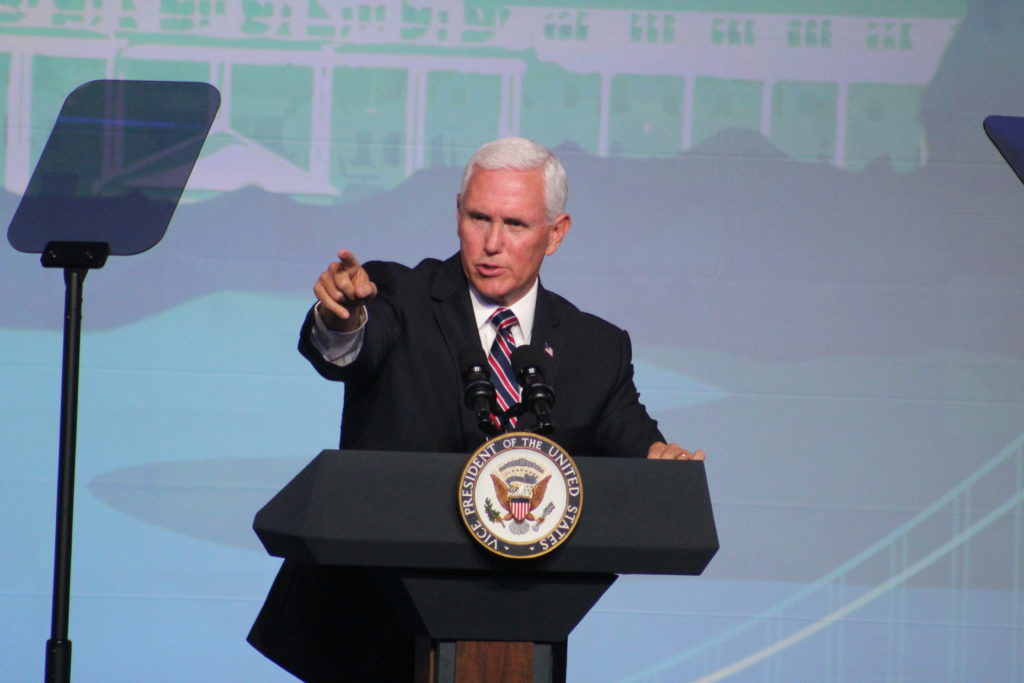
Republican Party leaders from across the nation gathered on Mackinac Island the weekend of Sept. 20 to 22 for the Biennial Republican National Leadership Conference, where they discussed problems and solutions to national and state issues.
Local politicians — including Hillsdale’s United States House Rep. Tim Walberg, of the Seventh District, and Michigan House Rep. Eric Leutheuser — contributed to the discussion at the national level but focused on solving problems in Michigan.
The main topic of discussion included the state budget proposal, which will affect spending for roads.
Leutheuser described conversations in Lansing right now as “interesting,” explaining what he said is a long process as the house tries to pass a budget.
“When there’s a Republican executive, we want a really robust executive,” Leutheuser. “And when there’s not a Republican executive, we don’t like to have a robust executive.”
The house is in its third budget proposal process, he said. Each house and the executive make their budget recommendations and then get together to figure out the best proposal.
Gov. Whitmer’s original proposal included a 45-cent gas tax that would help fund the $900 million of road construction projects. The money from the tax, however, wouldn’t solely fund the roads. It would create a $2.5 billion increase in state spending, with the majority of funds going toward other projects.
This, Leutheuser said, was a non-starter for budget negotiations. Whitmer made that proposal at the beginning of the summer, and it has been a long summer of negotiations. Some met with Whitmer to negotiate, but she ultimately rejected a number of the house’s proposals.
The fiscal year for Michigan ends on Sept. 30, making this crunchtime for Michigan legislators to agree on a budget. If not, the consequences could lead to a government shutdown, layoffs for 48,000 people, and problems for schools.
“If you’re a school district, a community looking at revenue sharing dollars, any number of things, we have to have this done by Sept. 30 to avoid dominos falling,” Leutheuser said.
During the negotiating process, house representatives said they would create a separate proposal if they couldn’t agree with Whitmer, and that is exactly what they did.
For a long time, Leutheuser said, there was no general spending used to fund the roads. But he said he thought it was time that changed.
“Roads are either a priority or they’re not, and many people think they are,” he said.
The house republicans also allocated more discretionary spending from the general fund in their proposal, a decision Whitmer said was a bad idea. The republicans once again separated from her budget recommendations.
Michigan’s 97th District House Rep. Jason Wentworth agreed that it’s good to see leadership in the house and senate proposing a budget that excludes Whitmer’s gas tax.
The house recently passed the Republican’s proposal that includes increased spending for education. Leutheuser said $15 billion — a huge part of their budget — goes toward the School Aid Fund 2019-2020. This fund will significantly increase special education and education for economically-disadvantaged students.
“That’s a big chunk into education,” he said.
Instead of negotiating with the governor, Leutheuser joined with his colleagues in the house and passed the bill to allocate increased spending toward the school aid fund with 91 votes in a house of only 110 total representatives. Both house Republicans and Democrats passed it.
A big part of understanding the role of the different Michigan branches in budget proposals goes back to a basic understanding of the balance of powers, Leutheuser said. This budget proposal process makes sense as the legislative branch is taking the lead on crafting legislation.
It is now Whitmer’s move, as the executive, to complete the process and either sign it or not. Leutheuser said he thinks she will sign it.
Wentworth said the proposed gas tax would cause harmful consequences if passed.
“When we talk about the big number, if we put that money in the system at once, it will create a system of increased cost,” he said. “The price of asphalt, the price of gravel will increase dramatically and that will hurt the progress in our state.”
Such increased spending, he said, would ultimately hurt the roads.
Vice President Mike Pence also gave a speech at the conference, in which he highlighted Michigan’s role in the upcoming election. He thanked lawmakers for their hard work, specifically commending them for their work on the budget proposal.
Michigan is a key battleground state, as proven in the last election when the state voted in favor of the president, and Pence excited those at the conference by remarking on the upcoming 2020 election.
“It’s not enough to win the next election,” he said. “We have to win the next generation with your energetic work here in Michigan every day between now and election day.”
