
Imagine living in a world before phones, before the internet, before even radio existed. It is in this world that fraternities and their predecessors, literary societies, thrived.
From 1882 to 1898, a fraternity named Phi Delta Theta became the first faculty-approved Greek society on Hillsdale’s campus.
Despite its short-lived time at the college, this house had a surprisingly large impact on the Greek life to come and on-campus life as a whole. Simply by existing, it catapulted fraternities into the center of student life, because, despite the fact that multiple fraternities were formed before Phi Delta Theta, in those days Greek organizations were not permitted on Hillsdale’s campus.
“They had to operate sub rosa,” said Linda Moore, the public services librarian at Mossey library, “kind of off campus; hidden because the faculty was concerned about secret societies, and people not being loyal to the institution, but rather to their secret society.”
Even before the faculty allowed them on campus, Phi Delta Theta played a major role in forming Hillsdale’s first unofficial sorority.
“When Phi Delta Theta was still active at Hillsdale in the year 1887,” the 1951 edition of the Winona Yearbook printed, “its members instigated the founding of Michigan Alpha Chapter of Pi Beta Phi, known then as I. C. Sorosis.”
They too had to operate in secrecy though, posing as a literary society.
“The meetings were held in the girls’ rooms,” the Winona Yearbook printed, “and were only literary enough to conform to regulations.”
Before the faculty finally gave in and allowed fraternities at the college, it was these literary societies that ruled campus.
“Those literary societies weren’t merely social,” Moore said. “They were helping people to prepare for typical careers at that time”
Without the many opportunities that students have on campus now, members would rely on these literary societies for much of their entertainment and academic support, which generated a great deal of devotion for one’s society.
“They were more devoted to the literary societies than necessarily the college,” Moore said.
This same kind of dedication was found in the up-and-coming fraternity houses as they arrived on campus, which led to a fracture in literary societies as the college knew them.
“The Greek system, fraternities, and sororities,” Moore said, “led to their ultimate downfall.”
With the literary societies losing their support, the more socially oriented Greek houses took control.
The fraternities and sororities were revolutionary in their time; they fielded football and baseball teams, hosted parties, and fostered a brotherhood or sisterhood that the literary societies couldn’t develop in its members.
“There’s a smaller group, and there’s a smaller goal, and people feel a kind of loyalty to that,” Moore said. “There was the same devotion, and a kind of competition between the organizations.”
Just as it did by founding Pi Beta Phi, Phi Delta Theta impacted campus in its early days of Hillsdale Greek life. Even more than 65 years after the national fraternity revoked its charter for the Hillsdale chapter, its traditions were still firmly rooted on campus.
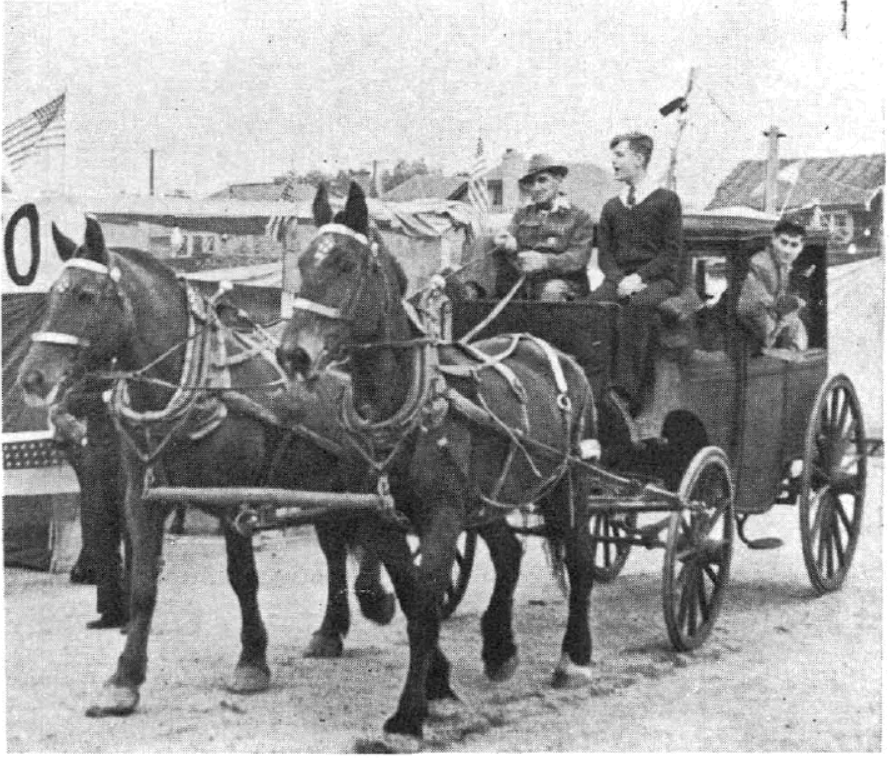
“The brothers of Delta Tau Delta take time from their academic activity to go for a spin in their old, but colorful, fire engine,” the Winona Yearbook printed in 1964. “Just as the men of Phi Delta Theta did, many years ago, as they traveled to the Hillsdale County Fair.”
Even though it only stood on campus for 15 short years, the impact that Phi Delta Theta had on campus Greek life was immense, and it’s clear that The Collegian’s response to Hillsdale’s charter being revoked on the grounds of ‘low standing’ still holds true today: “We can, therefore, state with a conviction derived from observation and experience that its courses have never been stronger, its entrance and graduation requirements never more rigid, its faculty of instruction never more efficient, and its facilities and equipment for college work have never been better or more complete.”
