
Why has nationalism come to dominate the American conversation in recent years, particularly on the political right?
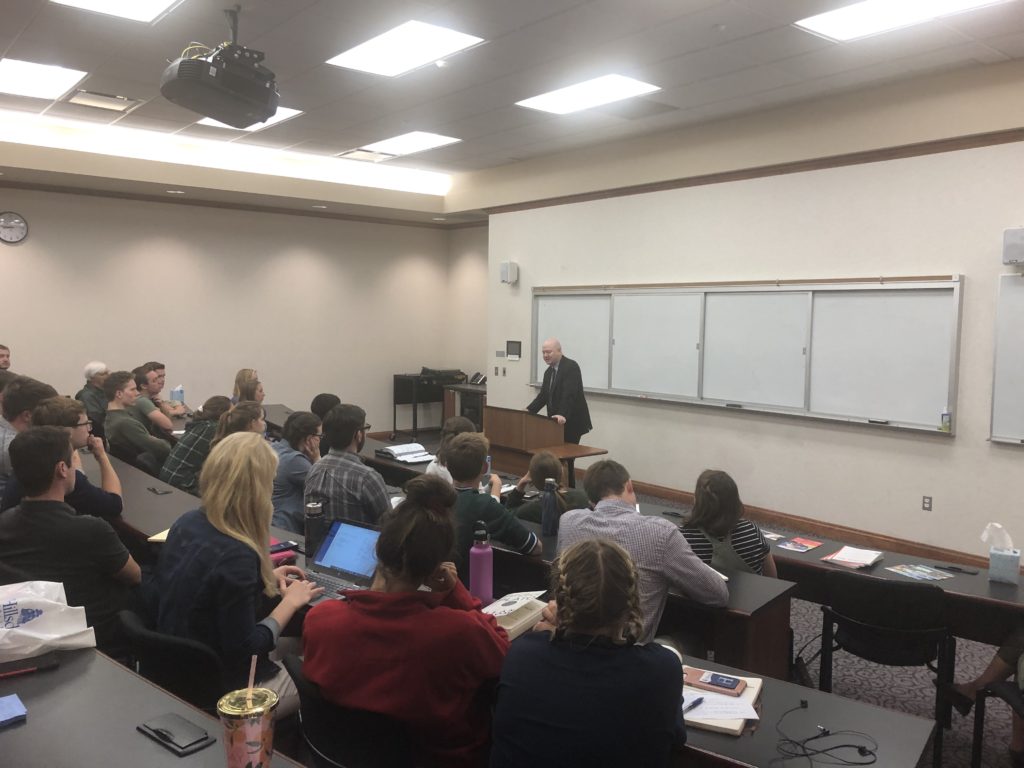
That’s the question Daniel McCarthy, editor of the conservative academic journal Modern Age, addressed in his lecture “Nationalism and the Future of Conservatism” on Sept. 5. Hosted by Hillsdale College’s Dow Journalism Program, McCarthy spoke to a room packed with guests.
McCarthy began his lecture by addressing the negativity surrounding the idea of nationalism.
“The word ‘nationalism’ is very polarizing and very troubling to many people, and for good reason,” McCarthy said. “They think of World War I and countries at one another’s throats. They think of Nazi Germany, ethnonationalism, and white nationalism — various crackpot, racist ideologies.”
He also acknowledged the more nuanced concerns conservatives in particular have with it.
“For many conservatives, the word has negative overtones because they might think of nationalism in terms of economic protectionism and a violation of the capitalist, free-market order,” he said. “And there are many other conservatives who think nationalism is antithetical to federalism or European Christendom.”
McCarthy sought to dispel those notions by pointing out the positive role nationalism has played throughout history.
“Nationalism was one of the chief forces that brought down Soviet Communism in the 20th century,” he said. “You had Germans, Hungarians, and others in Eastern Europe who chafed at being ruled by regimes that were puppets of international communism run from Moscow. Nationalism was also part of the Western Allies’ ethos in the second World War and then later during the Cold War. Americans saw themselves as standing up for God and country against the international menace of communism and Nazism.”
In the years following the Cold War, however, America’s foreign policy remained focused on liberalizing the world even while democracy failed to take root abroad. According to McCarthy, the American leadership classes continued to believe in the idea of liberalism as having rendered national identity irrelevant. Even the idea of citizenship started to be viewed as outmoded.
“There was instead this kind of liberal conceit that saw humans economically, as either consumers or entrepreneurs,” he said. “Culturally, liberalism tended to frame human beings in terms of identity politics, such as being a racial or sexual minority, and not as citizens. In politics, there was a tendency away from self-government and democracy in its most unruly form and instead liberalism became very much identified with administrative control. The public would simply rubberstamp their policies through elections, not take matters into its own hands.”
By the time the 2016 election came around, the atmosphere was ripe for a politician to come along and sweep away the old elites. That’s what propelled Donald Trump to the White House, according to McCarthy.
“Trump’s message focused on Americans as citizens and the nation state as a political community,” he said. “He talked about borders. He talked about immigration and restricting it. He talked about American businesses and the idea that jobs need to be kept in this country and that we should not be indifferent about them being shipped off to China. And in terms of foreign policy, Trump has been very critical of the internationalism, or even the globalism, that characterized both Obama and previous Republican administrations like George W. Bush.”
McCarthy noted the critiques of nationalism that have been levied in the era of Trump, but he warned that the question is not whether nationalism will arise but rather what kind will arise.
“Nationalism is not inherently good or bad,” he said. “It can take different forms. If a sober, conservative nationalism is rejected in America, there is a great danger that we will get a radical and very nasty kind of nationalism.”
The other alternative, McCarthy explained, is the collapse of political community into anarchy.
“It’s not that government would disappear but rather that Americans would come to feel they have nothing in common with one another,” he said. “Either they are isolated, atomized individuals or they are members of ethnic, religious, racial blocs. They don’t have common ground as citizens and Americans from which to engage in deliberation and search for the common good.”
McCarthy concluded by reminding the audience of the vital role the political community plays in society and the good it can accomplish when done right.
“Human beings are connected to a higher and lower nature and a higher and lower realm,” he said. “One of the things worth preserving about the political community and the nation state is that it too is an intermediary between the universal and particular. A healthy nationalism is a balance between the transcendent and the reality that we are embodied human beings who exist within social, familiar, and economic contexts. That’s the great glory of political communities.”
Joy Brower, a junior studying economics and French, said this insight that there is a proper balance to nationalism particularly resonated with her.
“He mentioned that as humans, we aspire to the transcendent, but our feet are still on the ground,” Brower said. “I thought that was a really good way of putting it, especially the way he tied it to the concept of nationalism. Losing sight of humanity, especially in politics, is dangerous.”
Junior Isaac Kirshner, an American Studies major, had a more mixed reaction.
“He was talking about the duality between particulars and universals,” Kirshner said. “The question is which comes first. You must have both; I just think prudentially the emphasis should be on localism over nationalism right now. We’re getting a resurgence of nationalism, but we need to look at localism as a serious alternative.”
Nonetheless, Kirshner said he appreciated the fresh perspective.
“McCarthy presented a new antidote to the problem of liberalism in America,” he said. “I’m not quite sure if nationalism is the right solution or necessarily the conservative solution, but it’s definitely worth looking into.”
