
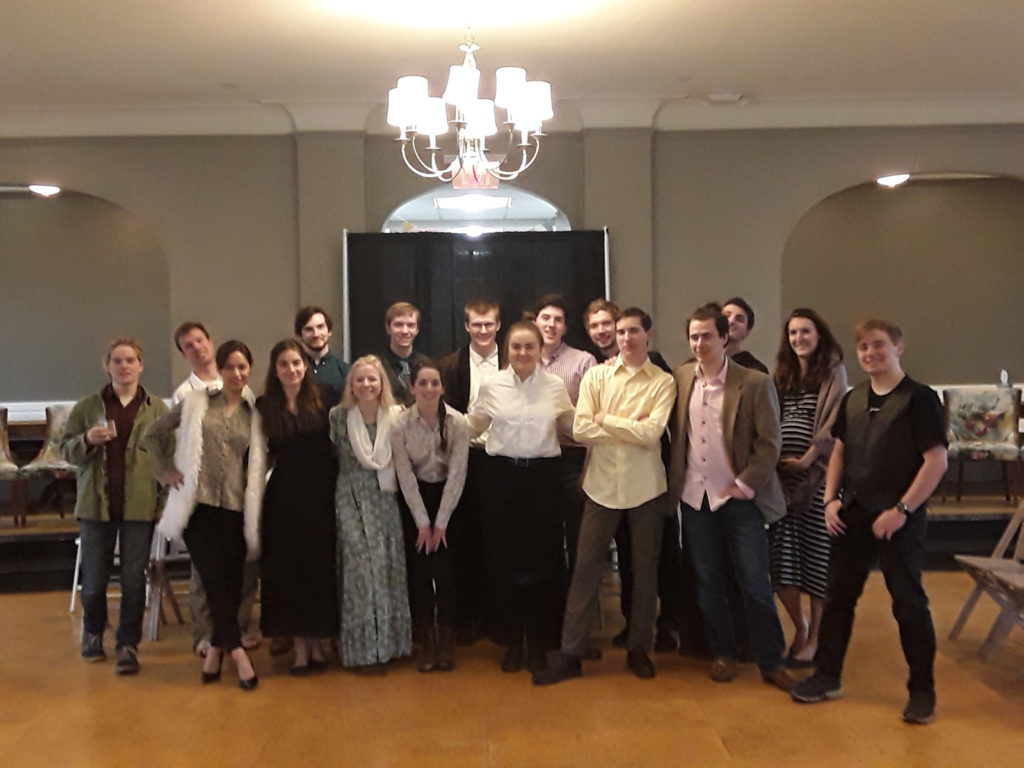
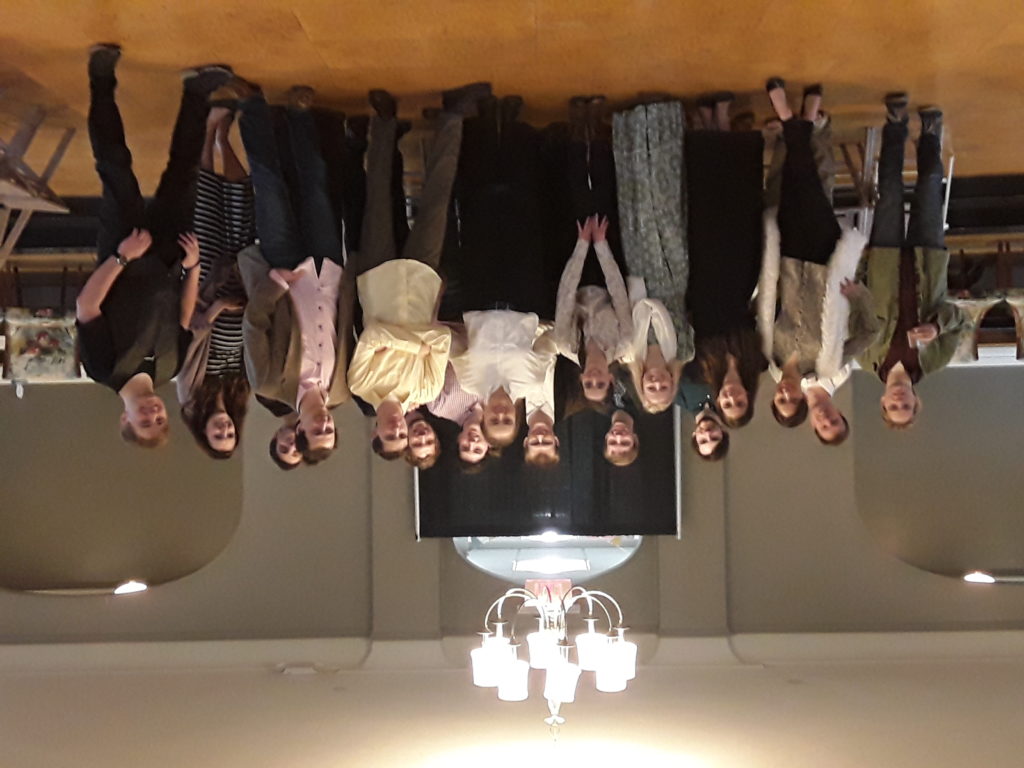
Isabella stands before a tyrant dressed in blood-red clothes. Her feet are pressed into the ground as she looks him in the eye: An Antigone in modern dress. “Sir, believe this,” she says to him with her chin upraised, “I had rather give my body than my soul.”
This is Isabella, the epic heroine of William Shakespeare’s dark comedy “Measure for Measure,” this year’s Shakespeare in the Arb production, directed by senior Andrew Kennedy, working in close conjunction with the Shakespeare Society.
“Measure for Measure” is a gritty play dealing with themes of vice, hypocrisy, political corruption, and the difference between the law of the state and the laws of morality. The play’s protagonist, Isabella, played by junior Elizabeth Bachmann, is training to become a nun when she is abruptly thrust into a world of vice, political intrigue, and murderous violence.
It all begins when Duke Vicentio, played by senior Alexander Frigerio, briefly steps down from his position as duke of Vienna so that he might travel to Poland. His cousin Angelo substitutes for him while he is away.
Angelo, a violent and lecherous man who, as leader of Vienna, is described as “taking the law by the nose,” condemns to death those people whom he deems sexually immoral. Two of these victims are Isabella’s brother, Claudio, and his pregnant lover Juliet, whom he intends to marry. Encouraged by her friend Lucio, Isabella begs Angelo to set Claudio free. Angelo offers her an ultimatum: to sleep with him and free her brother, or remain a virgin and watch Claudio’s execution.
Given the dramatic nature of the play, “Measure for Measure” is classified as a “problem play.” The British Library says “it sits uneasily between tragedy and comedy,” and thus is rarely staged. As a result, most problem plays are not as well-known as Shakespeare’s more straightforward genre plays, such as “Macbeth.”
This is not the first time Shakespeare in the Arb has tackled one of Shakespeare’s problem plays. Last year, the racially-charged comedy “The Merchant of Venice” was directed by senior English major Molly-Kate Andrews.
Senior Stephen Tanquist, who played Lucio in the production, offered some insight into why Shakespeare in the Arb selects these seldom-produced plays.
“I think often times the directors are inclined to choose plays that people haven’t seen before, because then that gives them the opportunity to surprise the audience,” Tanquist said. “One of the plays that was tossed around for this year was ‘Romeo and Juliet,’ which was almost immediately shot down, because everyone knows ‘Romeo and Juliet,’ and there’ll be no surprise for the audience. With plays that people don’t know, there’s more freedom to interpret and to put your own reading of the show in, whereas with more popular and well-known shows, everyone thinks they know what it’s about.”
The talented, powerful cast did not fail to surprise and astound the audience. One audience member, sophomore Isabella Biernat, said she had never seen or read “Measure for Measure” before attending Shakespeare in the Arb last weekend.
“I really liked the play as a whole. It was a wild ride from start to finish and I was engaged the whole time,” Biernat said.
Although Tanquist and the Shakespeare Society’s faculty supervisor Professor of English Benedict Whalen both indicated how talented the cast was. They truly embraced Shakespeare’s language with a loving, informed imagination, while still allowing the original text to shine. No comedic opportunity was lost, nor was the play’s taut dramatic intensity loosened.
Shakespeare in the Arb presented both the audience and the cast with an opportunity for educational advancement.
“I think Shakespeare has a tendency to deal with complex, difficult subjects in intricate ways,” Tanquist said. “Hopefully ‘Measure for Measure’ will confront them with things they haven’t thought before, confront them with ideas like justice and mercy, and startle them. Force them to come to terms with scenarios and ideas in ways that are alien to our experience here at Hillsdale.”
Whalen also encouraged students to seek out the moral and thematic meanings of “Measure for Measure.”
“There is much that we might learn from ‘Measure for Measure.’ Some of the more prominent themes in the play are hypocrisy and deceit in rulers, the relationship between the public and the private, between law and morality, between justice and mercy. It is a play that swings between the comic and the tragic, and it has a remarkable, apocalyptic ending,” he said.
