
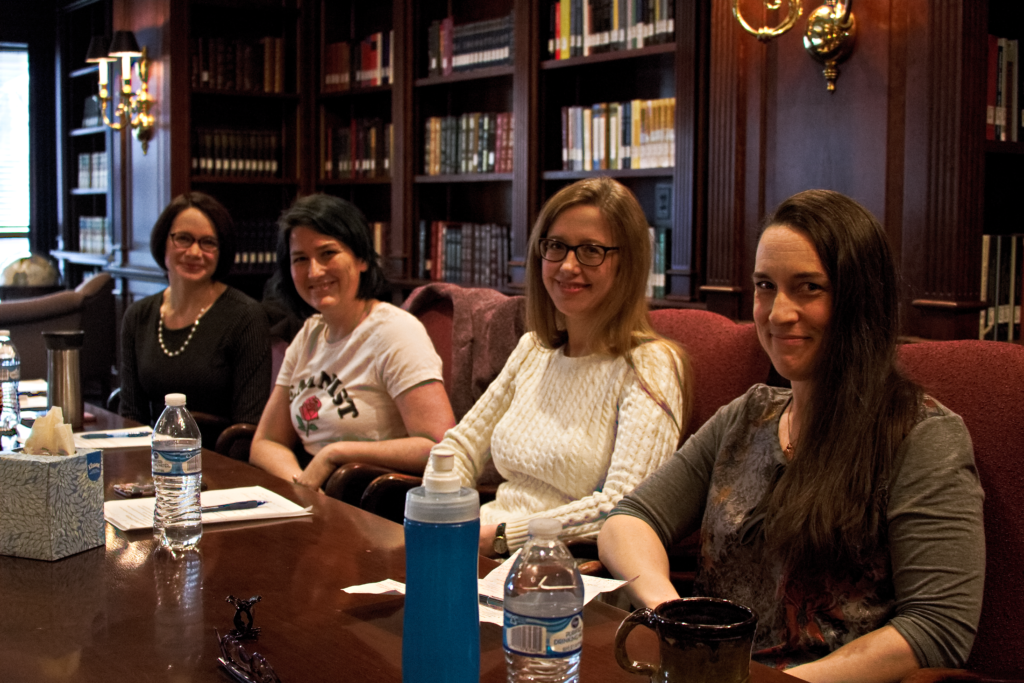
Four faculty brought different perspectives on the feminist movement at a panel discussion this week.
On Tuesday night, students, faculty, and professors alike crammed into the Heritage Room for a professorial panel discussion on feminism and its role in America today. Hosted by the Fairfield Society, the event featured Assistant Professor of Classics Laury Ward, Visiting Lecturer of Biology Angelica Pytel, Associate Professor of English Lorraine Murphy, and Assistant Professor of French Anne Theobald.
Mary Kate Boyle, junior and president of the Fairfield Society, said the goal for the panel was to encourage audience members to reconsider their preconceptions of feminism.
“I think there’s an attitude toward feminism on campus that views it in the most radical and vitriolic light and sees that as all feminism is,” Boyle said. “I wanted to promote discussion where we could hear from some respected and thoughtful women and learn that feminism doesn’t have to be liberal and manhating.”
The panel, run as a question-and-answer dialogue moderated by sophomore Kailey Andrew, covered everything from the definition of feminism to gender stereotypes. The panelists based many of their answers off their own experience. For instance, Pytel explained how her childhood shaped her views on feminism and that she associates “positive thoughts” with the term.
“I was raised with the mentality where girls were not forced to conform to certain gender stereotypes as I was growing up and therefore I was free to choose what was best for me as an individual and to express my personal liberty,” she said.
Ward also spoke from personal experience. Sporting a pink shirt with “FEMINIST” emblazoned across the chest, she shared a story about one reaction she received when someone found out she would be speaking at the event.
“I’ve been on a number of panels, and some of been closely related to my field of study, but some have not,” she said. “This is the first panel I’ve been on that I’ve had someone come up to me to ask if I felt like I was an authority to speak on this topic. I think this shows that the word ‘feminist’ triggers a lot of defensiveness.”
The dialogue broadened into a discussion of equal rights. While the panelists agreed that they had never felt held back or been denied opportunities because of their sex, Pytel said there is “absolutely gender inequality everywhere.” She said she hopes to see that change — especially in politics.
“If we have an equal number of men and women in Congress, it will change the dynamics,” she said. “Women have different priorities — we’re more unity-oriented, more family-oriented. I’m not saying we take over everything; we just need an equal voice. If you’re a man and in power, then, yeah, we’re coming — for half your power.”
Murphy, however, suggested that the culture’s exploitation of women might be a greater issue than an inequality of rights.
“I don’t think we can talk very long about girls and women flourishing without talking about their relationship with men,” she said. “The hyper-sexualization of women in popular culture is honestly the thing that scares me the most. I think it has a lot to do with women knowing how to relate in healthy, respectful, honorable ways with other women and with men.”
Sophomore Isaac Kirshner attended the discussion. He said as a male he doesn’t feel threatened by feminism but suggested it’s time for the feminist movement to refine its message, since its basis is “rooted in the idea of the dignity of the human woman.”
“We should preserve the dignity of the human being as an equal person created in the image of God,” he said. “We can reframe the argument into a discussion of why is the human being special and what makes us all special together. I think there needs to be an inward look into what the movement means today.”
Junior Kathleen Hancock said that while she doesn’t define herself as a feminist, she appreciated the event.
“In the past I’ve been of the opinion that I don’t want to support the movement but rather individuals,” Hancock said. “I think when you take the label of feminism, you get a lot of baggage because of the extreme that is portrayed, especially by Hollywood and the media. It distorts it. The panel was very much focused on the middle ground of what a majority of women who claim to be feminists believe. That was really insightful.”
