
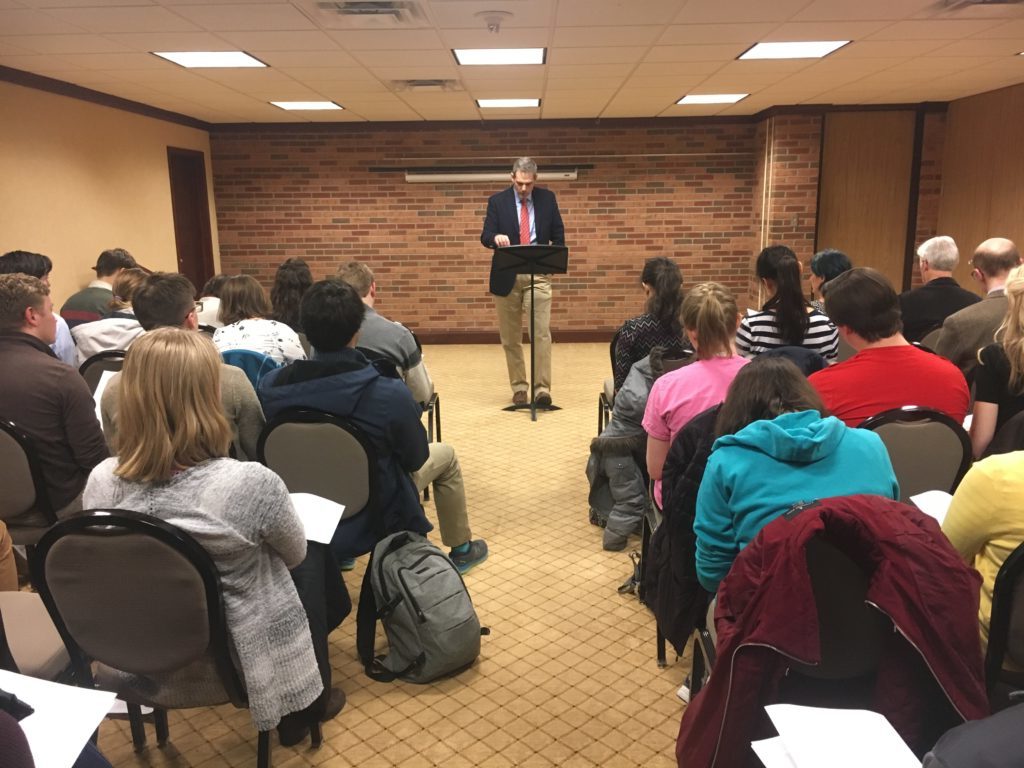
Assistant Professor of Education Jeffrey Lehman told students he planned to “begin with the end, put the beginning in the middle, and then end with the middle,” while explaining the virtues of a teacher on March 21 at an event hosted by the Hillsdale College Latin Teacher Program.
Lehman started the lecture by explaining the two aims of education: wisdom and charity. Seen as parallel ends, he said, one has to do with the intellect — wisdom — and one with spiritual formation — charity.
According to Lehman, wisdom in the classical tradition plays a great role in the philosophy of education.
“Classical education has a strong emphasis on order, the way one thing relates to another,” he said. “This impulse to order should be at the foundation but also at the ultimate end.”
This order is something to which students should be constantly directed, and not just at the university level, Lehman said.
In the biblical tradition, wisdom becomes something that concerns God,
“You seek it out as a way of understanding God but also the world itself, discerning structure in creation,” Lehman said.
Lehman then went on to discuss the theological virtue of charity, which “is the paramount virtue that colors and directs all other virtues.”.
Both wisdom and charity are the ends of education, according to Lehman. With that in mind, he discussed the beginning of education: humility.
“I tend to make you talk, and I don’t talk as much. I try to elicit as much active participating in the student as possible,” Lehman said. “This is rooted in a notion of humility: having a measure or true opinion of the way things really are.”
Lehman said humility is important in teaching a student. A teacher should not dump “tremendous amounts of information on students,” he said.
“For both Aquinas and Augustine, the idea of learning is something that happens in the soul of the student,” he said. “When the teacher does what he or she does best, they’re aiding the natural process.”
After beginning with humility, the teacher must be sustained in charity, according to Lehman.
“Notice the kind of interplay between humility and charity,” he said. “If you begin with humility and you’re sustained by charity, then it’s going to fend off the opposite of humility, which would be pride.”
What comes in the middle are many virtues, some of which, Lehman said, are moderation, courage, kindness, and perseverance.
“These are the kind of things we can model for our students and hopefully encourage the students to hold them in their own souls as well,” he said.
In regards to moderation, Lehman explained the dangers that can come with excess.
“There’s a moderate way of pursuing these things,” he said. “As the body can be worked to exhaustion, so too can the mind be spent. You don’t want those people around you to suffer because you lack moderation in the pursuit of your calling.”
Lehman made a point to mention the crucial nature of kindness in education.
“Kindness is one of the virtues that is largely lost in public discourse today. I feel it part of my mission to reinforce it,” he said. “To treat another with kindness is fundamental.”
Shelby Bargenquast ’19, who plans on pursuing a career in education, said the event was a good reminder of the virtues necessary for a fulfilling career, especially in the first year of teaching.
“There are two very different sides of education that we get here,” Bargenquast said. “There’s difficulties and there’s a lot of hard work. There’s this other side where it’s this great, fulfilling, and joyful career, and you have to merge the two and know it’s going to be hard work but rewarding.”
Junior Joe Toates, who was in charge of the event, said Lehman’s talk was a good mix of the two sides of education.
“It was a really great mixture of broader philosophy of education as well as practical discussions of teachings and various struggles and strategies,” he said. “Lehman has talked in class about a lot of those different virtues and how important it is to be willing to approach the class with humility — that you don’t know everything — and that’s OK.”
