

There was a period of time during my high school years that I contemplated pursuing a music major with an emphasis in piano performance. When I told my piano instructor that I was applying to Hillsdale College, however, he quickly informed me that no professor worth his salt would teach at an unknown liberal arts school not even listed among the top music schools in America. I’d be wasting my time.
And typically, he’d be right. The music departments at tiny liberal arts schools often are a joke, more or less.
But almost as soon as I set foot on campus, I realized Hillsdale was different. With 25 percent of non-music majors involved in music on campus, Hillsdale abounds with talented musicians, many of whom could have gone to top music schools but chose not to. I discovered that these students are at Hillsdale not because they weren’t good enough to get into conservatories but rather because they wanted to grow as humans, not just as musicians.
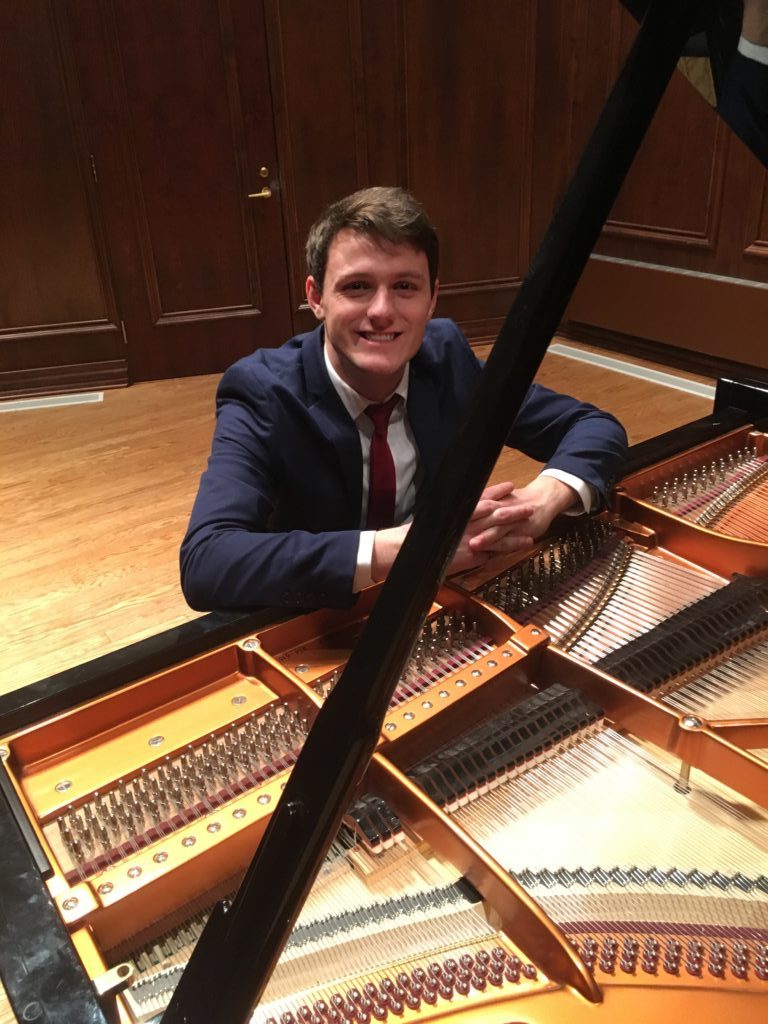
Such is the case for Sam Musser, a junior double majoring in music and religion. Musser gave up a spot at Lee University’s music conservatory, ranked in the top 30 percent nationally, to study at Hillsdale because he wanted more to his education than just the piano.
“When I chose Hillsdale, my parents wanted me to double major, not because they were afraid I wouldn’t get a job with only a music major but because I have so many interests to pursue,” Musser explained. “In a way, just going to a conservatory would have been so narrow it would’ve felt like a waste, whereas going to a place focused on producing well-rounded individuals allows you to exercise and grow in all areas.”
Senior Joshua Brown is a biochemistry major, but as a high school student, he seriously considered pursuing music professionally. He said he had the opportunity to attend the University of Notre Dame’s conservatory and a full-ride scholarship to Butler University’s school of music.
As much as he enjoyed the violin, however, Brown realized he wanted something more in life — to settle down and have a family, for instance. He’s getting married this summer, right after graduation and right before he starts medical school at the University of Indiana.
“Hillsdale gave me the chance to pursue the sciences and music while still getting to explore some other areas,” he said. “It’s not that I got less at Hillsdale but that I chose to have more.”
Zsanna Bodor, a sophomore, has a similar story. Bodor was admitted to several schools known for their music programs. She received an excellent music scholarship from the University of Illinois, consistently ranked among the top 10 schools of music by U.S. College Rankings, but turned it down.
“I would’ve been tied to completing a Bachelors of Music in violin performance,” Bodor recalled. “That’s the only way I could’ve maintained my scholarship. I love violin, but it felt scary to go into that kind of situation — limiting, really.”
Hillsdale, on the other hand, offered a much more well-rounded education, which Bodor said has been perfect for her.
She’s double majoring in music and German.
The freedom to play music while also investigating other fields is precisely the goal, according to James Holleman, chairman of Hillsdale’s music department.
“Music is part of who these students are,” Holleman explained. “It’s part of the balance they have to have. They stick with it through high school because it’s important to them, and at Hillsdale, it still gets to be important to them.”
That hasn’t always been the case. When Holleman arrived at Hillsdale 22 years ago, the music program fit the small-liberal-arts-school stereotype neatly. Holleman had noticed that things went awry when models that worked for music departments at big state schools were slapped onto small colleges. He was determined to avoid that mistake.
“I needed to create a program that fit Hillsdale and the liberal arts,” Holleman said.
As he undertook the project of reshaping the college’s music department, Holleman found himself looking back to his time with the Jackson Youth Orchestra.
“I had all these kids who thought they were disappointing me when they said they loved music but wanted to pursue other interests, like science and English,” Holleman remembers. “I thought, ‘Can we be the school for those students?’”
From this came the idea of opening the music program to all musicians on campus regardless of major — and of dealing with the scheduling mess it made.
“We have to understand the academic pressure students are under, not only the pressure the college puts on them but also the pressure students put on themselves by participating,” Holleman said.
It’s a tradeoff, but it works. In 2017, Hillsdale was chosen as one of only two orchestras to perform at the College Orchestra Directors Association (CODA) national conference in Washington, D.C. The organization was so impressed with the quality of Hillsdale’s performance that they changed the way they select orchestras for the conference to always include one orchestra from a smaller program and one from a larger program.
Bodor said she thinks the democratization of Hillsdale’s music program is a big part of its success.
“Here, we do music because we love it,” she observed. “I think sometimes at a big conservatory there’s a danger of losing the joy because it’s so ultra-competitive. I think that atmosphere would have stifled me. Music gives me so much delight and it’s so special to be part of an environment like this. Some of the richest and most beautiful friendships I’ve formed are with people I’ve met through music.”
Hillsdale may be small, but there’s no shortage of musical opportunities: concerto contests, opera workshops, orchestra, master classes, chamber music, national competitions, accompanying, even playing gigs at Broadlawn.
“I’ve had all the opportunities I’ve ever wanted,” Brown said. “Oftentimes at bigger schools there’s a hundred people doing the same thing as you and there’s a lot more competition for a lot fewer spots.”
Musser said Hillsdale’s rather unconventional approach to music reflects its commitment to cultivating self-government. Hillsdale provides all the tools and resources needed for success, but it’s up to the students to take ownership of their pursuits. Because of that, Musser said his musical abilities have grown more in the last two years of college than all of high school.
“Hillsdale doesn’t ‘produce’ anything,” he pointed out. “Other universities will make you something, but at Hillsdale, you make yourself. You become what you’re going to become because you’re in charge of your education. Hillsdale is just a support and reference for you and your educational journey. When you approach it like that, it changes everything.”
As I look back to my high school days, I realize that my piano instructor was, to an extent, correct. Hillsdale isn’t a conservatory. But it’s not trying to be one. Hillsdale is a place where musicians can continue their music studies at a high level while pursuing other interests and other majors. And there’s nothing wrong with that.
As Tova Foreman, a senior classics major and the winner of this year’s violin concerto competition, put it: “At Hillsdale, I’m a violinist, but that’s not the only thing I get to be.”
