
It’s another Monday, and I can barely keep my eyes open. My head starts to nod up and down as I fight sleep in my 9 a.m. American Heritage class. I reach over my giant American Heritage Reader and grab the cure for my weary eyes: coffee.
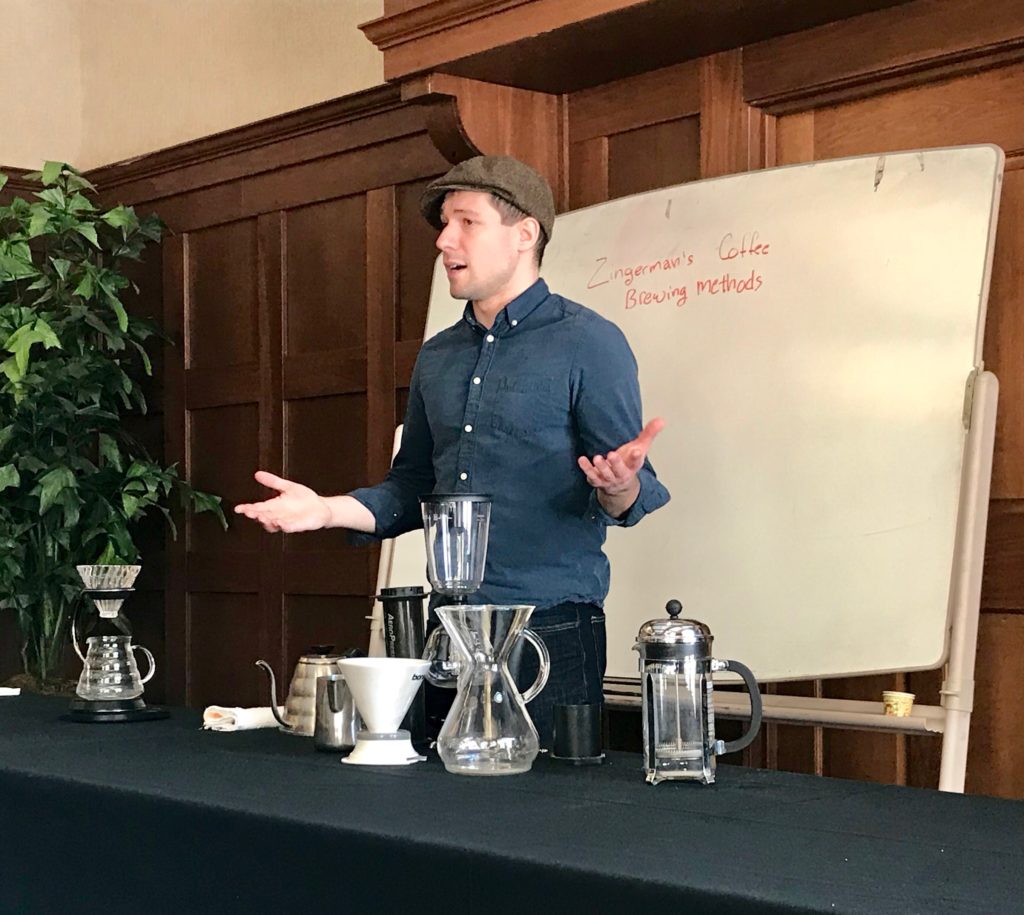
A couple of weeks ago, I attended a coffee tasting and brewing class taught by Christopher Glasow, a roaster and trainer for Zingerman’s Coffee Company. Within the first five minutes of the class, I was convinced coffee is more than a caffeine source, more than pushing a button on a machine. It is both an art and a science.
The flavor we taste when drinking a cup of coffee is only 20 percent taste, according to Glasow: 80 percent is aroma. Because of this, brewmasters become quite skilled at distinguishing a good coffee largely based on its smell.
Acidity “plays a vital role in making coffee pop inside the palate,” Glasow said. When acids hit the palate, each produces a different sensation, triggering either the sour, bitter, or sweet receptors.
The way coffee feels when it hits the mouth, whether its taste is heavy or light, is referred to as its “body.” A coffee’s “finish,” or after-taste, is what remains on the palate after swallowing, and can be either short or lingering.
Ideally, coffee should be brewed at a temperature between 195 and 205 degrees Fahrenheit; temperatures above this threshold could burn the coffee, and temperatures below do not sufficiently extract the coffee flavor from the bean. Glasow added that even the quality of water can change the flavor of coffee: minerals help coffee bind to water, and so the ideal water for coffee should be mineral-rich and have a pH level of 7.
After learning the science behind the perfect cup of coffee, we tasted one type of coffee, Zingerman’s Ethiopia Harrar roast, brewed six different ways. Each brewing method produced a slightly different cup of coffee.
V60 pour-over
With its glass vessel and grooved filter-holder, this brewer uses a paper filter and very fine grounds to produce a “delicate and complex” flavor. When brewing with the V60, Glasow demonstrated how to “bloom” the coffee, to ensure all of the gases from the coffee escape. The bloom is simply a quick bubbling up of carbon dioxide from the coffee grounds, achieved by a gentle stir after the initial pour, before adding the rest of the hot water. Glasow said this process gives a “more consistent and even extraction.” The final product was smooth, sweet, and nutty. It had a light body and a long finish.
Chemex
A cousin to the V60, the Chemex also has a glass vessel and filter, but has a single groove on the side of the filter for the water to flow through. Stirring the coffee and water gently as it filters through the groove loosens up the thick line of coffee along the filter paper and allows the coffee to fully absorb the water for the best flavor. The coffee had a nuttier and more bitter flavor, much stronger than the V60, with a longer finish and heavier body.
Immersion brewer
Glasow referred to this brewer as “a cross between a pour over and a French press.” Its plastic filter and glass vessel was designed to produce a stronger pour-over coffee by increasing the amount of time the water and coffee grounds are in contact — Glasow recommended steeping for one minute — before a lever is pushed to release the the coffee into the vessel. Because the water and coffee are in constant contact with each other, the immersion brewer produces a very balanced cup of coffee, with a heavy body and short finish.
French press
A coarse grind and the longest brewing time made for a very smooth cup of coffee from the French press. Typically, coffee brews for three to five minutes in a French press, depending on the desired flavor. Prior to steeping, Glasow recommends slightly agitating the water and coffee mixture by stirring. The resulting coffee brewed was bitter and strong. It had a long finish and a heavy body, packing a powerful punch to the palate.
AeroPress
Glasow compared the AeroPress to a “coffee syringe.” The small, compact plastic device uses pressure to force hot water through coffee grinds, like a manual espresso machine, great for coffee on the go. However, each use only produces eight ounces of coffee.
Brewing with the AeroPress is unique in that the entire process is inverted. The top chamber of the AeroPress is filled with coffee and water while the plunge is actually the base of the brewer. After two minutes of steeping, the AeroPress is flipped, so that the plunge can push the water and coffee mixture through the filter and into a cup. This method produced a very strong cup of coffee with a complex flavor and a short finish.
Syphon
The oldest design for coffee brewing, dating back to 1830s in Germany, the syphon uses a vacuum technology, based on the law of gravity and heat to brew coffee. A butane flame heats a lower vessel of water and the steam produced goes through a glass tube into a higher vessel, mixing with the coffee grounds. The coffee-water mixture then filters back through the tube to the bottom vessel, ready to serve.
The coffee from the syphon was nutty and sour, possibly due to the higher temperature at which it was brewed. It had the lightest body of all the brewing methods and was very smooth.
Takeaway
We live in society that demands everything we do to be simple and fast. Unfortunately, simple and fast doesn’t always make for the best brewed cup of coffee.
To brewers like Glasow, coffee is more than caffeine: it’s an art, meant to be enjoyed and tailorable to please any palate.
Next time you have a cup of coffee, let the caffeine become an afterthought. Try to identify some of those flavor components jumping around on your palate. When your eyes start to close, open your other senses and enjoy the divine liquid.
