
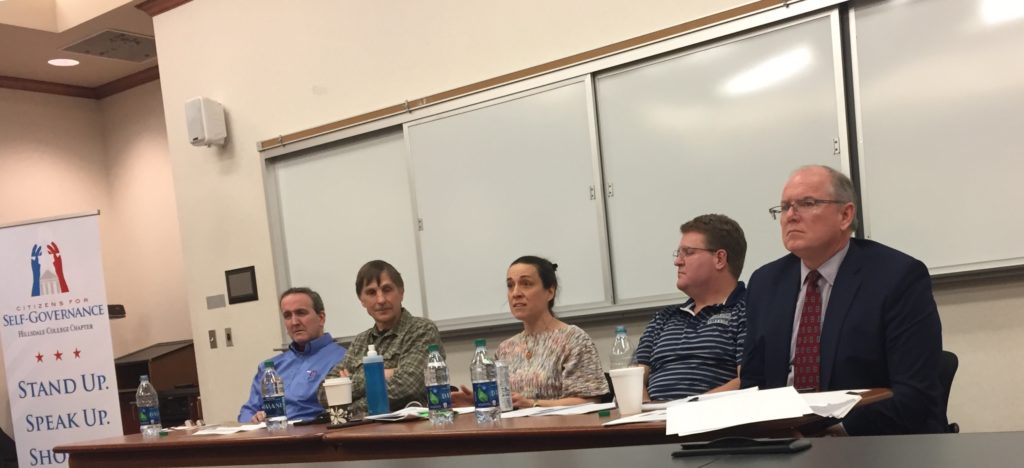
Faculty were split on the social ramifications of marijuana legalization in Michigan during a panel discussion this week.
On Feb. 5, Hillsdale’s chapter of Citizens for Self-Governance hosted a discussion panel on the legalization of marijuana. As Professors Angelica Pytel, Roger Butters, Gary Wolfram, Paul Moreno, and General Counsel for Hillsdale College Bob Norton explained the legalization process, they concluded that there is still plenty of uncertainty surrounding the new legalization and, whether good or bad, there are going to be major societal ramifications from the legalization.
“Those of you who know Tom Petty know that the proper name for marijuana is ‘Mary Jane,’” said Professor of Political Economy Gary Wolfram.
Visiting Lecturer of Biology Pytel wanted to clearly explain what marijuana is.
“We use the word marijuana too loosely,” she said. “Cannabis is not just marijuana.”
She reminded everyone that cannabis is a species of plant, not a drug, and many different organic products can be derived from cannabis. While those products include marijuana and cannabinoids, the hops in beer can also also be derived from cannabis. Pytel wanted to make it clear that cannabidiol, which comes from cannabis, can be used and abused.
“Does consuming cannabis products cause harm? The answer is that anything can cause you harm,” she said.
Once Pytel had clearly defined marijuana and its effects, Norton focused on the legal side of Michigan’s legalization of marijuana. He reminded the audience that medical marijuana was actually legalized in Michigan in 2008; now it is also legalized for recreational use.
Norton explained the specifics of the legalization in Michigan, pointing out that Michigan has the most lenient marijuana laws in the country, even more lenient than the laws in California.
“The law now says you may have marijuana about your person. You can have 2.5 ounces on you or 10 ounces at your home, or 12 marijuana plants at your house, but you can’t sell it yet,” Norton said.
Butters, associate professor of economics, addressed the effects that legalization of marijuana would have on taxes. He pointed out arguments in favor of legalization: A tax on marijuana would generate money, and legalization would fight black market trade of the drug.
“Anytime you have something that people want really bad, there are people out there who are willing to provide it,” Butters said. “Along with those black markets, you get the crime and everything else that comes along with it.”
Butters said there are, however, arguments on each side, and legalization is more of a societal issue than just a purely economic one.
“The economics do not always tell you what you should do,” he said. “You could easily argue either way. On the one hand, you could argue that legalization is a route to less crime. And you could likewise argue that legalization is a way of permitting something into society that you may not want.”
According to Professor of History and Dean of Social Sciences Moreno, our understanding of drug legalization falls short.
“I think it’s a great failure of understanding history that we are venturing again into this question of drug legalization,” he said.
Moreno argued that the history of legalized drugs shows that their legal status actually led to more addiction, and addiction changed behavior and led to more societal issues like traffic fatalities, domestic abuse, illness, and work productivity. He pointed to the legalization of morphine during the Civil War: People eventually became addicted to morphine although it was only a treatment.
The addictive substances that are legal in the U.S. now are naturally leading to more addicts, Moreno said. There are an estimated 15 million alcoholics and 50 million nicotine addicts, but only about 1.5 million cocaine addicts in the U.S. now. Part of that is because cocaine is illegal, even though it is much more addictive, according to Moreno.
“Legalization of any drug usually leads to an increase in the use of other legalized drugs,” Moreno said.
Wolfram ended the panel discussion by saying there is still a lot of uncertainty on the subject of legalization.
“Markets don’t like uncertainty and we have a great deal of uncertainty in this industry,” he said.
The greatest uncertainty arises from the disconnect between federal law and state legalization of the drug. Although states are legalizing the drug, the federal government still classifies it as a Schedule I drug. Most Schedule I drugs are narcotics like LSD, Heroin, and Ecstasy.
This uncertainty is simply not helping the issue, according to Wolfram. While there may be economic benefits to legalization, the uncertainty at the state and federal level prevents any kind of surety.
All the panelists agreed that no matter what the benefits and drawbacks of legalization are, there will be major societal impact and it is important to understand the nature of the drug and its physical, economic, and societal consequences.
