
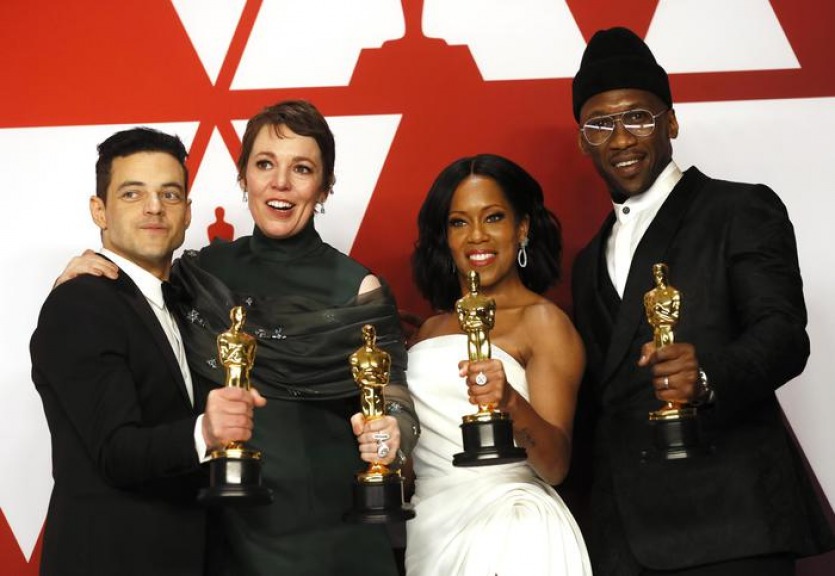
On Sunday night, as actors and actresses denounced President Trump, Americans watched the most pro-life Oscars ceremony in the history of Hollywood. One after another, the nominees affirmed the pro-life values that many conservatives hold dear.
Consider the case of “If Beale Street Could Talk,” which produced an Academy Award for Best Supporting Actress for Regina King. The film, based on the novel of the same title written in 1974, follows the romance of Tish and Fonny in Harlem. Tish carries an unexpected pregnancy to term as she and her family attempt to free her fiancé, Fonny, from a wrongful conviction. One of the most moving scenes in the movie takes place when Tish tells her family she is pregnant. The family waits expectantly for Tish’s father to react, when he bursts out in laughter and exclaims, “I hope it’s a boy!” The joyful reaction at unexpected life, even in challenging circumstances, embodies the character of the pro-life cause.
Dr. B.J. Miller’s words to a patient: “We’re here to continue to talk through this crazy thing called death,” are the first dialogue in the trailer of “End Game,” a Netflix documentary nominated for Short Subject. The film’s intimate portrait of Zen house, a hospice project seeking to change the perspective of terminally ill patients, explores how we die and what is important in death. The mission of the project is obvious on its straightforward, deliberately-designed website with large, bold text: “We believe that dying is both sacred and unknowable, which allows us to be fully present with each individual.” End-of-life care is one of the medical field’s greatest ethical threats at the moment. In our society’s desperate chase for comfort and avoidance of suffering, we have actually forgotten the meaning encountered through the process of dying, grieving, and letting go. The doctors featured in “End Game” have made it their life’s work to restore meaning and beauty to the ends of our life.
The Left calls the pro-life stance an oppression of women and the Right glosses over it as hating abortion. Obviously, neither one of these shallow dismissals can accurately portray an entire movement. Some are keen enough to remember the escalating issue of euthanasia and end-of-life ethics, but the pro-life cause encompasses the entire timeline starting at a little dot called Birth and ending at another dot called Death. At its core, the pro-life cause is the defense of human dignity fueled by compassion, not any religious, scientific or political argument used to support one’s opinion. Its mission includes the protection of infants at risk of being aborted by unprepared and vulnerable parents, but the mission does not stop when a baby is successfully born alive (unfortunately, an accomplishment today). The pro-life movement is a warrior fighting for the dignity of every vulnerable person. A flourishing culture of life honors the intrinsic worth of every human life – to respect persons of all ages, all races, all abilities, and all privileges.
Best Picture went to “Green Book,” a film about Tony, an Italian-American man becoming the driver of Dr. Don Shirley, an African-American classical pianist in the segregated Deep South. In one of their first rides together, Tony garbles through a mouthful of fried chicken, “You people love the fried chicken!” To which Dr. Shirley responds, “You have a very narrow assessment of me, Tony.” Their unlikely friendship explores the necessity of personal relationship in reconciling the wounds of racism. Racism has carved deep scars into relationships in America. While policies can solve institutional injustices, the injury will only be healed through a personal encounter and reconciliation with their differences and assumptions.
“Lifeboat,” nominated for Short Subject Documentary, portrays the traumatic journey of refugees fleeing Libya because of the poverty, violence, trafficking plaguing the country. The preview holds an uncomfortably long shot of a small motorboat occupied by the wailing of one of its six cramped passengers, letting the ugliness of underprivileged life rear its face. “Minding the Gap” examines the cycle of poverty in America from the perspective of the teenagers forging community in a half-pipe. The beauty of the family is emphasized in “Bao”’s portrayal of a turbulent mother-son relationship and “One Small Step”’s story of a Chinese-American girl, her dream to become an astronaut and her father’s unwavering support. Both films were nominated for Animated Short Film.
It is easy to despair in a society as divided as our own. Today’s culture of efficiency and comfort gravely threatens the dignity of life. Earlier this week, every Democrat senator blocked the Born Alive Act, legislation requiring medical attention for babies born alive after failed abortion attempts. Just last month, a doctor in Ohio was fired for euthanizing 27 terminal patients against their will by administering fatal doses of painkillers. Offenses against life are no longer rare, but the Oscars gives hope in what can sometimes appear to be a losing battle. Life is still precious, and many still recognize its beauty. Most of this year’s film nominations capture the beauty of life, and they provide a perfect starting place to meet others, encounter our differences, and begin restoring this broken society.
