
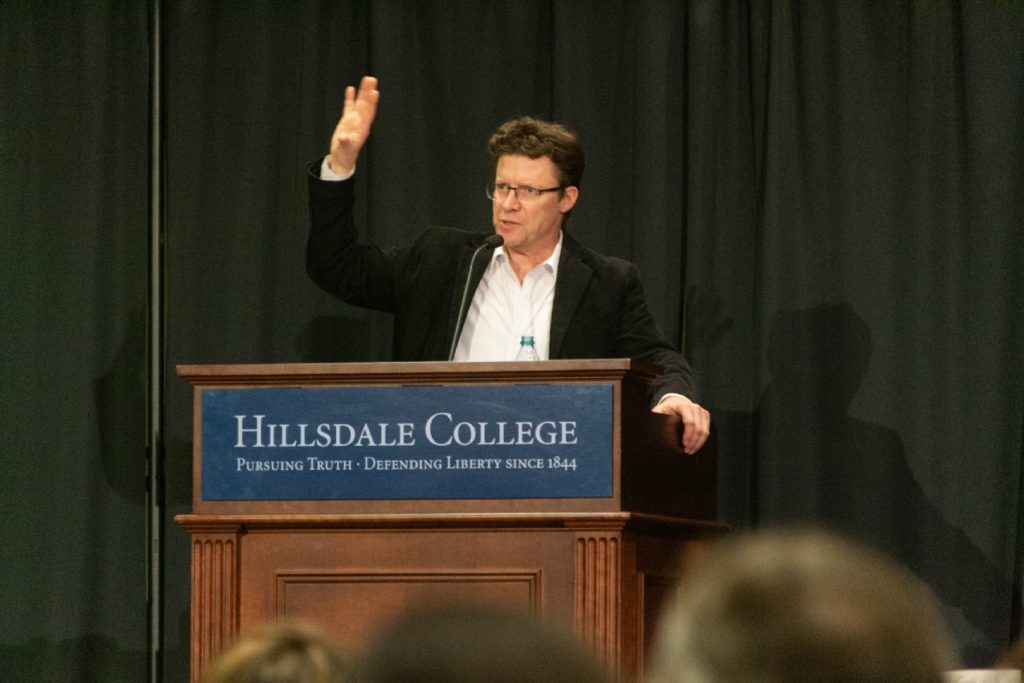
An increasing presence of technology in the everyday lives of Americans could potentially contribute to the loss of “prudence, judgement, and sociality,” according to writer Matthew Crawford during a speech Tuesday for Hillsdale College’s Center for Constructive Alternatives.
The first CCA of this semester addressed artificial intelligence.
Crawford, a writer and research fellow at the Institute for Advanced Studies in Culture at the University of Virginia and a contributing editor to The New Atlantis, spoke to the potential consequences of new technology on how we function in society. His upcoming book, “Why We Drive: Toward a Philosophy of the Open Road,” will address the impact our traffic laws have on individuals.
Artificial intelligence and other technological developments, Crawford said, may hamper individual choice as society delegates more responsibility to robots. He said an emphasis on human agency, as opposed to more reliance on technology in policy, would help citizens live according to prudence, judgement, and sociality.
“When I say ‘open road,’ I mean to invoke the space of human agency that is opened when people are left to their own devices,” he said. “What if we used our blessed eyeballs to determine whether to turn left at an intersection?”
Using everyday city traffic as an example, Crawford argued that, as technology eliminates the small tasks and decisions of everyday life, individuals will lose their initiative and personal liberty.
An increasingly technological society, according to him, would be detrimental to the practice of prudence, which comes only from experience “and is cultivated only when we are free to err.”
Crawford showed a brief video of a busy intersection in Addis Ababa, Ethiopia, which functioned well even without stoplights or designated lanes. The implementation of artificial intelligence in intersections like these, he said, was unnecessary, given how well individuals cooperate on their own.
The cooperation of drivers in underdeveloped countries, Crawford said, is one example that proves that “self-government as a principle will help us confront the world of artificial intelligence.”
“Disorder is bad,” Crawford said. “The project for rational control rests on a very thin conception of what reason consists of and too narrow a view of where it is located in society. The Addis Ababa intersection is the picture of rational control.”
Crawford argued that by delegating more small decisions — like when to stop and go at a large intersection — to tech companies and municipal bureaucracies, citizens would lose their political liberty as well, becoming more like subjects than citizens.
“From the perspective of a central power, what is wanted is an idealized subject of a different sort, an asocial one, an atomized account of a human being,” Crawford said.
The simple forms of cooperation and communication that one observes in the seemingly chaotic streets of Addis Ababa represent a system that balances the rational government with individual freedom, according to Crawford.
Assistant Professor of Theology Jordan Wales said there may be better examples than the Addis Ababa intersection to support Crawford’s general argument, and he said Crawford’s observations may be more relevant in issues such as parenting, rather than municipal traffic.
Senior Dylan Strehle said Crawford had some good points, but he said Crawford’s example of the Ethiopian intersection was not well-received.
“Crawford was incredibly articulate and presented a compelling case,” Strehle said, adding that Crawford could have done better addressing students’ questions.
Wales, who will be on the faculty roundtable Thursday night, said he will address his thoughts on how Crawford’s view of the lack of individual initiative could relate to parenting.
“A system that enforces obedience without reflection is a system that raises children without initiative, thoughtfulness, or creativity,” he said. “In driving, we see this in the use of a GPS.”
