
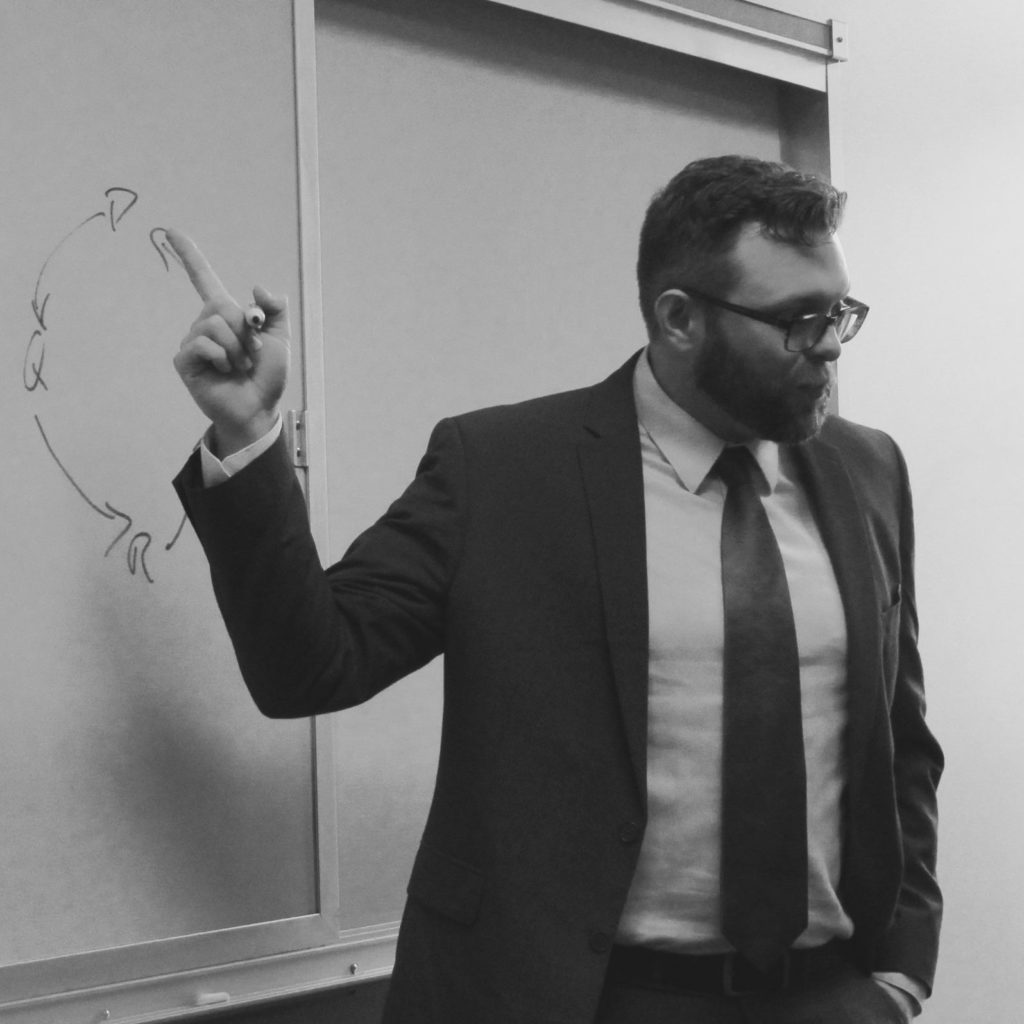

Both Assistant Professor of Philosophy Ian Church and Assistant Professor of Philosophy Blake McAllister have been accepted into a two week residential seminar program on “science-engaged theology” and will attend the seminar to further explore their own philosophical queries.
Hoping to bring science, theology, and philosophy in closer dialogue with one another, the Fuller Theological Seminary will host a seminar this summer focusing on “The Created and Fallen Image of God.”
The program aims to support “science-engaged theology, training theologians in psychological science to make new discoveries and contribute to theological progress,” according to the Fuller website. Church applied to the program because it already fits in with his current research and a paper he is writing on divine hiddenness and non-resistant non-believers he said.
Church said he hopes to answer why a person could be non-resistant to the idea of God, but still not believe, if God is perfectly loving. This question also relates to the problem of evil, since it seems that God can sometimes remain hidden in times of great pain or evil.
“The question of whether or not there are people who are non-resistant in their non-belief is to some extent an empirical question,” Church said. “The psychological literature on the problem of divine hiddenness has been acknowledged but it’s never been explored.”
Church said psychology can provide insight into this problem of divine hiddenness since the field may provide insight into the possibility of a non-resistant non-believer.
Church went on to suggest that one’s community may play a role in one’s ability to be non-resistant in non-belief.
“Is it possible to be non-resistant in your non-belief if your broader social community is resistant in non-belief?” Church asked. “Some empirical literature seems to suggest that that is at least doubtful.”
However challenging, this assumption has its problems.
“That assumption is rarely called into question in philosophical literature because you look like a jerk,” he said. “I can talk to you about people who are as deeply familiar with all the evidence as anyone could ever ask for but nevertheless they fail to believe and are atheists.”
The seminar will be an opportunity to understand the psychological dimensions of divine hiddenness through the integration of these different fields.
“The goal is to try to bring theology and the sciences in closer dialogue with one another and philosophy as well,” he said.
McAllister’s question concerns the epistemology of religious conversion. McAllister said religious conversions primarily concern each person’s perspective.
“You can have an atheist and you can have a theist that will look at the very same event, and one will see an irredeemable evil that no good God could possibly allow, and the other will see something that, while tragic, will be redeemed in the end,” he said.
McAllister hopes psychology will aid in answering his question on the multiplicity of perspectives.
“At a certain point, psychology needs to come in to help us understand the empirical data on what is triggering these perspective shifts,” he said.
The seminar will also give both professors the opportunity to apply for more funding, which, according to Church and McAllister, may benefit some of the students at Hillsdale. Church mentioned the possibility of funding psychology students’ research or perhaps a reading group.
“The initial hope is that I could use some of those research funds to fund student research here,” Church said. “I’d be particularly interested in getting students to work on the intersections of philosophy, psychology, and theology.”
Tom Burke, chairman and professor of philosophy and religion, wrote the recommendation letter for Church. According to Burke, a science-engaged theological approach is certainly something that could be brought to Hillsdale.
“A college dedicated to traditional Western values needs to embrace both theology and science, and both science and theology need to be in constant dialogue, for such will benefit both on a number of levels, including that of practice,” he said in an email.
