
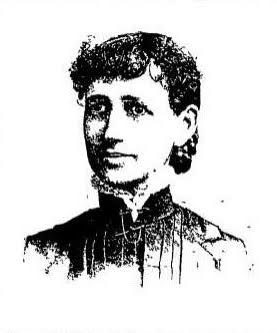
Expendability is the byword for most of the Gilded Age’s newspaper verse, and the work of Rose Hartwick Thorpe is no exception. Although her 1867 poem “Curfew Must Not Ring Tonight” was of the most popular ballads of the 19th century, by the late 20th, it faded into obscurity.
Thorpe began publishing as a 16-year-old growing up in Litchfield, Michigan, through a gig with the Detroit Commercial Advertiser: she would submit one poem weekly, and the newspaper would send her a free subscription.
One week in 1870, Thorpe was too sick to pound out a fresh poem for the Commercial Advertiser. So she sent in a rough copy of “Curfew,” a ballad she had written three years previously for the local Litchfield paper. It puts to verse a legend about a woman named Bessie in the 17th century English Civil War whose bravery saves her Royalist lover from execution at the hands of Oliver Cromwell’s Puritan Roundheads.
In a mimicry of Henry Wadsworth Longfellow, Thorpe organized each stanza around the titular refrain, “Curfew must not ring tonight.” This trick hyper-intensifies focus on Bessie’s determination to stop the bell signaling her lover’s death from ringing at sunset. She succeeds by climbing a belltower and holding herself against the gong. The lack of noise confuses the Puritan chain of command, and they wait longer than usual to proceed with the execution. Cromwell arrives on the scene, and after learning what Bessie has done, pardons her lover. Amor omnia vincit.
A captivating story, maybe. But a mess of a poem. Thorpe’s trochees flop along in jangly heptameters, each line stapled to the next with hackneyed end rhymes. Just get a load of this stanza where Bessie confronts the bell ringer:
‘Bessie,’ calmly spoke the sexton,—every word pierced her young heart
Like the piercing of an arrow, like a deadly poisoned dart,—
‘Long, long years I’ve rung the Curfew from that gloomy, shadowed tower;
Every evening, just at sunset, it has told the twilight hour;
I have done my duty ever, tried to do it just and right,
Now I ’m old I will not falter,—
Curfew, it must ring to-night.’
And on and on like this for about 70 lines. Readers loved it.
Newspapers across the country reprinted Thorpe widely. The British press picked up the poem, and it reputedly became one of Queen Victoria’s favorites. The continental European press took note, and soon, foreign translators rendered Thorpe into 17 different languages—a major feat for an amalgam of empires rutted deep in the Hohenzollern Mindset.
By the 1880s, the poem had become a staple of popular American literature. It was widely anthologized and taught in classrooms around the country. Thorpe continued to pump out poetry, as well as children’s books — though never quite with the same electrifying success of “Curfew” — and used her literary clout to promote literature supporting modesty and the temperance movement.
Hillsdale College jumped onboard the Thorpe train in 1883 when President DeWitt Durgin, impressed with the continued popularity of “Curfew” in both Europe and America, recommended that the college award her an honorary Master of Arts degree, which it did that same year. Upon receiving the degree, Thorpe thanked Durgin and the college for taking pride in her local achievement.
“My heart rejoices in the thought that, while other states and other lands are sending tokens of remembrance, my own has offered the kindest recognition of all,” she said. “Through you I wish to return my heartfelt thanks for this high appreciation of the poem, which was written in Hillsdale County.”
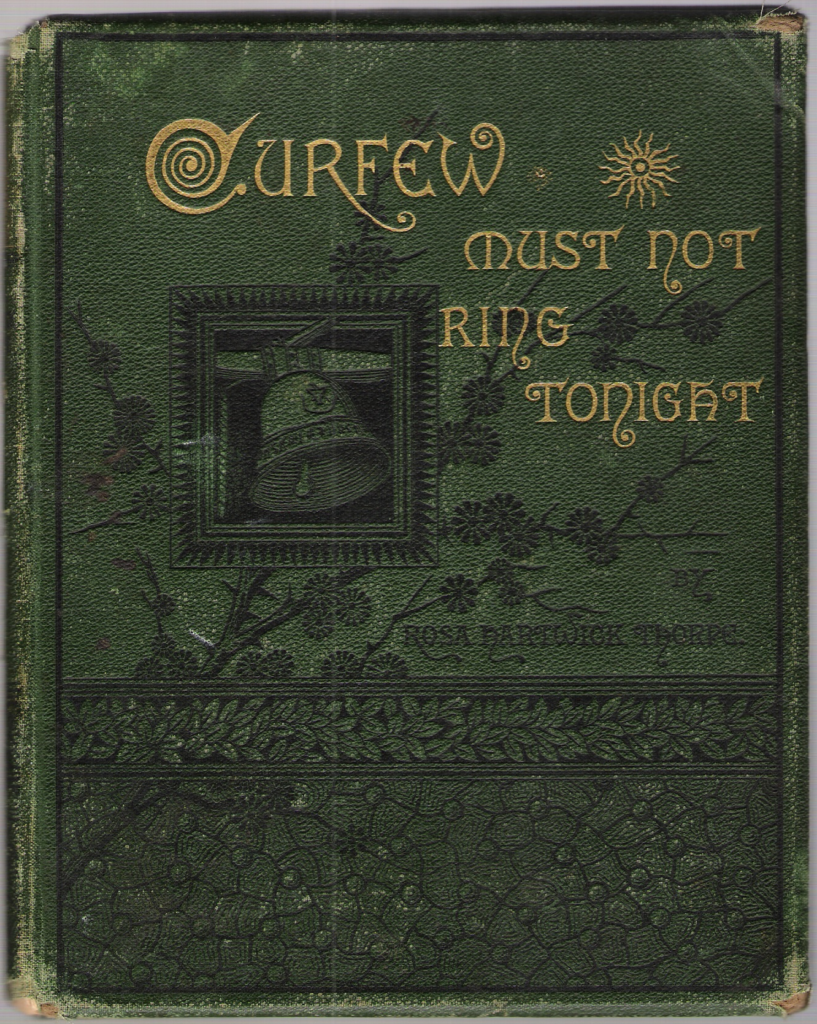
Following the ceremony, Thorpe presented Durgin with an illustrated copy of “Curfew,” dedicated to “the future prosperity of this noble institution.”
Thorpe remained involved with the college—although at this point she had become an editor in Chicago—and sometimes performed readings in Litchfield and Hillsdale. She contributed her greatest gift to Hillsdale in 1895: the song for the dedication of the Alpha Kappa Phi memorial to students who fought for the Union in the Civil War. It was sung at the beginning of the ceremony. Will Carleton, Hillsdale College’s other famous poet of the day, concluded the event with his own composition, written specially for the occasion.
Soon Thorpe’s ever-ascendent fame swept her away from the Midwest. In 1896, she and her husband moved to San Diego, California, where Thorpe embarked a number of literary ventures. The most successful of these was “The White Lady of La Jolla,” a book about a local rock formation resembling a young bride drowned before marriage. She also published a popular compilation of her moralizing children’s poems, “Ringing Ballads,”—no doubt great stocking stuffers for young Victorians.
By the turn of the century, “Curfew” had become canon in American letters. Thorpe was honored at Chicago’s World’s Fair Columbian Exposition in 1893. The composer Stanley Hawley set “Curfew” to music in 1895. The playwright David Belasco (best known for being the first to bring “Madame Butterfly” to the stage) used it as inspiration for his 1895 play “The Heart of Maryland.”
“The picture of that swaying young figure hanging heroically to the clapper of an old church bell lived in my memory for a quarter of a century,” Belasco recalled about the first time he read Thorpe’s poem. “When the time came that I needed a play to exploit the love and heroism of a woman I wrote a play around that picture.”
The early 1900s brought even more accolades. Author Lucy Maud Montgomery quoted “Curfew” in her 1908 classic “Anne of Green Gables.” Three silent films based on the poem were released. Two modified the title to the more sonorous “Curfew Shall Not Ring Tonight.”
Hillsdale College President Joseph William Mauck took note, and hung a photograph of the poet on the second floor of Central Hall in 1916, among the ranks of other notable alumni (none of these pictures remain today).

Thorpe died of ill health in 1939, but her fame lived on. Only the next year, the near-blind New Yorker writer and cartoonist James Thurber produced and illustrated version of “Curfew” in his “Fables for Our Time and Famous Poems Illustrated.” The poem also enjoyed continued popularity in Hollywood, with references by Jack Warner in “Scrooge” (1951) and Katherine Hepburn in “Desk Set” (1957).
In the late 1960s, the folk group The Chad Mitchell Trio adapted the song into a ditty titled “Hang on the Bell, Nellie,” which subverts Thorpe’s moral tone to laud the sexual revolution. The final couplet captures the song’s twist on Thorpe: “As you swing to the left, Nellie swing to the right / No matter when that curfew rings, we’re gonna swing tonight.” The band played the song on the popular variety show Rowan and Martin’s Laugh-in, and nearly everyone who had gone to high school got the joke. It was the apex of the poem’s popularity.
But time, time is a ship on a merciless sea, drifting toward an abyss of nothingness.
Schools don’t teach “Curfew” anymore. Hollywood could care less. And it’s not going to pop up on Jimmy Fallon anytime soon.
Only Litchfield still honors Thorpe’s legacy. All of the town’s public service centers are marked with a bell, and the fire department’s motto still reads “Curfew Shall Not Ring Tonight.” In the center of Litchfield, an eight-foot high bell-shaped memorial commemorates the poet’s life and works.
Even this shall pass.
