
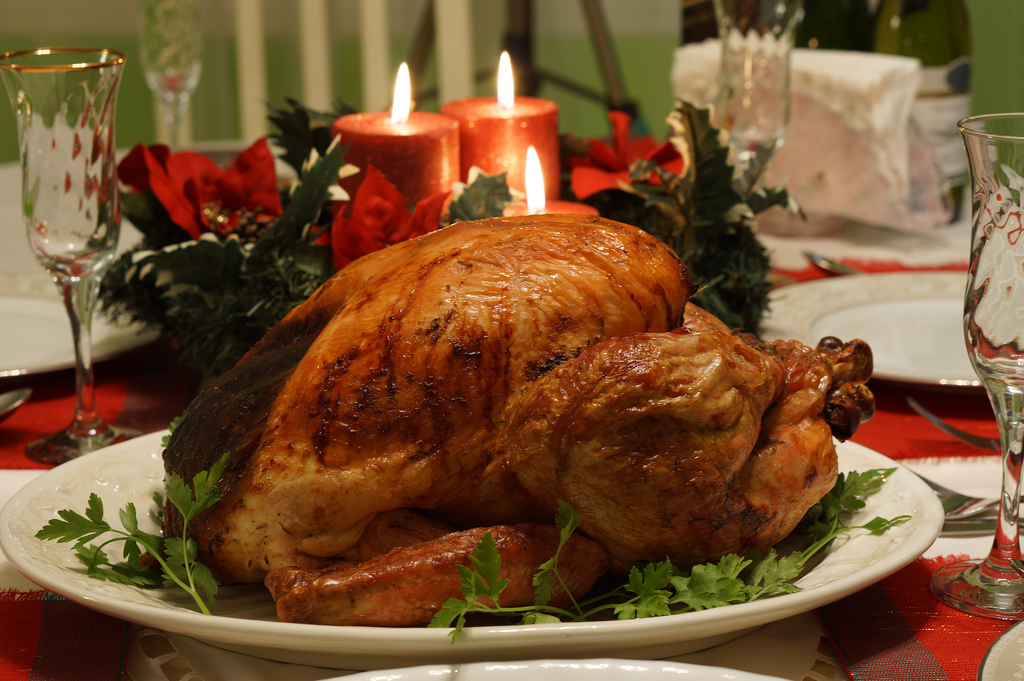
Back in the day of scheduled television specials, one of my childhood favorites was the classic Peanuts Thanksgiving cartoon. Peppermint Patty invites herself and her friend Marcie to Charlie Brown’s home for the holiday dinner. She doesn’t let “Chuck” get a word in edgewise, making him unable to tell her that he was going to his grandmother’s home for Thanksgiving. Charlie Brown ends up “cooking” (with the help of his beagle, Snoopy) the only foods he knows how to make: popcorn and buttered toast. When Patty sees this feast, she exclaims, “Look at this! Is this what you call a Thanksgiving Day dinner? Did we come across town for THIS? We’re supposed to be served a REAL Thanksgiving dinner!” Clearly, she had specific expectations of what foods a Thanksgiving feast required. Charlie Brown actually did provide some of what we associate with that first Thanksgiving feast, celebrated by Separatist Pilgrims and Wampanoag Indians at Plymouth Colony in 1621: corn and bread of some sort. What Patty lamented was the absence of turkey and all the trimmings. Turkey, of course, is the mainstay of Thanksgiving. It’s the trimmings, though, that truly make a Thanksgiving one that deserves the very subjective label of traditional. Much of that reflects regional backgrounds and even generations. Canned or homemade cranberry sauce? Green bean casserole or fresh green beans? Pumpkin pie made with frozen pre-made crust or pastry crust from scratch? Sweet potatoes baked with a marshmallow topping and lots of sugar, or fresh ones mashed with cinnamon? The quintessential trimming, dressing (stuffing if it’s put in the turkey cavity to bake), speaks to regional differences more loudly than anything else. Chestnut-based dressing has an East Coast provenance, while cornbread-based dressing has more Southern roots. Which version one prefers is an expression of family history.
The absence of proper dressing can make or break Thanksgiving. When I was in graduate school in the late 1990’s, I spent one Thanksgiving holiday housesitting for my mentor, a favor that included permission to host some friends for the day. Intent on being a good hostess, I let my guests choose the dressing. They went with chestnut, which I had never eaten, let alone cooked. So, I borrowed a friend’s Williams-Sonoma holiday cookbook and wrote my shopping list. One small problem: the only chestnuts I could find were the water chestnuts in the Asian section of the grocery store! The resulting dish was certainly edible, but it wasn’t the cornbread dressing that I loved. Without it, Thanksgiving dinner wasn’t quite right.
The next year, I found myself cooking Thanksgiving dinner once again, but in much different circumstances. I had been invited to spend the holiday with my boyfriend and his brother’s family in Meridian, Idaho (that boyfriend became my husband the following summer). This was my first introduction to the extended Birzer family, who met me at the airport while Brad drove through a blizzard to get from Helena, Montana to Meridian (a Boise suburb). Brad had warned me that if I wanted a traditional Thanksgiving meal, we would have to cook it ourselves as his Japanese sister-in-law was not familiar with that kind of cooking. I arrived armed with my mom’s recipe for cornbread dressing, but not quite realizing that she had given me the large group version of the recipe. Brad and I did not get the turkey in the oven soon enough either, so his nephew and niece (ages 6 and 4 at the time) declared to their grandmother on the phone that they were starving. These were kids who happily ate sandwiches of Japanese fish egg jelly, which I was instructed to pretend was normal. With this introduction as the person responsible for the “starving time,” I was then given the phone so that I could “meet” Brad’s mom. After that rather nerve-wracking distraction, the turkey was finally ready, as was my first attempt at making cornbread dressing — enough to feed 25 people, it turned out. Post-dinner clean up included directions from Todd to remove ALL of the turkey meat from the carcass, another first for me in that holiday week filled with new experiences and relationships, into which I brought my traditional cornbread dressing.
I don’t recall the family’s reaction to my dressing, perhaps because I was so happy to eat it. Now my own children insist on cornbread dressing at Thanksgiving (actually, they’ve never had any other kind). It’s part of our family’s holiday tradition, though I’ve scaled back the recipe to feed a family rather than a restaurant. More than any other holiday, Thanksgiving revolves around food, and not just any food. The dishes we each associate with this day of gratitude link us to generations of family and to the particular places those generations have lived. The varying regional versions of “turkey and all the trimmings” remind us that this very American holiday unites us in all of our variations of ethnic and regional backgrounds into one grateful people, celebrating the abundance of food and fellowship occasioned by the willingness of American Indians in the Plymouth Colony area to help the newcomers from England survive, a willingness borne of our common humanity.
The editors invite faculty members to contribute to Office Hours, a weekly column dedicated to promoting relationships between staff and students through the giving of advice and stories. Send submissions to the Opinions Editor at kmcghee@hillsdale.
