
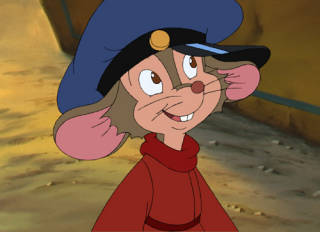
When Steven Spielberg saw “The Secret of NIMH” (1982), Don Bluth’s animated film about tenacious field mice caught in a mental ward, the director loved it so much that he asked Bluth to do it again — only this time starring Jewish émigré mice.
Bluth jumped aboard immediately and, with Spielberg’s collaboration, he spun “An American Tail” (1986), the story of Fievel Mousekewitz, a young Ashkenazi mouse fleeing with his family from northeastern Ukraine to New York City in the 1880s. Fievel runs into a carnival of adventures along the way: a sweatshop in the Flatiron district, Tammany Hall politicians, and a host of Know-Nothing cats attempting to purge Manhattan of all immigrants.
The film was a runaway success and became the highest grossing non-Disney animated film at the time of its release. Its popularity spawned a theatrical sequel, “An American Tail: Fievel Goes West,” (a lesser film in every respect save one: It contains Jimmy Stewart’s final performance before his death). A horde of direct-to-DVD sequels followed, as well as a TV show and, eventually, a PlayStation 2 game.
Fievel’s success led Spielberg to create Amblimation, a production company designed to rival Disney’s dominance over animation. The effort did not last long. After “An American Tail,” Amblimation only produced two more movies, “We’re Back! A Dinosaur’s Story” (1993) and “Balto” (1995), both of which underperformed at the box office. The release of Pixar’s “Toy Story” in the same month as “Balto” was especially disastrous — and spelled out doom for Amblimation.
But Spielberg and Bluth’s ambition in “An American Tail” still shines through the former studio’s wreckage. It’s the only children’s movie I know of that gets away with a violent pogrom in the opening scene. And it’s one of the few films where the violent conclusion—a feline slaughterfest at the hands of “The Giant Mouse of Minsk,” a steampunk golem—is fun for the whole family.
“An American Tail” succeeds because Bluth’s animation fit Spielberg’s desire for the simultaneous horror and humor unique to Jewish storytelling. And for Spielberg, the film was a personal statement, too: Fievel takes his name from Spielberg’s own émigré grandfather.
It’s no wonder Spielberg later picked Fievel as the logo for Amblimation. The company may have collapsed, but the ragged Jewish mouse still stands in proud opposition to Disney’s squeaky clean Mickey.
