
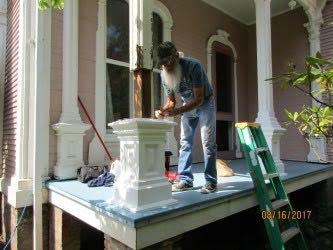

Austin Gergens | Collegian.
More than a century after one of the original residents scribbled his name and the year “1883” onto one of the attic walls, Robert Eden is leaving his own mark on the Victorian-era residence.
Four different homeowners have resided in the house since it was first built in 1880, entirely by hand. Eden, a Hillsdale professor of politics emeritus, has lived in the house for 31 years and is currently in the process of restoring it. He plans to move to North Carolina once the work is finished.
The restoration process began as a solo mission, with Eden personally designing and building a soft maple frame for the kitchen cabinets and then purchasing the doors. He added a homely touch by making a wooden sliding ladder with a food basket on top. The ladder fits inside the cabinet doors and allows one to snag hard to reach snacks. In the early years, he brought up several oak doors from the basement and reinstalled them in a few of the door frames.
“My largest personal contribution was the brick style shed I built with my son in 2005,” Eden said.
In the spring of last year, the project became a team effort when Eden enlisted the expertise of carpenter John Luttenton and landscaper Cindy Riddle. Luttenton and his team of two have taken great care to preserve as many of the original parts of the house as they can, while concurrently restoring parts that have aged poorly.
Luttenton’s contributions to the project come after 45 years in the carpentry business, building, repairing, and finishing houses.
“I’ve seen houses 25 years old that don’t look anywhere as good as this old house,” Luttenton said. “Old homes should be preserved and not torn down as so many are these days.”
Eden’s house lacks some of the conventional interior structure of a modern home. In earlier times, families would store most of their possessions in the attic, so the closet storage space in Eden’s home is much smaller than in homes today. The house also lacks a mudroom, so Eden converted the kitchen to a mudroom and pantry, since it was difficult not having a space to shed or grab layers during the ever-changing Michigan weather.
The team of handymen mostly did finish work on the house with some additional electrical work in the interior. Finish work is the last stage of work on a house and is meant to remain visible, requiring an enormous amount of patience and attention to detail. Replacing bases, columns, lap boards, and the porches around the house are a few of their major accomplishments.
Luttenton lamented how often carpenters take shortcuts on finish work, resulting in wasted time and materials. A single base for a column consists of 62 unique pieces, according to Luttenton, and while some of the bases were salvageable, others had to be partially or fully recreated.
The bases that needed fixing were recreated incorporating useable original base pieces.
These parts were combined with new wood, of the same type, to create a stronger base.
Eden said he is grateful for Luttenton and Riddle’s commitment to doing work the right way.
“It’s a real pleasure to work with them,” Eden said. “As a writer and fellow craftsman, I appreciate people who take their work seriously.”
A pair of oak columns on the second story was the most ambitious task the workers faced in the whole project. With the aid of Hillsdale’s A Few Good Men club, the men were able to put the new columns into place.
“Nick Scovil and I pushed the posts up a ladder while a carpenter pulled it up with a rope,” senior Andrew Sheard said.
The exterior of the house presented even more challenges. During the Victorian era, there was virtually no insulation, and moisture would pass freely in and out of the walls. This cycle caused paint to lift as water exited the home, and it was hard to tell when the house needed new paint. Modern Victorian homeowners often wrap their house in vinyl for as a cheaper way to provide aesthetics and protection. But vinyl doesn’t allow the house to pass moisture through it, trapping it inside the house and leading to rot and potential bug infestation.
“You never want to wrap an old house because it will rot from the inside out,” Eden said.
Luttenton said that after months and months of work, he is excited to see the final product.
“When people walk up and say ‘wow,’ I know that we’ve done good work,” Luttenton said, “It’s neat to see the house come back to life.”
