
German Department Chair Eberhard Geyer began instructing at Hillsdale College, the department and the students studying the language have more than tripled in size. But what most students have found makes studying the language so appealing are the ways in which the students, professors, and honorary bring German culture to life on campus.
“There are students here on campus whom I have never spoken English to,” Associate Professor of German Fred Yaniga said. “Sometimes I’ll meet students and they’ll be with a significant other, or family member who doesn’t speak German and we’ll speak English, and we’ll stop and look at each other in the middle of the conversation and say, ‘This is the first time we’ve ever spoken English together. How strange.’”
Assistant Professor of German Stephen Naumann said though sometimes it’s necessary to break into English, he always gives students, even those just beginning to study the language, a chance to use German first.
This persistence of professors to bring out the best in students lends to the department its vibrant legacy. Geyer, who has taught German at the college since 1985, described how the program, particularly the number of students majoring or minoring in the language, has expanded over the years.
“When I came here there were some 30 students taking German [for a major or minor], and I was the only instructor, and now we have over 100 enrolled, and we have three German professors,” Geyer said. He attributed this growth to “dedicated teaching, viable in-house overseas programs, and vibrant extracurricular activities,” as well as the generosity of the college.
Though some students are more involved than others, between large weekly German lunches in the dining hall, a new film series each semester hosted by the professors, and festivals and food-centered gatherings put on by the Delta Phi Alpha German honorary, the department boasts a lively and active membership.
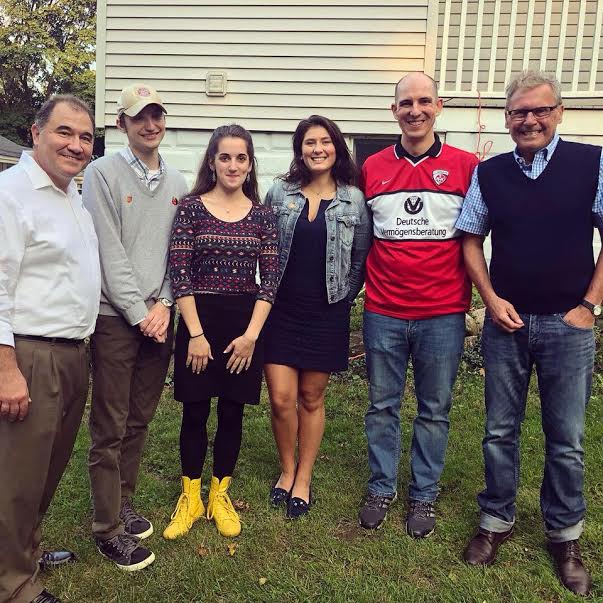
Last month, Naumann, Yaniga, and Geyer hosted a swath of 50 students for their yearly Oktoberfest cookout in Naumann’s backyard.
“Yaniga gets some homemade brats from the local butcher, we roast them and we cook them Wisconsin-style in beer and onions on the stove, and then we have red cabbage and some other nice delicacies,” Naumann said. “We get pretzels from our bakery, and some beverages, and just kind of enjoy a few hours of conversation. Who doesn’t love to be outside for a couple hours on a Sunday afternoon in October?”
Oktoberfest, which Naumann has hosted since he began teaching at the college in 2012, also involves an initiation ceremony for the new members of the German honorary. The honorary organizes several other cultural activities each semester, including an annual cookout at Baw Beese Lake, called “Grillen Abend,” or “evening grill,” according to Delta Phi Alpha President Peter Partoll, a junior. Professors also host students at their houses for meals, and take students every year to the Christkindlmarket, or Christmas market, in Chicago.
“Most of all, it’s the spirit of what the Germans call Gemütlichkeit, a super long German word which just means ‘coziness,’” Yaniga explained. “Germans tend to need a party to create that, and they’re experts at creating that Gemütlichkeit atmosphere with festivals.”
It’s this feeling of Gemütlichkeit, among other things, that has endeared so many students to the department. Partoll, who took his first German class at Hillsdale his freshman year, is now a German major, in addition to leading the honorary.
Partoll explained that he was not planning on studying German in college until he visited Hillsdale. A few weeks into his freshman year, while taking an intro class, Naumann encouraged Partoll to move up to the German 102 class. Though Partoll decided not to advance until after the first semester, he was able to skip the intermediate class, and is now majoring in German.
“At the time I was a little nervous, but now I’m very grateful that both Naumann and Yaniga made me take that placement test,” Partoll said.
Geyer said his “baby,” the Würzburg study abroad program which he initiated in 1986, has become a very popular feature of the department, in addition to the Saarland University exchange program, which was started in 1996.
“The good thing about either program is we don’t outsource,” he explained. “We have our own in-house overseas programs, both for the summer and for the semester. If you have a scholarship, that applies for the semester in Germany, which again, makes this program, compared to other programs in America, very affordable.”
But for many German students at Hillsdale, it’s the weekly “Stammtisch” lunches in the dining hall that are the real staple. Every Friday, from 12 p.m. to 1:30 p.m., professors from all across campus dine with 20-25 students of varying levels of ability, all speaking German.
“Today we were making plans for an April 1 joke that we want to plan, and talking about movies that we saw over the course of the week,” Yaniga said, smiling. “It can be very casual, sometimes it can be academic. But we were also talking about politics at the table, with the elections coming up in Bavaria. And we’re doing all that in German. It’s not always perfect German, sometimes we’re filling in a lot of vocabulary, sometimes we’re speaking a little bit of pigeon language, but because we have a lot of very good native speakers and near native speakers, we always have a lot of people who can guide the students in conversation.”
Naumann said joining the table “takes some courage,” but he always pushes first year students to go at the end of their first week, and introduce themselves to three people.
“It’s a challenge, but it’s also fun, and it’s something they can see themselves improving in as the weeks go by, and we’re doing this together. And then, there you are at Stammtisch, discussing contemporary politics,” he said. “It gives students a chance to own the language that they’re working so hard to learn.”
The Friday lunches, which are attended by approximately 20-25 students and faculty each week, have attracted German speakers from all across campus, including English, music, and history professors who know the language. Timo Blasius, who is visiting campus for the semester from Saarland, Germany as a part of the exchange program, said he attends Stammtisch every Friday.
“It’s good to speak German once a week,” Blasius said. “It’s a good experience for them to hear a real German, without an accent maybe, because even though Dr. Yaniga and Dr. Naumann speak very very very well, they still have an accent. You hear it as a native speaker, since it’s not their first language. I think it’s good for students to here a real German speaking.”
Blasius said the students do a good job with the language, though many prefer to simply listen to his German.
“Mostly it’s that when I’m coming, everyone wants to hear me speaking German,” Blasius said, laughing. “In most cases I just talk to Dr. Yaniga and Dr. Naumann, but sometimes to other students as well.”
Though at the end of the day the German students are still American, Blasius expressed affection for the college’s efforts to bring a real taste of German culture to campus.
“It would be the same if we play American football in Germany, which is copying it, but it is nice to have,” Blasius said. “I enjoy it, being around people who like the same things as I do.”
Yaniga called this marriage of culture and classroom essential to the learning process.
“Learning happens in community, learning doesn’t happen in isolation,” Yaniga said. “But sometimes the classroom isn’t the only place to build community, so we try to extend that.”
