
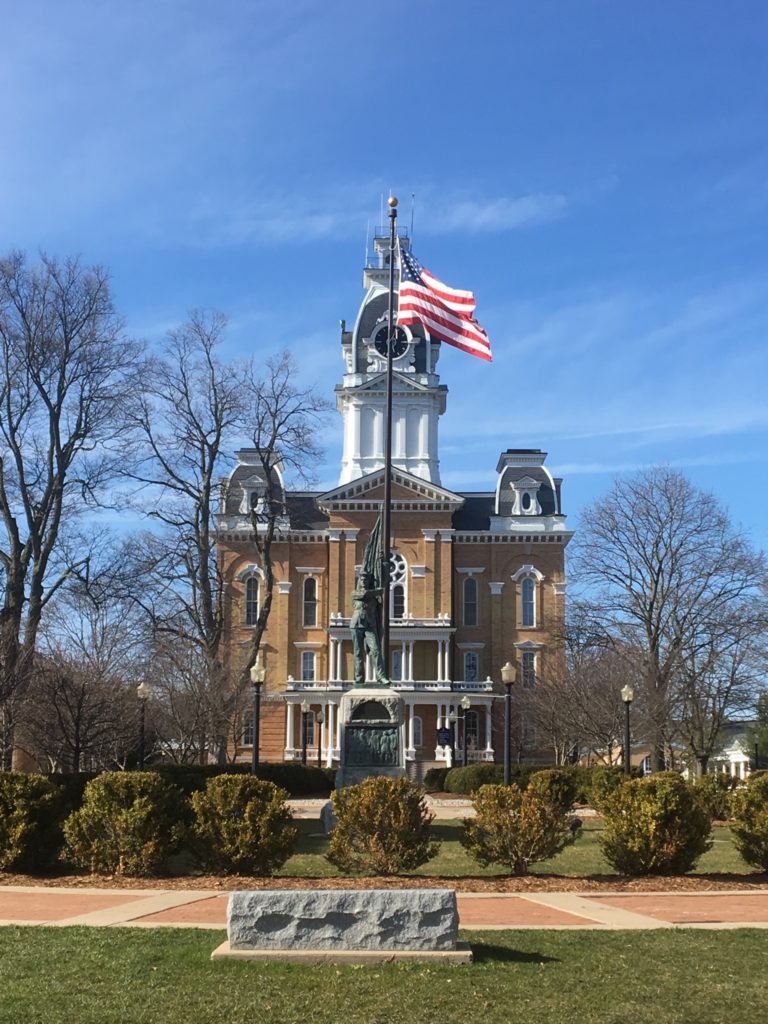
Despite its selective admittance rate and academic rigor, Hillsdale College was excluded from the Wall Street Journal’s annual college rankings because it “does not participate in the federal student aid program,” according to the Journal’s senior director of communications Steve Severinghaus.
The Journal ranked nearly 1,000 U.S. universities and private colleges in a report published last week, but only considered those schools that report certain data to the Department of Education. This methodology differs from other publications, like the U.S. News and World Report and Princeton Review — both of which reach out to individual schools not in the database for information. As a result, Hillsdale is included in the U.S. News’ Best Colleges list released this week — ranking 76th among national liberal arts colleges — but doesn’t appear in the Journal’s.
Hillsdale does not accept federal funds and is thus not required to submit information about students’ race, ethnicities, and genders to the Department of Education. It is also not tied to Title IV guidelines, which determine federal financial aid — a factor the Journal requires for a four-year school to be considered. Hillsdale College President Larry Arnn said this policy has “worked well” for the college and has been in place for 60 years.
“It is the reason we are able to recruit, admit, and teach as if everyone who comes here is a student, an individual, a free person, and not a representative of a group,” he said in an email.
Even if Hillsdale sent data not readily available via the Education Department directly to the Journal, Director of Institutional Research George Allen said the Journal would still not consider Hillsdale “because non-Title IV schools are ineligible to appear in their rankings.”
Provost David Whalen called this methodology “clumsy.”
“Hillsdale merits inclusion because of the obvious strength of the education here,” he said in an email.
Allen said the Journal also requires information Hillsdale could not provide, like federal loan repayment rates and the ethnic profiles of its students and faculty. Until this methodology changes, he said, Hillsdale will not appear in the Journal’s ranking, though Severinghaus said the Journal “hopes to include Hillsdale in the future.”
Unlike the Journal, U.S. News and Princeton Review do not request information that would compromise the mission of the college. Allen said the data other college information services request is “wide-ranging,” and includes information on “admissions, academics, athletics, extracurriculars, faculty, facilities, finances, financial aid, graduates, students, and staff.”
Professor of History Paul Rahe said the Journal’s exclusion of Hillsdale was not done out of “malice,” but rather, out of “slovenliness.”
“The answer is laziness,” he said. “It’s a common enough human fault.”
Rahe, who wrote about the Journal rankings in a recent article for Ricochet, said Hillsdale’s freshman class is in the 95th percentile, placing the college “a cut below” the University of Michigan.
Hillsdale’s class of 2022 boasts an average ACT score of 30.16 and an average 3.89 GPA, compared to University of Michigan’s freshman class, which had an average ACT score of 31 and an average 3.80 GPA, according to its admissions page.
Whalen said Hillsdale competes against many of the Journal’s top schools, like Harvard University, the Massachusetts Institute of Technology, and Yale University, in terms of “cross apps,” meaning students often apply to both Hillsdale and high-ranking Ivy League schools. Hillsdale even swipes the occasional student away from these schools, Rahe said.
Rahe, who previously taught at Yale, said Hillsdale’s academic rigor is easily comparable to that of schools like Harvard and Yale. The only “real difference” he said he’s noticed is Hillsdale students’ tendency to shy away from being “intellectually aggressive.” When compared to students at high-ranking schools, Rahe said Hillsdale students “don’t think enough for themselves.”
“They don’t know how good they are,” he said.
But even that, he said, is changing.
“My freshmen this year have been quite aggressive,” he said. “They’re asking questions and pushing back. My sense is we’re getting there.”
And after four years of a rigorous liberal arts education, Rahe added, Hillsdale students are well prepared to compete against graduates from the Journal’s top schools.
“We do an astonishingly good job educating our students,” he said. “And they should think big.”
