
Across the country, college administrations and students are fighting battles against sexual assault, binge drinking, and gender inclusion.
Its target? The Greek system.
These single-sex organizations are plastered all over the media with stereotypes including raging parties, extreme hazing, and elitist exclusivity. The Greek system appears to cultivate secret societies revolving primarily around social functions, causing problems on campus rather than serving the community.
In August, Harvard University forced their last-standing sorority to close because of a rule that prohibited members of single-sex organizations from holding leadership positions throughout campus. Earlier this month, Monmouth University in New Jersey banned all sorority and fraternities indefinitely because of violations of conduct. The college’s administration cited incidents of hazing, alcohol, drug use, and “lack of academic focus” as reasons to shut down the Greek system.
Non-Greeks see Greek life as a danger; Greeks see their system in danger.
While the Greek system is broken and falling apart in many places across the country, the foundations on which these organizations were established still remain strong today, ensuring the possibility for chapters to return to the noble beliefs on which many of these groups were founded.
When executed properly, young adults can thrive and grow within Greek houses, being challenged by valuable lessons to better themselves and learn from their mistakes, as well as the mistakes of others.
Historically, Greek houses were built on virtuous grounds, seeking community and cultivating a spirit of service among one another and in the greater community. Phi Beta Kappa was founded in 1776 at the College of William and Mary as a secret honor society, the first of its kind to use Greek letters to form its name. Its goals in forming were to encourage excellence in both liberal arts and the sciences. Today, it’s considered one of the most prestigious honoraries.
In 1825, Kappa Alpha formed at Union college, based off of a similar set of ideals as Phi Beta Kappa. Kappa Alpha, however, focused on a creating a community with high ethical and social values. The members wore badges and participated in initiation ceremonies.
Today, things are the same.
Joining Greek communities ties members to a long history of strong ideals — building community, cultivating character, and enabling change within the community.
It’s an investment and can be a life-long commitment. Most Greek organizations rely on a strong alumni base of advisors that guide active members through running the organization. The saying that “sisterhood” is for a lifetime is often not just a slogan, but a reality.
Recently, an alumna of my sorority experienced the sudden death of her husband while she was eight months pregnant. It was her sisters who gathered together to provide whatever they could. As an advisor was sharing this story with my chapter, she said, “It’s your sisters who are the ones by your sides at the funerals.”
Character growth is at its core. Fraternities and sororities are run by large national organizations with regulations to protect its members, the chapters themselves, and the institutions which which they are affiliated. Each individual group has standards that members must fulfill for membership. Chapters are held accountable in various ways — and national panhellenic and interfraternity groups have rallied together to fight issues such as hazing.
According to ABC News, the North American Interfraternity Conference is working alongside the National Panhellenic Conference to speak with thousands of students about the dangers of hazing, most notably alongside parents such as Evelyn and Jim Piazza, whose 19-year-old son, Timothy, was a victim of hazing and died in his fraternity house, Beta Theta Pi.
Even after experiencing the tragic death of their son, both Evelyn and Jim are not trying to abolish the Greek System. They’re fighting for reform and increased legislation.
“We believe through the interactions that we’ve had that there’s a real sincerity to make a difference,” Jim Piazza said on Good Morning America.
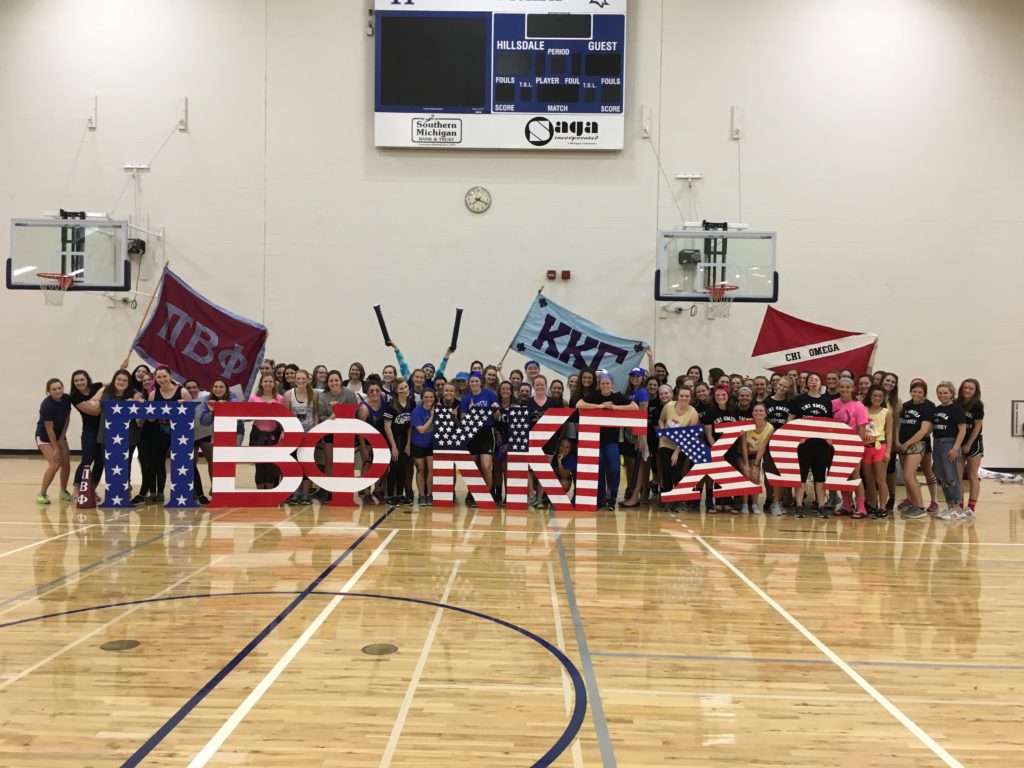
Greek systems at Hillsdale College have encouraged support by nurturing the school community. Hillsdale’s Greek members are one of the strongest supports to the college post graduation. On the Hillsdale College Alumni Executive Board, each of its four members were members of Greek organizations while at Hillsdale. Of the other alumni board members, 67 percent were Greek. Of alumni and students who contributed financially to the college in the 2017-2018 fiscal year, 56 percent had a Greek affiliation while attending the college.
My experience in Greek life has been positive. Our rituals are meaningful and impacting — they guide my actions and unite me to the generations of sisters that have come before me. I encounter a strong support system and am consistent encouraged to better myself daily. I am forever grateful for the chance to “Go Greek.”
Josephine von Dohlen is a senior studying American Studies and the president of Chi Omega.
