
When Devaun Chandler was sold into human trafficking by her own mother to her brother-in-law, at the age of 13, she did not realize she was a slave. She had already been sexually violated prior to this point.
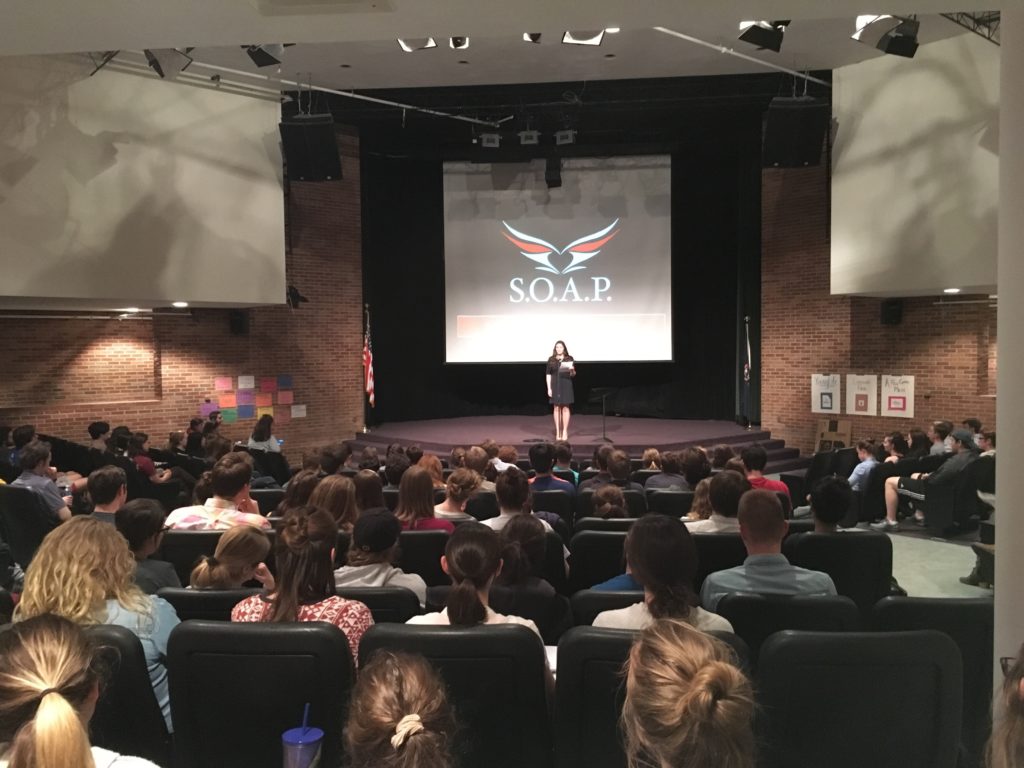
On Thursday evening, InterVarsity Christian Fellowship brought Chandler, a survivor of human trafficking and vice president of the metro Detroit division of Save Our Adolescents from Prostitution, to speak to students about how to fight human trafficking. Before a full audience at Phillips Auditorium, Chandler shared her survival story.
Senior Elizabeth Garner, who coordinated the event in collaboration with InterVarsity, said the group almost had to cancel the event when the original speaker, S.O.A.P. founder Theresa Flores, was unable to come due to sickness that morning. Fortunately, InterVarsity was able to contact Chandler, who spoke in her place.
“It really was a miracle that we were able to find a survivor who was also a Christian, heavily involved with the S.O.A.P. outreach, and available at such short notice,” Garner said.
Chandler shared her personal story, explaining how she did not understand what was happening to her while enslaved between the ages of 13 and 16.
“I thought it was my choice, because I did it and my brother-in-law did not have to hit me to get me to do it,” Chandler said. “I did not know I was a slave.”
Chandler explained traffickers play on emotional vulnerability, which is why an average 50 percent of human trafficking victims are children, since they are more emotionally insecure.
“They use a lack of knowledge of your own value to use you,” Chandler said. “I didn’t know I had value, so I thought I owed something to them.”
Freshman Danielle Lee, who attended the event, said she was surprised to discover human trafficking victims could be so young.
“I always thought it was just older women,” Lee said. “But when I heard that children were a main target, it showed me that human trafficking can mess with people’s minds at such a young age, causing them to grow up with damaging effects.”
Most girls and boys in human trafficking will not try to escape, Chandler said, because they do not think there are other options, and their enslavers have convinced them no one else will love them. Often, victims think the lifestyle they are forced to submit to is their own fault, she added.
According to Chandler, this psychological slavery is also the most difficult aspect of human trafficking to overcome. She said even today if she saw her brother-in-law, she would feel she owed something to him, because that habit was ingrained in her mind at such an early age.
“It’s not an easy fix,” she said, “It’s a long process of healing.”
It was not until after attending a S.O.A.P. event that Chandler decided to start speaking about her slavery to try to help other girls. S.O.A.P. works by leaving bars of soap, labelled with the national human trafficking hotline number, in one of the greatest hotspots for human trafficking today: hotel rooms.
On Saturday, following Thursday’s event, students drove to hotels in Jackson and Coldwater to deliver soap bars and inform hotel workers.
Freshman Keely Rendle, one of the 22 volunteers, said volunteers also shared signs of trafficking while delivering the soap to help hotel employees be more aware.
“If a girl comes in and she’s not appropriately dressed, or has no baggage, something’s not right,” Rendle said.
Garner said employees not far from Hillsdale witnessed trafficking in their own hotels.
“They’ll see a young girl with a much older man getting a room, and then multiple cars coming through. It’s obvious what’s happening,” Garner said.
Though employees have called the cops, the girl often does not escape, due to other threats behind the scenes.
“Really the best option would be for the victims to find the soap, during their only moment alone when they’re cleaning up in the bathroom, and be able to call the human trafficking hotline,” Garner said. “Because those people know how to handle these situations, and they can do a type of undercover mission to rescue the girls.”
Because of the huge financial success of the industry, human trafficking continues to take an average of 300,000 victims around the globe each year, a large percentage of whom are never found, Chandler said.
“There’s a huge demand for it,” Garner said, “which means that it’s going to continue to happen way more often than we realize or would like to think.”
Rendle remains hopeful, however.
“The odds aren’t really great, so you can kind of look at it hopelessly. But God can work through the tiny things, which is comforting. We did our part and delivered the soap; now we just need to pray that God will use that,” Rendle said.
Chandler emphasised the importance of taking action.
“Be smart. Trusting your gut is a huge thing. I was taken to a Lover’s Lane at 14, with my brother-in-law,” Chandler said. “When the woman working asked me if I was okay, I told her to leave me alone. But if she had called the police, that would have been an actual step that would have made me realize something was wrong. So don’t hesitate.”
