
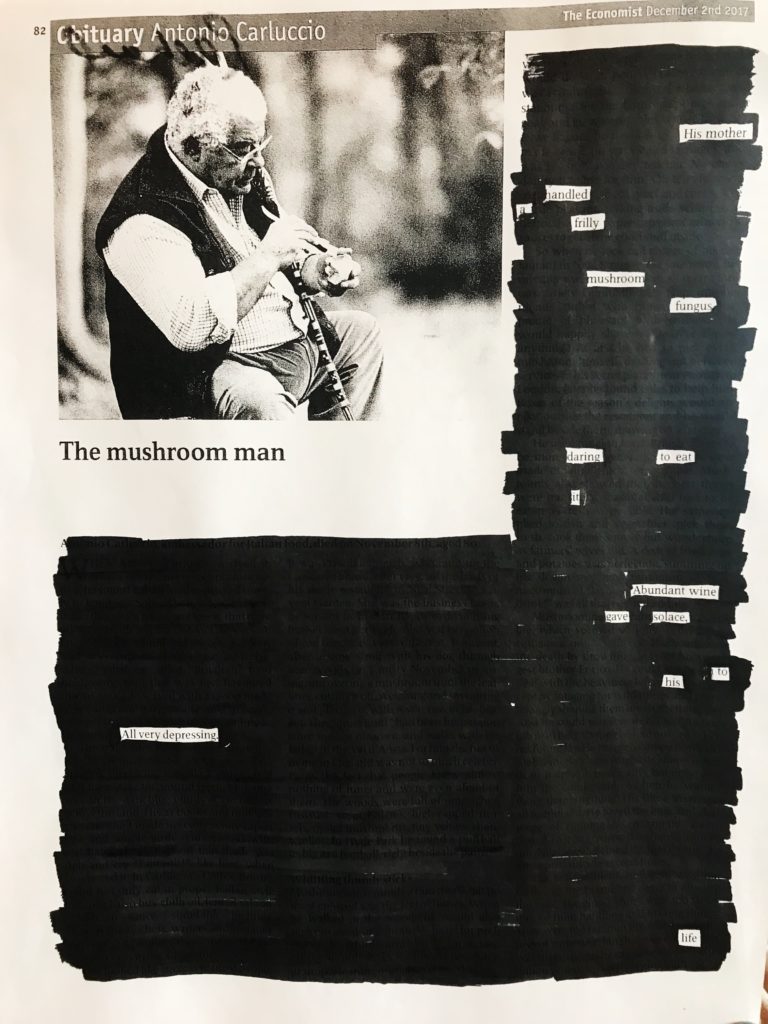
Scrolling through Twitter in the middle of January, Joseph Garnjobst, professor of classics, encountered blackout poetry — a form of poetry composed by selecting words on a page from a book or printed article and blacking out all the extra words, creating a poem. The next day, he picked up an old newspaper sitting on his desk and began to arrange his own poem.
Three months later, he still writes one every day.
“I could never have written any of the poems I have found, and yet working within the structures of somebody else’s words, somebody else’s letters, somebody else’s syntax, somebody else’s ideas, I am able to find ideas that are unique,” Garnjobst said.
Alpha Rho Tau, the art honorary, hosted a blackout poetry event on Tuesday at Rough Draft, providing magazine articles and black markers for those in attendance to arrange their own poems.
“It’s a cool mix of visual and literary art,” senior Rachael Reynolds, president of ART, said. “You make the choices both in space and in word choice.”
Reynolds said the inspiration for the event came from Garnjobst, who reached out to her with the idea of hosting an event for students.
“He asked me to get ahold of Professor Bushey and see if she would judge, so I did,” Reynolds said. “And five minutes later we had a plan. It was very spur of the moment.”
When Garnjobst first heard of blackout poetry, he said it was pitched as an exercise in creativity.
“I think it’s a good exercise that anybody can do, so I wanted to show how accessible it was,” Garnjobst said.
Participants in attendance at the blackout poetry event had their pieces of poetry judged by both Garnjobst and Professor of Art Barbara Bushey. Winners were recognized in five categories: best voice, best narrative, best use of language, best imagery, and best in show.
“Judging was very hard,” Garnjobst said. “Some of these were rookie seasons — they were made in voyage — they were hilarious, some of them were a little heartbreaking, some were sad — a lot of emotions were found within them all. Just as a creative exercise, for me it was wonderfully successful.”
After all the poems were turned in to be judged, Garnjobst and Bushey read them aloud to those in attendance, which Bushey said was her favorite part of the evening.
“I love the randomness of the medium, and thus the links to dada and surrealism,” Bushey said in an email. “It’s a lot of fun, and restrictions sometimes are just what is needed to foster creativity.”
Garnjobst said he thought everyone had a good time creating the poems.
Katie Sorensen, who won the award for best voice, said in an email this was the first time she tried blackout poetry, and that she had heard of Garnjobst’s work and wanted to learn from him, since she knew he had experience.
“My winning poem, blacked out from the obituary of a Gullah woman in South Carolina, was ultimately an entreaty to shun nonsense, but preserve hope,” she said. “I think its bleak tone stood out to the judges.”
Gianna Marchese ’17, winner of the best in show category, said in an email that her final poem was part of a longer poem she had constructed throughout the night, and ripped it in half before turning it in, thinking it might be funny.
“I try and go for short and funny rather than long and poetic — super not my style,” she said.
Her favorite part of the evening, like Bushey, was listening to everyone else’s poems.
“I think the idea of blackout poetry is really great and such a cool exercise to get people out of their own heads,” Marchese said. “As a Hillsdale student, I can say that we can easily get caught up in overthinking things and with blackout poetry, it really restricts that overthinking — or at least limits it. There’s only so much you can do with the words that someone else has already generated for you and it’s up to you to craft them into something more.”
Sophomore Timothy Green won the award for best imagery. He first encountered the poetry method from Garnjobst, who had him try a poem a few weeks ago on the spot.
“Blackout poetry is less about writing and more about creating,” Green said in an email. “You have an article from some source and a unique poem rises out of it as you work. It exercises a part of the brain you wouldn’t usually use, which makes it a lot of fun. Plus, you feel like you’ve created a personal masterpiece when you finish.”
Green said his poem was about confidence and the importance of being sure of yourself.
“I used the image of a motorboat revving up to speed,” Green said. He created the word “vroom” using letters scattered throughout the article, which Garnjobst liked.
Reynolds won for best narrative.
“He gave us all obituaries – the first one I picked up was of an Italian man referred to as ‘the mushroom man’,” Reynolds said. “So naturally I tied mushrooms to wine and it got dark.”
Senior Patrick Lucas’s poem won for best use of language.
Garnjobst will teach a Collegiate Scholars seminar in the fall titled, “Blackout Poetry.” He hopes to have about a dozen students write blackout poetry daily, as well as read several pieces each class.
“I thought as a creative exercise for me, if it’s going to work for me, it can work for students,” Garnjobst said. “It’s also something that anyone can do, and last night’s gathering was an example of that.”
Each day, after Garnjobst writes his daily poem, he sends it out to friends, family, and students — totaling around 150 people. He says the practice has made him notice things a little bit more.
“If you were to put a black piece of paper in front of me, and say, ‘Write a poem,’ I would be very hard-pressed to do so,” Garnjobst said. “However, looking at someone else’s words, it is possible to find some things and make some sense out of that.”
Editor’s note: Interested in trying blackout poetry? You can try with this piece right now. Grab a pencil and a marker and begin by circling in pencil words to make a poem. Blackout with marker all the words you don’t use. Share your poems with @HDaleCollegian on Twitter or Instagram.
