
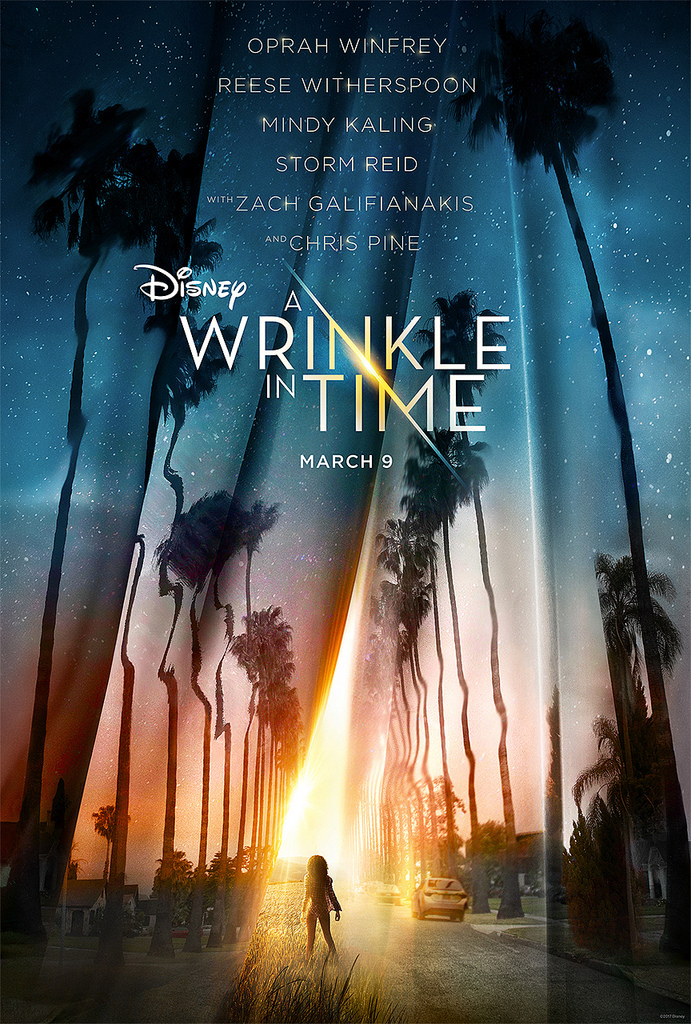
“A Wrinkle in Time,” it seems, is meant to be a book — and nothing more than that.
Last month I warned fans in a Collegian review of Madeleine L’Engle’s novel “A Wrinkle in Time” that Disney’s movie adaptation would disappoint if it departed from the foundations of the book and swapped a story for a soapbox. When “Wrinkle” director Ava DuVernay’s film premiered March 9, the movie proved me right. All its razzle dazzle couldn’t compensate for the weak plot, underdeveloped themes, and severe didacticism that replaced the thrilling tale and powerful themes of the book.
I don’t always find it helpful to assess a movie by comparing it to the novel or play or work that inspired it. But DuVernay’s “Wrinkle” didn’t just deviate from L’Engle’s book. It totally defiled it. DuVernay rushed L’Engle’s clear but dense plotline, skimping on important scenes to incorporate pointless montages that showed off pretty visuals. The Christian themes upon which L’Engle built her novel were scrubbed from the film and replaced with empty sermons on self-love and self-confidence. Oprah Winfrey’s character, a celestial guardian, literally hangs in the sky as a shimmering, larger-than-life hologram as she tells the story’s heroine to stop doubting herself.
The book, a staple in the canon of eighth and ninth grade literature, so often delights the adolescent students who make up the majority of its audience. And the story remains generally intact on the silver screen: A self-conscious middle school girl, Meg Murry mourns her father, who disappeared four years ago when he tessered (traveled through time and space to another world) and never returned. In her grief, Meg turns to belligerent behavior, and only her little brother, Charles Wallace Murry, can comfort her. Meg and Charles Wallace stumble into adventure with their friend Calvin after they meet the “Mrs.” — a group of celestial beings named Mrs. Which (Oprah), Mrs. Who (Mindy Kaling), and Mrs. Whatsit (Reese Witherspoon). The children and their guardians set out to rescue Meg and Charles Wallace’s father and defeat a being of supreme evil along the way.
The plot suffered in the movie, however, because DuVernay focused so heavily on her special effects. The movie raced through scenes that needed to establish the story. The audience was left wondering why, for example, Dr. Murry (Chris Pine) left his family for an experimental and potentially fatal leap into another universe when he seemed to adore his wife and children. DuVernay left out L’Engle’s legwork, which explained that Dr. Murry and his wife decided he could embark on the government-led project, despite the risks.
The movie also failed to address Charles Wallace’s intelligence. Actor Deric McCabe stumbled through Charles Wallace’s lines, which were far too complicated for a child actor. With such a performance, Charles Wallace came off as an incredibly obnoxious know-it-all, rather than a sweet boy genius. When IT, the aforementioned being of supreme evil, possessed Charles Wallace, his suffering generated little sympathy, nor did it suffice to explain why Meg unleashed bravery unknown even to herself to save her little brother.
Because DuVernay nixed the novel’s Christian elements, she couldn’t incorporate the novel’s dominant theme of self-sacrificial love. She instead pushed a message of self-love, which, of course, isn’t necessarily wrong. It just doesn’t make for a good story, especially since DuVernay didn’t sell the theme well. L’Engle carefully pieced together the idea of self-sacrifice before the motif exploded into the essence of the book at the plot’s climax. She threaded Bible verses into the speech of several of her characters — Mrs. Whatsit even recited Isaiah 42:10-12: “Sing unto the Lord a new song, and his praise from the end of the earth, ye that go down to the sea, and all that is therein; the isles, and the inhabitants thereof. Let the wilderness and the cities thereof lift up their voice…let the inhabitants of the rock sing, let them shout from the top of the mountains. Let them give glory unto the Lord.”
It’s no surprise, then, that Meg realizes she can rescue Charles Wallace from IT’s grasp by sacrificing her own life to secure his.
DuVernay’s version isn’t as seamless. Meg struggles with self-doubt, the Mrs. teach her about self-confidence, and she then saves Charles Wallace because she believes in herself. Exactly how she manages to defeat the universe’s origin of evil (which had dominated an entire planet and inspired every bad thing that had ever happened on planet earth) is not addressed. Meg simply enters IT, somehow extracts Charles Wallace from his possessed state, and returns with him to the Murry’s backyard moments later.
This poor presentation is perhaps why the movie’s major themes feel like didacticism. While L’Engle brilliantly conjured her book’s raison d’etre from thoughtfully sequenced groundwork, DuVernay blasted her solution of self-love over and over and over. The Mrs. chastise poor Meg, crippled by an awkwardness inherent to her age, when she can’t believe in herself enough to perform the tasks she needs to do. Without this self-love, she couldn’t tesser or see into the future. But after enough pep talks from DuVernay’s favorite celebrities, she shone with confidence.
It’s not a surprise that L’Engle’s Christianity didn’t make the final cut of “A Wrinkle in Time.” It is disappointing, however, that DuVernay had to butcher the story to make a movie that burst with stunning visuals, plot holes, and didacticism.
Here’s some good news, though. Filmmakers have tried many times to make movie worthy of “A Wrinkle in Time.” They might try again. And hopefully, they’ll learn from DuVernay’s mistakes.
