
Courtesy | Sarah Strubing
Twenty-four million people in the U.S. alone struggle with an eating disorder, showing that often eating disorders may go unseen in neighbors, friends, and family. Annie Giupponi, a counselor at the Ambler Health and Wellness Center, shared this statistic at a Lighthouse event on Thursday night. Because of her professional experience working with college students with eating disorders, she, as well as two students, provided valuable advice at the club’s first event of the semester.
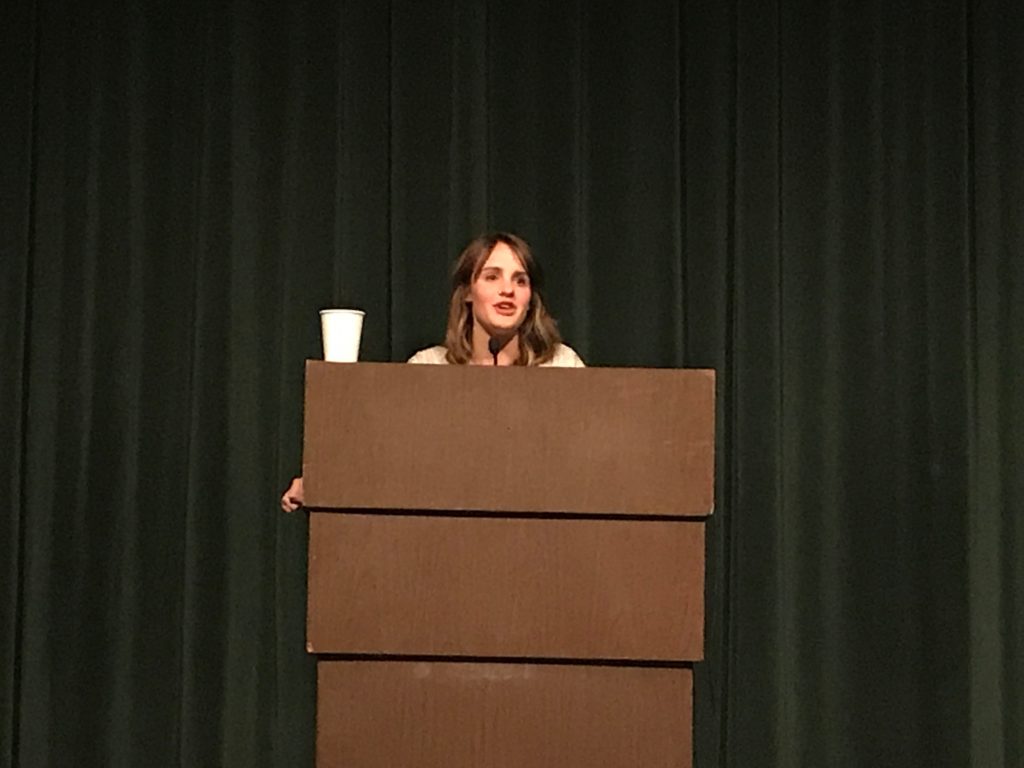
President of Lighthouse and senior Taylor Hannel started the night by sharing the story of her own struggle with an eating disorder and her path to recovery to a crowd of about 75.
Hannel revealed about three years ago she sat in the same seat as those in the audience, listening to a similar talk about eating disorders sponsored by Lighthouse. She admitted even as she sat in the audience years ago, she denied she was having significant troubles.
“I thought, ‘I didn’t have a problem; I don’t have a story worth sharing,’” Hannel said.
She started seeking counseling from the health center when she first transferred to Hillsdale three and a half years ago. She said it wasn’t easy, and it took many visits to start talking about her anxiety and depression and even longer to open up about the abnormal behaviors she was noticing about herself.
Hannel elaborated on the everyday anxieties caused by her eating disorder, from getting dressed in the morning, to avoiding mealtimes, to facing the pressure of perfection in her studies.
After her counselor suggested the idea of visiting a residential eating disorder program, Hannel was apprehensive. As they talked about it more, she said she started to see a light at the end of the tunnel.
“I began to think that things can get better, that they will get better, and that I deserve to get better,” she said.
Hannel explained that last spring she took time off from school to finally take the step to visit a residential eating disorder program.
“Just going to treatment doesn’t make you cured. Just going to therapy once or twice doesn’t make you better,” Hannel said. “It’s continual, and you really have to work at it.”
Senior Branden Bisher gave his testimony following Hannel.
Bisher destigmatized the assumption that eating disorders are gender specific. He noticed the start of his trials with his body image as early as the age of eight.
He explained a misconception he realized about eating disorders: it doesn’t have to do with the food itself at all.
“It comes from looking for something I could control or place value on,” Bisher said. “I channeled all the anger from what people had told me, and I expressed it through those habits.”
Above all, Bisher said he could not separate recovery from his faith.
“Recovery for me is taking the focus off myself and realizing that we are all a work in progress,” Bisher said. “Jesus tells us that wherever you are, whatever you have, he’s going to meet you where you’re at.”
Giupponi finished the talk by providing advice to those who might have a friend or family member who struggles with mental health and explaining what an eating disorder is and feels like.
“It’s easy to over-simplify and minimize how difficult it can be,” Giupponi said.
She explained that the statistic of 24 million people who have an eating disorder only reflects a number of people who are diagnosable and have reached out for help. She said 98 percent of these 24 million people are between the ages of 12 and 25, vital years where adolescents and adults deal with the stress of being in high school and college.
“Take time to listen,” Giupponi said. “Your friend might share something that seems really small to you, but is really huge to them. Be patient; recovery can be a long process.”
Giupponi said she is passionate about helping college students overcome eating disorders through her work at her private practice in East Lansing and here at Hillsdale where she works once a week with students.
“If you would have asked me three years ago what I needed to hear, it would have been, ‘It’s okay to not be okay; you don’t need to have everything figured out,’” Hannel said.
