
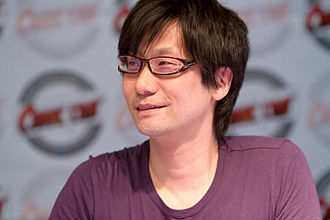
Postmodern thinker Hideo Kojima in 2001 predicted the future. In his classic work “Sons of Liberty,” Kojima depicts a world where media surrounds the individual with constantly changing and useless information, or “junk data.” This junk data drives the individual to build their own truth and abide by it with slavish devotion.
Kojima writes: “Everyone withdraws into their own small gated community, afraid of a larger forum. They stay inside their little ponds, leaking whatever ‘truth’ suits them into the growing cesspool of society at large.”
I agree with Kojima’s thesis. We live in an era where the complete bounds of human knowledge are mere clicks away, where the average person can learn whatever they want in moments. Truth is cheap and conforms to our whims. As news feeds become increasingly partisan and journalism fractures into specialized sources, two people can believe in two completely different and conflicting truths about the world around them. In the quest to shore up these gated communities, everything becomes a tool.
Including history.
I understand the attraction. History is an easy target. With the entirety of human action to draw from, a savvy researcher can prove almost anything. Look no further than Martin Luther King Jr. Every year, news sources from all over the political spectrum depict him in the starkest terms possible. With articles like “Martin Luther King Was a Radical, not a Saint,” from Truth-Out, or “Pseudo-Pacifism: Why Privileged People Love Quoting MLK,” from Patheos, serving as prime examples.
King becomes a devout Christian, an adulterer, a militant revolutionary, or a pacifist of the first degree – whatever it takes to align his mission with the mission of the author. Even the Hillsdale Collegian published such an opinion, titled “Embrace Reverend King, Revolutionary Ideas and All.”
Most historical opinion pieces, no matter the source, begin with an opinion. The author hopes to communicate what they believe is historical truth. The desire often comes from an understandable place – a wish to inform the public how a historical figure or event relates to their views. Then the research begins, with the author scouring the internet and library for quotes or passages that support their claim. They find the quotes, plunk the article out, and send the piece in by deadline. Then they move on to their next project, while their work remains online or in print for the world to see and digest.
While cathartic for the author, the process is intellectually dishonest.
Whenever an author begins with an opinion, an objective for their piece, they write poor history. The nuances and details of history – something that requires years of in-depth study to understand and apply properly – become obstacles to the opinion.
Dishonesty stems from the misunderstanding that history conforms to the current reality. That people who lived 50, 100, or 1000 years ago somehow fought the same battles that we fight today; That Martin Luther King Jr., Winston Churchill, Otto Von Bismarck, or Joan of Arc could understand or interface with our problems.
Raised in a world where students view history as a tool for the present, where history teaches us about our lives and how to live them better, the author assumes that the issues they are passionate about have historical equivalents.
History rarely, if ever, provides equivalents to the current day. Anne Louise Germaine de Staël-Holstein, a French-speaking Swiss author, once said that “to understand everything, is to forgive everything.” History creates problems for every political ideology. By definition, ideology requires clear-cut answers to questions. The more history someone reads, the more nuanced their understanding of a time and place becomes.The lines between the “winners” and “losers” of history blurs and conventional narrative becomes increasingly difficult to defend.
The historical hit piece shows no interest in furthering understanding. When an author starts with an opinion before writing a piece, their research focuses on making that opinion a reality. The author boils a historical figure, whose life and times could take years to understand within their context, down to the basest and most partisan elements possible. Who the subject really was does not matter; what matters is that this person agreed or disagreed with what the author believes. Decades of life, condensed into a 1,200-word newspaper article.
People should have historical opinions, and should debate the minutia and specifics of historical issues, but actively diminishing history for the sake of feeling secure in your own worldview conflicts with the liberal arts tradition.
As people continue to wall themselves into their gated communities, doing everything they can to establish and defend their own truth, this practice takes on an entirely new level of destructive power. As the author leaves the article steeping in the public eye, moving on to discover the next “hot take,” his words become ammunition. With all human knowledge available to them, the average person shirks other options for the sake of the comfortable one.
The walls of their gated community grow, and historical reality becomes increasingly blurry. I ask only that writers try to combat this phenomenon and treat history with the respect it deserves. Take the time to research before forming an opinion, try not to force history to say something it clearly does not, and interact with scholarly work on each topic. History is only capable of so much. As the gated communities continue to grow, the need for non-partisan truth becomes increasingly important. Try not to become a part of the problem.
Because the alternative is easy. Very easy.
Take Hideo Kojima for example. He makes video games. The “gated communities” passage is from the classic “Metal Gear Solid 2: Sons of Liberty.” Kojima made the game in active rebellion against overzealous fans of “Metal Gear Solid,” as well as to comment on postmodernism. He never predicted the future, he just responded to the world around him and the direction he saw it going.
I am guessing you took my words at face value though.
Besides, the truth would have made for a bad intro.
Shadrach Strehle is a junior studying history.
