
Adolf Hitler’s rise to power in 1933 bewitched the German Evangelical Church. They covered their altars with swastika flags and sang Nazi songs in their services. Their new doctrine, in the words of Pastor Julius Leutheuser, was “Christ has come to us through Adolf Hitler.”
There were a few who resisted the development. Of the 18,000 Protestant pastors in Nazi Germany, about 3,000 joined the Confessing Church. This church opposed the compromised doctrine of the national “Reich Church” in 1934 by signing the Barmen Declaration, which asserted that they “repudiate the false teaching that the church can and must recognize yet other happenings and powers, personalities and truths as divine revelation alongside this one Word of God.” The Declaration signees included Dietrich Bonhoeffer, a Lutheran pastor who would eventually give his life for the liberty of the Christian faith in Germany.
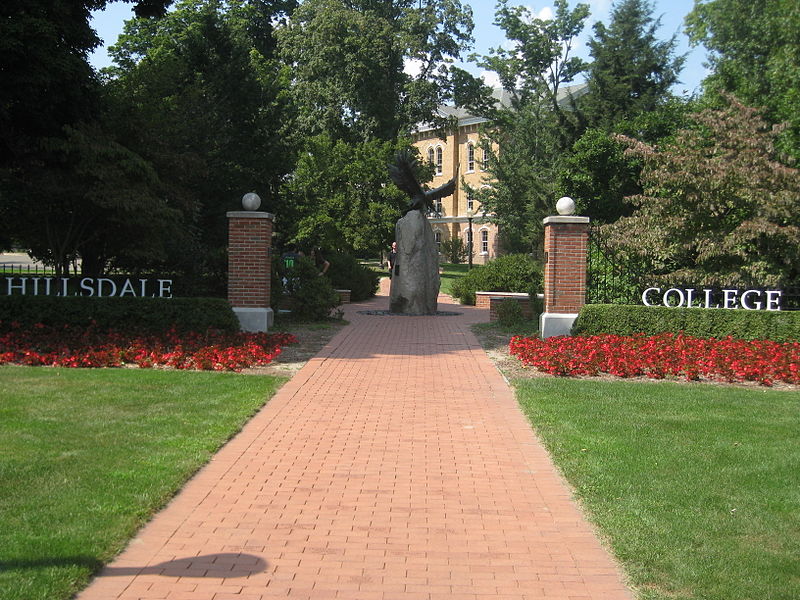
Hillsdale’s Liberty Walk has no obvious advocate for religious liberty. None of the statesmen on the walk contemplated and wrote about religious liberty to the extent that Bonhoeffer did, nor did they pay for that liberty with their lives. Bonhoeffer belongs on our Liberty Walk because liberty defined his thoughts and actions in both life and death, and because his addition to campus would appropriately reflect the college’s mission statement, in that the college considers itself a “trustee” of its theological inheritance.
Bonhoeffer died to preserve this theological inheritance in Germany. Yet, like the rest of the figures on the Liberty Walk, he was also a sort of statesman; the Barmen Declaration, which he signed, was akin to an Emancipation Proclamation for German Protestants. Through this document, Bonhoeffer helped establish the Confessing Church, and for two years afterward, he taught at a Confessing Church seminary, Finkenwalde, which the Nazis eventually shut down.
In June of 1939, Bonhoeffer left Germany after being informed that war was imminent. But he returned to Germany only a month later. “I have made a mistake in coming to America,” he said. “I must live through this difficult period in our national history with the Christian people of Germany. I will have no right to participate in the reconstruction of Christian life in Germany after the war if I do not share the trials of this time with my people.”
Upon his return, Bonhoeffer joined the German Secret Service, during which time he secretly helped Jews escape Nazi oppression under the guise of collecting information from different locations around Europe. He was also involved in a plot to assassinate Hitler. “Silence in the face of evil is itself evil: God will not hold us guiltless,” Bonhoeffer said. “Not to speak is to speak. Not to act is to act.”
The Nazis arrested Bonhoeffer after tracing funds he used for “Operation 7,” a plan intended to rescue Jewish immigrants by giving them papers as foreign agents. After a year in prison, the Nazis eventually realized the true extent of Bonhoeffer’s resistance activities and sent him to the extermination camp at Flossenbürg. He was hanged on April 9, 1945, only one month before Germany’s surrender.
Bonhoeffer shone as a beacon of liberty in a sea of unbelievers who surrendered to Nazi nationalism during the war. He believed that succumbing to the Reich Church by pledging allegiance to Hitler would compromise his faith, which is why he resisted the regime and helped free those whom the regime oppressed. Not only that, but he stood for his principles with boldness, even when they were dangerously unpopular. Hillsdale students and professors express appreciation for his legacy, and the college, which can identify with Bonhoeffer in its bold and principled resistance toward federal funding, would do well to memorialize his stand for liberty.
Bonhoeffer was committed to liberty even unto death; in fact, death to him was a kind of liberty. “Freedom, we sought you long in discipline, action and suffering,” reads a poem from prison. “Dying, we now recognise you in God’s countenance.”
Brooke Conrad is a junior studying English.
