
Zane Miller | Courtesy
After Professor of Theater James Brandon and his wife decided to adopt a child from Russia, he felt an obligation to at least try to learn a little Russian. As a theater professor and lover of cinema, he knew where to go. He marched into Mossey Library and checked out all the Russian language movies — nearly 50 in all — and watched one each night to learn phrases and try to grasp the Russian idiom.
After two weeks, he inserted the next disc from the stack, “Chayka,” from 1970. It looked grainy and bootlegged, as if someone had brought a camcorder into a Russian movie house and sold the recording.
But after a few moments Brandon recognized it as Anton Chekhov’s “The Seagull.”
The realization intrigued him, even though Brandon was prejudiced against the Russian playwright after reading him early in college.
“I hated Chekov when I first encountered him,” Brandon said. “Bored me. I wasn’t ready to listen, there are some things you don’t get right away.”
But seeing Russians acting the play opened his eyes to its beauty and complexity.
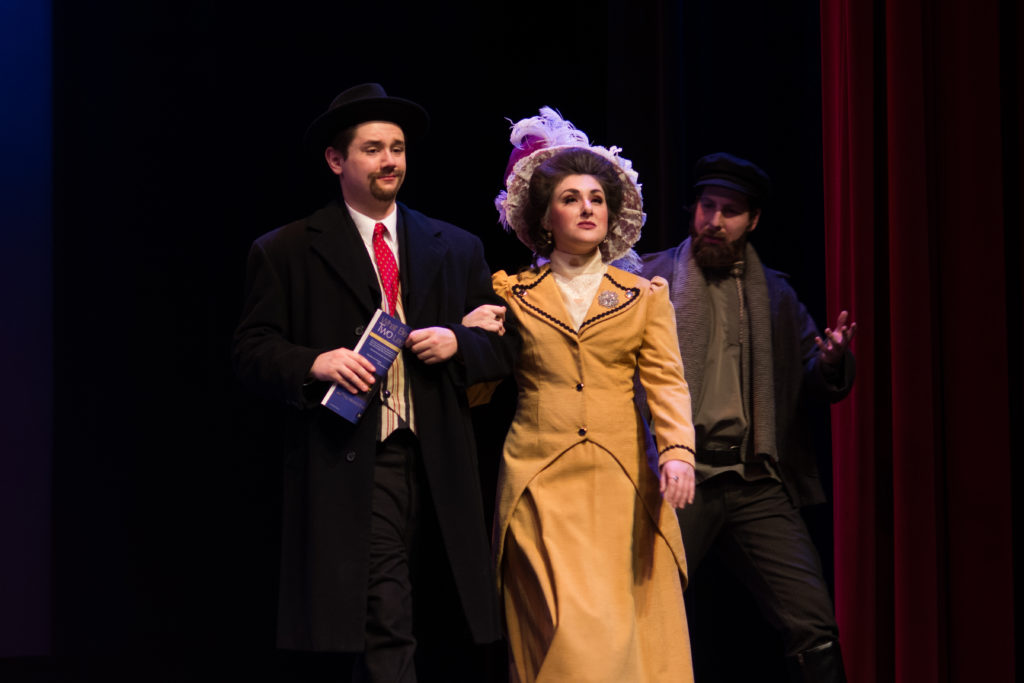
And now the Tower Players of Hillsdale College tackle this pivotal work in theatrical and artistic history on the Markel stage from Wednesday through Saturday with performances at 8 p.m. with a 2 p.m. Saturday matinee.
Brandon likens the play’s second premiere to the fall of Constantinople. And that is not too bold a comparison. “The Seagull” is the consummation of realist and naturalist elements into which 19th century theater had only dipped its big toe.
Before Chekhov, Ibsen, and Strindberg, theater was purely presentational. The actors addressed the audience in loud voices, making for performances that would seem like mere poetry recitation to a contemporary audience.
After the play flopped initially, Chekhov elicited the help of Konstantin Stanislavski to develop a method of acting for realist drama.
“Stanislavski basically said ‘hold my beer’ and changed everything,” Brandon said.
Nowadays, any acting on television or in a film is the kind of acting that Chekhov and Stanislavski pioneered with the Moscow Art theater.
The Tower Players, under Brandon’s direction, debuted with a successful performance on Wednesday night and will perform this landmark play throughout the weekend.
The Tower Players will use Curt Columbus’ translation of Chekhov’s work, which Brandon said is “dynamite.” It is muscular and colloquial, correcting many errors which British translators have made in their attempts to connect with an American audience.
“The Seagull” tells the story of a household that has coalesced around Madame Irina Arkadina and shows the trials and struggles that arise from passion and artistic inspiration.
“The show is about how people approach life and how they deal with love,” senior Nikolai Dignoti said. “Some people want to love each other and be true to each other without seeing the bad things in the world. The happiest people are the ones who know life is difficult.”
Dignoti said the play’s themes of perseverance and survival offer insight into the Russian psyche.
“They believe that it will be better when it’s over, when you go to heaven,” he said.
It is a difficult play, with subdued dialogue, off-stage action, and complex emotional landscapes which mark the final Tower Players performance for two great actors: Dignoti and senior Glynis Gilio.
Gilio plays Arkadina with power, vulnerability, and restraint cracking her emotional facade only when absolutely necessary.
“Glynis is freaking killing it,” Dignoti said.
To prepare for her role, Gilio said she rehearsed in a corset and spent hours doing vocal exercises to find precise tones and inflections to play the aging star. That work paid off as Gilio offers a masterful performance that draws the audience along through her clear emotional struggles.
Dignoti plays Peter Sorin, the ailing 60-year-old brother of Arkadina, with authenticity, resembling a grizzled Russian, suffering from alcoholism.
The senior duo knew they wanted to portray siblings as accurately as possible. Dignoti and Gilio used Meisner technique to help draw out similarities between their two characters. In the technique, two actors sit less than a foot apart. One states a fact, the other repeats. Then they move onto questions and analysis of their conversation.
“It is a great way to get in tune for another actor’s speech and pitch,” Dignoti said. “Our characters have lived together for at least thirty years, so they would have surely developed similar speech patterns and mannerisms.”
This commitment to aesthetic realism provides the nuance and subtlety that makes the masterfully-written play sparkle on the Merkel stage.
The three other principals — Constantine Treplev, played by junior Lane Gaudet, Nina Zarechnaya, played by junior Rebecca Carlson, and Boris Trigorin, played by junior Austin Benson — all performed admirably.
Gaudet’s slim frame accentuates his youth and vitality during the first act, in which Treplev premiers his play, a strange monologue which he wrote for Nina, his lover. In the fourth act however, which occurs two years after the events of the first three acts, Treplev’s shoulders drop and his neck juts forward after countless hours spent craned over a desk scribbling away at his masterpiece.
Carlson’s transformation is equally dramatic. Her bright face and long hair make her portrayal of Nina the picture of youth, especially when standing next to Arkadina and her tightly-coiffed pompadour. But in the final act, her hair is coiled into a bun, and in those two years she has had a child and lost it as her dream of becoming a great actress lies dead at her feet.
Benson, adorned with a refined goatee, commands the stage for the majority of Act II as he relates the limits of fame to Nina. Despite his literary success, he thinks his work is stilted and uninspired. After establishing himself as an amiable but struggling character, Benson reveals the author’s sexual appetite in an understated yet shocking manner.
It is a well-rounded performance of a great play. The realist elements are nicely incorporated. In the latter two acts, characters sit with their backs turned to the audience without worry. Vocal projection is audible but not self-aware. And the beauty of the script overcomes any of the actor’s faults.
By the end play, Treplev has lost his idealism, and says, “Art is not about new forms or old forms, but what a man writes, what flows freely from his heart.” I left the theater with that line sitting like an anchor in my chest. I teared up as I crossed the parking lot, shaken by the realism and beauty and undetermined sadness of “The Seagull.”
