
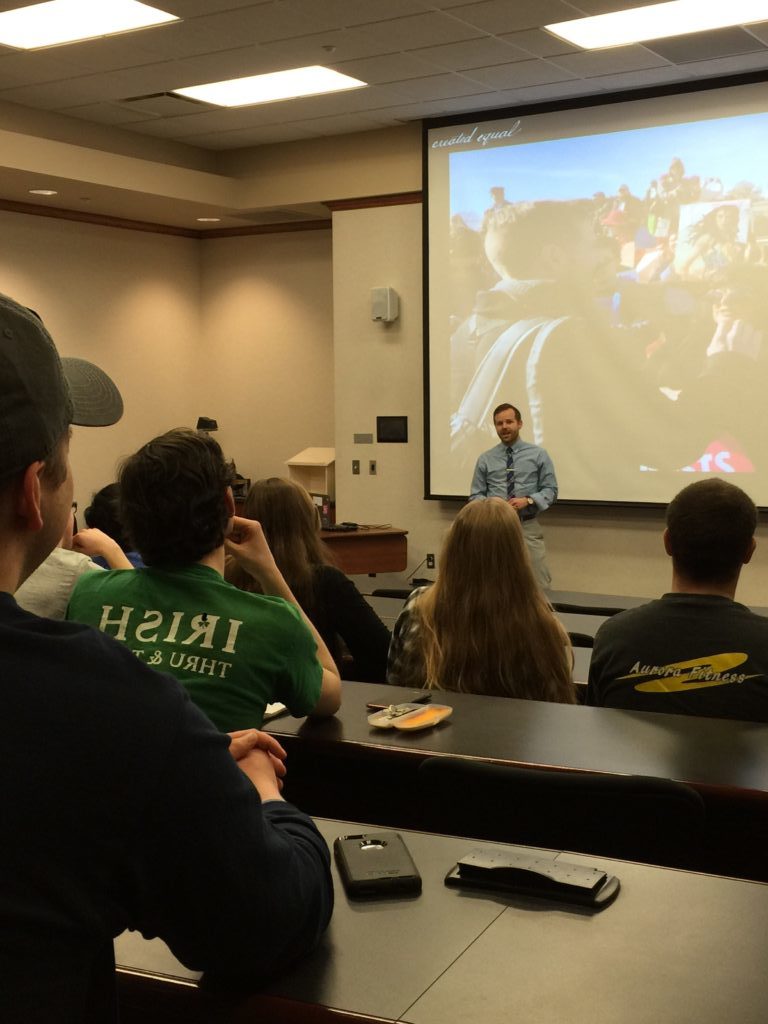
More than 30 students attended a lecture on campus Tuesday night given by Seth Drayer, director of training for the abortion advocacy group Created Equal. Hillsdale College Students for Life organized and hosted the event.
Drayer spoke for an hour about “changing the culture of abortion,” focusing on the importance of displaying images of abortion victims for the sake of “reaching mind and heart.”
“Videos and photos of abortion victims reach the heart faster than any words,” Drayer said. “If we use the visual evidence to reach the head and the heart, we can change how people think and how they feel, which will ultimately change their behavior.”
Displaying the images of aborted fetuses has become a point of contention in the pro-life movement today. Some say it is too gruesome and grotesque, while others, like Drayer, say it is the most effective way to achieve what he says are the goals of the pro-life movement: to make abortion illegal and unthinkable.
“Pervasive opinion in the pro-life movement is that graphic images are not effective, necessary, or a mature or moral way to conduct a pro-life argument,” Students for Life president junior Kathleen Russo said. “As a pro-life student body, we have a responsibility to look at the options in front of us and honestly consider what is most effective and what is truthful.”
Drayer also discussed the roles of facts and feelings in the abortion debate. Although he said facts should inform feelings about issues like abortion, Drayer didn’t discount the significance of feelings in the abortion debate today.
“Feelings are a chance to analyze and evaluate the truth about abortion and what it is and what it does,” Drayer said. “They are also an opportunity for us to point to a place of healing.”
That healing, Drayer said, is an opportunity for pro-life advocates to share the gospel, although he made it clear that Christianity is not a requirement for pro-life convictions and actions.
Part of what makes people uneasy about the pro-life movement’s seemingly good intentions is groups like Created Equal’s unabashed public boldness in showing dismembered fetuses. But Junior Erik Halvorson, secretary of Students for Life, was convinced.
“It was the most compelling argument for using pictures I’ve ever seen, and I’ve generally been against it,” Halvorson said. “You instinctually push it away, but that just shows how effective of a strategy it is.”
Still, the debate remains among the pro-life movement today. Drayer provided numerous anecdotes that he and the advocates at Created Equal have had where images have had a positive impact on post-abortive women.
“We aren’t a campus that shys away with things we disagree with,” Russo said. “Even if we personally disagree with showing graphic images, it is a valid position and valid argument we have to consider in order to be fully educated.”
Drayer and many students on campus maintain that when it comes to abortion, a picture speaks a thousand words.
“These are the facts of abortion: real babies are dying every day,” Drayer said. “The question for us: what will we do based on this?”
