
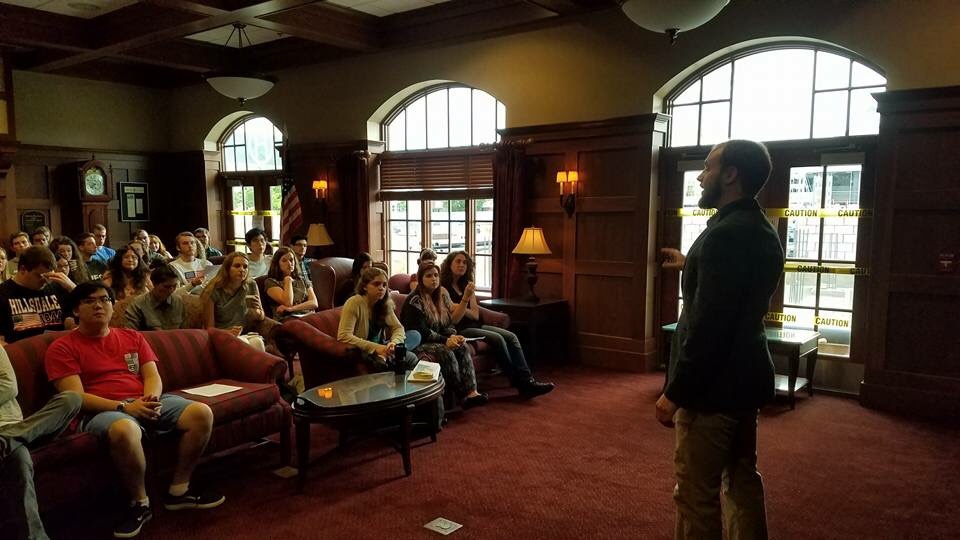
Each year, Hillsdale College sends several students to top 20 law schools, including schools such as Yale and Harvard. Not one of these students is a pre-law major.
In fact, Hillsdale doesn’t even offer a pre-law major. Instead, students interested in law school are encouraged to pursue their other academic passions in their undergraduate studies. The result: a diverse group of uniquely equipped students entering their first year of law school.
“We’re a liberal arts college, so we don’t provide professional or technical degrees, which is what a pre-law major would be,” said Nathan Schlueter, Professor of Philosophy and Religion and a pre-law advisor. “Fortunately, a real liberal arts education is the best preparation you can get for law school.”
The University of California, Berkeley, School of Law — consistently a top 15 ranked law school — keeps a list of pertinent skills for law students to possess on its website. Chief among these are strong written and oral communication, critical and analytic thinking, ability to research, and academic organization. According to Hillsdale students planning on attending law school next fall, these are skills their respective majors developed within them.
As an example, senior English major and founding member of the Hillsdale College Federalist Society Daniel Cody said he initially decided to study English because of a personal passion, but within the major he found incredible opportunities to develop his writing and ability to dissect the written word.
“The English department at Hillsdale teaches you to write with precision and to read closely,” he said. “I can’t imagine two more fundamental skills for the practice of law than that.”
Beyond his study of English, Cody said he believes a liberal education itself is a valuable resource to those entering the legal field.
“At Hillsdale, we’re always talking about being a more-full person, and that somehow knowledge and learning brings us closer to whatever we’re supposed to be, and I think that’s true,” he said. “I think that the people you want making, enforcing, and helping you comply with the laws ought to be the best they can be, intellectually and morally.”
It’s not only English majors who have discovered value for their legal aspirations in their specific field. Senior history major Jacob Weaver — also a founding member of the Hillsdale College Federalist Society — noted the research component of law school, and how the history department has prepared him for that.
“I am doing my thesis right now, and it’s just digging through old documents and case law and trying to match these documents with my thesis, and shape a thesis around these documents, and that’s what you’re going to do in law school,” he said.
Cody said he believes all of the departments at Hillsdale bolster these skills, citing philosophy and politics specifically.
For senior Dugan Delp, the economics department taught him to approach each situation and problem within its broader context. He said this was particularly helpful in taking the Law School Admission Test, a test which focuses heavily on logical inferences and contextualization.
“Economics helps you think critically and logically,” he said. “So with the LSAT, it really helped me find the issues, and find the logical discrepancies, and work through the logic games. I felt like I had a better grasp on all of those because of my understanding of economics.”
Delp, who is also majoring in Spanish, added that his foreign language background served as a strong point of diversity and interest in the application process.
Students don’t stop finding these benefits when they close their books, either. For senior theatre and history major Glynis Gilio, the stage provided its own preparation.
“When you’re an actor, you’re required to embody and take on people from many different places in history and many different social classes, and so you have to be able to get into that mindset, get on stage, and defend them. That’s basically what you’re doing as an actor, making a defense,” she said. “I think that empathy and the mechanics of [acting] are so important and helpful to attorneys.”
Additionally, she said she strengthened her researching skills while preparing to place her characters convincingly within a given play’s setting and framework.
The unique benefits of diverse study for prospective law students extend far beyond the humanities. In fact, students studying physics and mathematics routinely achieve some of the highest acceptance rates at top law schools, according to information published by the Law School Admissions Council. Hillsdale itself has a record of sending STEM majors to prestigious law school.
Weaver said the range of majors represented by prospective law students speaks to the diversity of the field and the possibility to find one’s own niche within it.
“More than the broadness itself, it’s about the mental development you can get from these different fields,” he said. “Having this diverse background within the field of law allows people to go off into different areas of the law that can be more of their speciality.”
Cody suggests that younger students interested in law school should pursue an undergraduate degree in something they are passionate about, rather than viewing their undergraduate years as simply “pre-law.”
“Everything that you need to learn vocationally, you will learn in law school and through practice,” he said. “If law school needed to be seven years, it would be seven years…focus on having a work ethic and an intellect which have been trained for the specific tasks of learning, comprehending, and focusing. Those are things you can learn in any undergraduate pursuit.”
