
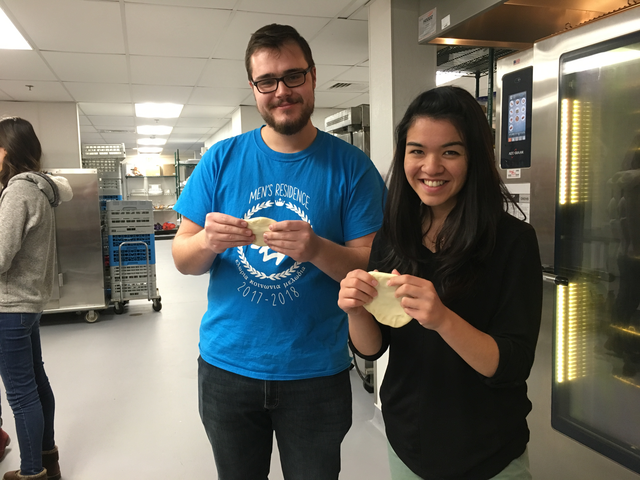
A distinct cheesy odor hung in the air of the state-of-the-art Searle Center kitchens. The range hoods roared. Stainless steel countertops reflected Italian staples: infused olive oils, roasted garlic, Parmesan Reggiano cheese, the fixings for dough.
Nine students learned how to cook simple Italian street food from scratch using just a few, fresh ingredients from Bon Appétit Executive Chef Patrick Kander on Feb. 6. They flattened dough spheres into 8” circles to cook in olive oil, watched demonstrations for making marinara sauce, pesto, salad dressing, and dough, and listened to Kander’s general tricks of the trade.
“Get good ingredients if you’re making everything from scratch,” he said. “It’s good, and good for you.” Kander emphasized that cooking from scratch isn’t overwhelming if one keeps it simple.
The spread covering the gleaming countertops was light fare: chopped salad, fried risotto balls called arencine, and piatta sandwiches — a trendy Italian pop-up street food. The class is the first of the semester, and had been rescheduled because of the influenza outbreak.
Kander opened the class with an inspirational story to show the power of food and convince students to buy real Parmesan Reggiano, not the white dust that comes in a green plastic shaker. After a devastating earthquake cracked cheese wheels, one chef promoted a parmesan risotto dish anyone could make around the world. Acclaimed chefs joined the trend and ultimately, international sales from the cheese sold saved the cheesemakers’ livelihoods.
Then he gave a tour of the high-tech kitchen: smart ovens with flash drives that read downloaded recipes and tell cooks what settings to use, and machines that blast -10°F temperatures to cool down food.
“The tech stuff is wild,” the 46-year-old chef admitted. “It’s nice to have those features. Even you guys can do it.”
Dave Apthorpe, General Manager of Bon Appétit, said that hosting the class in the Searle Center is a way for students to get involved, check out the kitchens and work there.
“One of our goals is not to have that viewed as, ‘that’s for CCAs, that’s only for outside events,’ We want it to be viewed as part of the college, it’s a good opportunity to show it off, have a students feel part of it,” Apthorpe said.
Mark Harrison ’18 and Tara Ung ’18 came to the class with open minds. While Ung only knows how to make Chinese food, she knows its essence involves experimenting. Harrison said he doesn’t know how to cook at all. In the kitchen, Ung does the bossing, which Harrison said sometimes works… and sometimes it doesn’t.
The couple enjoys cooking together: Last year, Harrison gave Ung a cookbook with traditional English dishes, “basically, what might’ve been Hobbit food,” Ung said.
Ung is a part-time student, off the meal plan and fending for herself with her 20-ounce Crock Pot. Her mom, dad, and grandma in Malaysia have taught her what she knows. In her estimation, Penang, Malaysia, has the best food in the world: a blend of Indian, Dutch, and English, and island flavors.
As for Italian? At the start of the class, her knowledge was limited to Olive Garden.
Kander waved his hands over the ingredients laid out and ready-to-use. He emphasized the technique, mise en place, which is French for having everything in place before cooking. He dumped the dough ingredients together and used the dough hook on a Kitchenaid to knead.
Then, he heated and stirred garlic, basil, oregano, salt, and pepper. Kander whirled to face his audience with a giant plastic vat of puréed tomatoes: “You’re obviously not going to make as much as I am,” he joked.
It’s true. Most of the time, Kander is dealing with how to feed a thousand students every single day, or preparing catering menus. That Tuesday night, he scaled it down to teaching students how to cook for two or three people at home, which allows him to be more intricate.
Kander’s motto is simple food, made from scratch: a lifestyle with monetary and spiritual benefits.
“I love to take my craft and show people it’s doable, no matter who you are,” Kander said. He said this is a two-way street: he teaches and his students reciprocate, like when people come back and tell him they made his recipes for their families.
Typically, he said, students are shy at first, but then they get involved and ask questions.
His back to the audience again, Kander added the purée to the other ingredients to let it simmer for 30 minutes. “People who say, ‘I make my sauce all day long,’ Don’t listen to ’em.”
He blended together another speedy sauce: a pesto that substitutes the expensive basil for the inexpensive yet flavorful arugula (blanched), combined with olive oil, almonds, salt, and garlic.
“Recipes are just words on paper,” Kander said. “As long as you’re doing the technique, you can use whatever ingredients you want to add a personal touch.”
Then, he pulled out a tray with small round dough balls, ready to roll while the sauce simmered.
While students smooshed and pressed, Kander demonstrated the versatility of a wine bottle as a rolling pin.
Ali and Bruno Cortes are students of the Van Andel Graduate School of Statesmanship who just got married in July. Ali said her mom and grandma are great cooks, and from their families the couple received nice kitchen equipment that needs using.
Ali said she liked the idea of making oils since she usually tries to avoid eating processed foods, a philosophy that is reflected in her love of making breads and using her dreamy Vitamix blender.
Off to the side of the action, Kander credited the presence of Marketing Manager William Persson ’17 with better marketing efforts to get out the word about the classes.
In the past, Persson said the cooking classes were a little less planned and not as marketed. Another factor that makes these kinds of events easier, Persson said, is that a better-trained staff means Kander can spend the day prepping for a class.
Kander and Persson have more events like this in store. From the students who attended Tuesday’s class and participated in a feedback survey, one student will randomly be selected to learn how to prep (and enjoy) a 3-course meal shared among three other friends. In the spring, Kander wants to host a wine pairing night for roughly 40 of-age attendees.
“Wine is food,” Kander said. “Jesus was right. Jesus did it right.”
Just before it was time to eat, Kander pulled out the foods that he had prepared ahead of time, the arencine and the chopped salad. He threw red wine vinegar, lemon juice, dijon mustard, basil, garlic, salt, pepper, and olive oil together and whisked.
“If you consider buying salad dressing, don’t,” he advised. “It’s just preservatives and sugar.”
Ung said she appreciated that Kander introduce the idea of mise-en-place because she, like many students, often starts cooking without laying out all the ingredients and often looks for things as she goes along.
But Kander does not believe that cooking is anything to do half-concentrated or half-prepared.
“Do one thing at a time, and do it well, and then move on.”
After the burners were shut off and the range cooled, Kander and the members of the cooking class split up and sat around two tables in the Searle Center and shared a meal together.
“Think about what a home-cooked meal means,” Kander said. “Food is love, and it’s 1,000 times better than going out.”
