
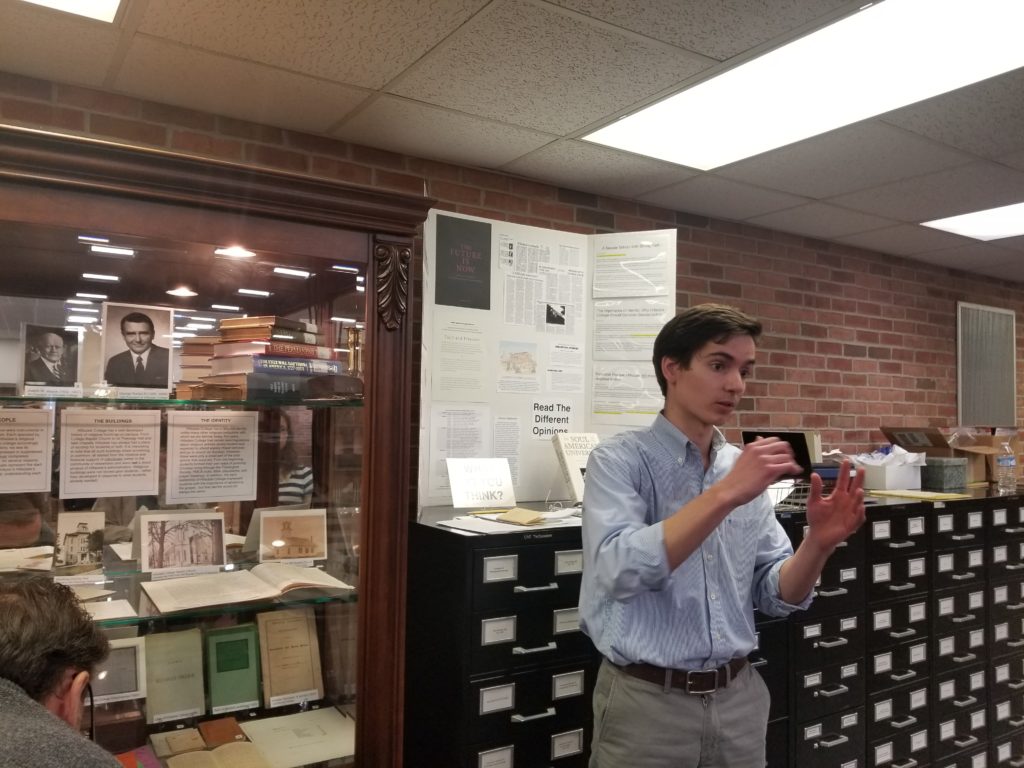

When senior Hans Noyes returned home, he asked his family’s Amazon Echo smart speaker the question he had explored for his project in the Public History course: Is Hillsdale College a Christian school?
“No,” the robot voice named Alexa responded.
“If I had done that sooner, I would have saved a lot of time,” Noyes said in a presentation of his research on Monday in Mossey Library before a group of 35 students and professors.
Noyes’ actual research found that the answer is much more complicated than that, which has led to uncertainty among many on campus as to whether or not Hillsdale is a Christian institution. Although Hillsdale was founded as a Christian institution by Free Will Baptist pastors, Noyes argued in his thesis that the surge of Christianity on campus among students was an unintended result of efforts to market Hillsdale as a conservative institution.
“The Collegian has published articles, both positive and negative, about it,” Noyes said. “People asked me if Hillsdale was a Christian college, and I didn’t know how to answer. I thought I should look into it.”
Visitors to Mossey Library can find Noyes’ research in the display case by the microfiche reader section on the first floor. The case contains books from the library archives, photos of people who influenced Hillsdale’s religious heritage, and a Bible from College Baptist Church, which the college helped to found. Booklets on the filing cabinet next to the display have more information to explore.
Noyes said the most surprising element of his research was the significance of the Free Will Baptists for Hillsdale during its early days. Not only did their philosophy influence the school’s mission, but they promoted the college in their magazines, sponsored scholarships, and donated funds for campus building projects.
“At the heart of the Free Will Baptist denomination, generalized, is freedom, freedom of the individual,” Noyes said. “It paired nicely with American freedom and, later, the Republican Party.”
He noted that Revs. Edmund Burke Fairfield, former college president, and Ransom Dunn — former college interim president, trustee, and professor — attended a meeting in Jackson, Michigan, in 1854 that laid the foundation of the Republican Party.
“Their political identity came from their religious identity, and that has shaped the college until this day,” Noyes said.
That, however, would reverse in more modern times.
Under President Joseph William Mauck, the college broke ties in 1913 with the Free Will Baptists, asserting its nonsectarian stance, to preserve its independence as they combined with the Northern Baptist denomination, according to Noyes.
In the 1960s, Hillsdale stopped its practice of mandatory chapel attendance and ended its official relationship with College Baptist in 1968.
“You had this developing trend toward less academic rigor and more of a party mentality in the students,” Noyes said.
When George Roche became president in 1971, he made efforts to extend Hillsdale’s reputation nationally, starting the Center for Constructive Alternatives seminars, Imprimis, and the Washington-Hillsdale Internship Program. It boosted Hillsdale as a politically conservative institution, according to Noyes.
“Something he didn’t expect, there was a pairing brewing in the ’70s, ’80s, and even today between evangelicals and conservative America,” he explained. “As he was attracting more and more conservative students, he was attracting more and more evangelical students.”
As a result, Noyes argued that Hillsdale was a Christian school at its founding but its status as one has become less clear now, since the strong religious community on campus appears to be an unintentional consequence of the school’s efforts.
“This is a nice reminder of how difficult it can be to shape history into a cohesive argument and prove one side or the other,” Provost David Whalen said after Noyes’ presentation. “It’s a beautiful example of how history can be complex and unclear. There are lots and lots of loose ends.”
Several students in attendance at the presentation expressed similar sentiments. They said they were surprised by how much history they did not know.
“I’m a senior, and I’d never heard most that,” Devin Ward said. “I think College President Larry Arnn should share some of that history, when he’s talking about the Good during freshman orientation.”
After listening to the presentation, Ward said she would not call Hillsdale a Christian college, because it does not have its students sign a statement of faith.
“I’m glad we don’t,” Ward said. “I liked how they didn’t market Hillsdale as this Christian college. If they had, I wouldn’t have gone here.”
Senior Dustin Pletan said he was not confident to determine if Hillsdale is a Christian school or not, after Noyes’ presentation, but that he learned about the religious heritage of the school that he did not do before.
For now, Pletan said, on this topic: “Ask Dr. Arnn.”
