
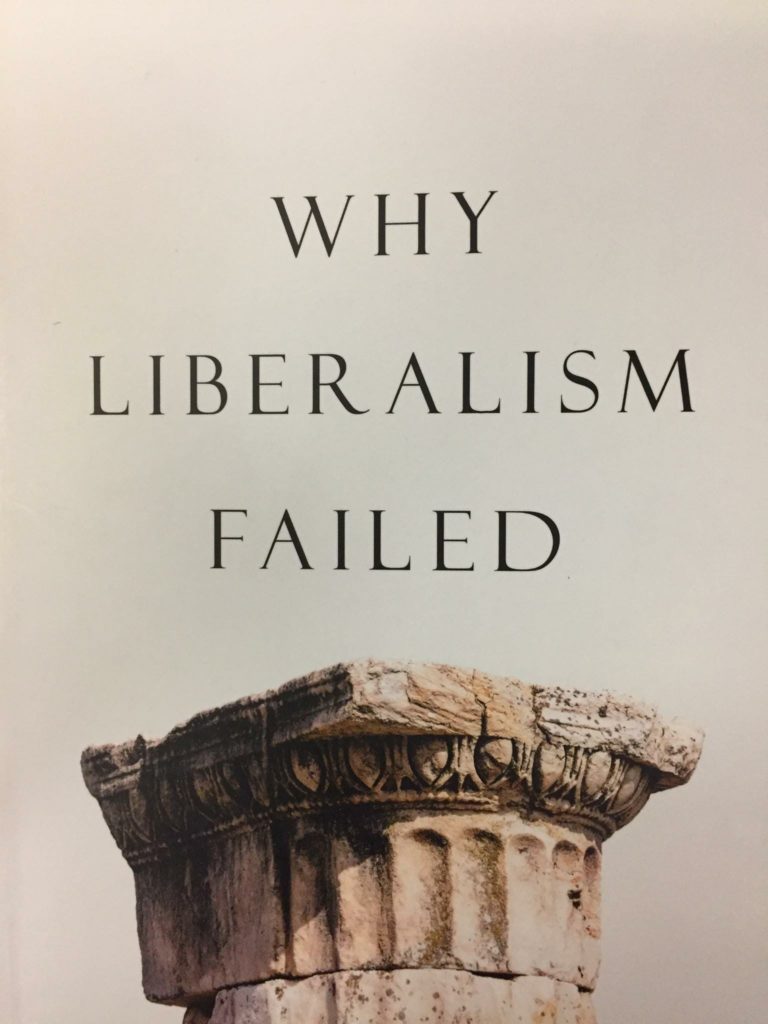

O, you who turn the ship of state and look to windward, consider liberalism, which has failed.
In his new manifesto, “Why Liberalism Failed,” the Notre Dame political philosopher argues that the dominating political project of the past 300 years has always been doomed to fail, that a political and social order designed to allow its denizens the license to a glut of self-indulgence can only end in self-consumption. Liberalism has failed because liberalism has succeeded.
Deneen argues that liberalism has transported the many nations and peoples in its thrall to an ideological frame of mind where order is constructed from a placeless state of nature theorized by seventeenth century Englishmen and adapted by conniving American aristocrats. By seeking to subdue nature and create a global culture with “a pastless present in which the future is a foreign land,” Deneen argues that liberal society has produced an era of placeless complacency.
Deneen passes his judgement on all bands of the political spectrum. Individualism and Statism are codependent forces; as the individual discovers he has more desires — always, in Deneen’s mind, desires relating to commerce — the state must advance to provide for his needs, his freedoms. In a beautifully poetic section, Deneen frames the 2008 world economy collapse as the result of both liberalism’s great success and failure. Because stockbrokers lived in a world disconnected from tangible communities, they were able to enrich themselves and issue irresponsible mortgages at the expense of local communities. At the same time, once the market turned on this culture hollowed out through self-indulgence, it left everyone participating in a state of “powerlessness and bondage.”
Deneen also does well to criticize the over-encroaching role of technology in the lives of liberal societies. He describes technology as producing an “oscillation between ecstasy and anxiety” in the lives of the people it affects. At the same time, he points out the flaws in modern education, how colleges now value educating their students in technology and financial utility over all else.
It’s a dark view of the way we now live, but Deneen offers three solutions. First, we must acknowledge the achievements of liberalism and not seek to return to a pre-liberal society. We can only move forward with our ideas. Second, we must reject all ideology. Finally, we must create a new mode of society that builds upon the ruins of liberalism.
But what even is liberalism? It’s a question Deneen never really answers. Not astonishing: the book is only 197 pages, a third of which consist of an introduction and conclusion. Perhaps Deneen should have provided his reader a more specific definition of liberalism other than bits-of-Hobbes-and-Locke-I-don’t-like. The closest he gets to a true definition is in the introduction, when he launches an adjective-laden invective against modern society.
“A political philosophy that was launched to foster greater equity, defend a pluralist tapestry of different cultures and beliefs, protect human dignity, and, of course, expand liberty, in practice generates titanic inequality, enforces uniformity and homogeneity, fosters material and spiritual degradation, and undermines freedom,” he writes.
Those are a lot of buzzwords for a political theorist. But like his more popular counterpart, American Conservative blogger Rod Dreher, Deneen is a man of buzzwords and hot takes. Both, however, are in essence Marxist historians who just lack Marxist conclusions. History is a battle. When ideas fail at one time, they fail forever, irredeemably. And when we lose history, we must retreat.
“Why Liberalism Failed” acts as a philosophical addendum to Dreher’s “The Benedict Option.” Both see the cracks in modern liberal society and recoil with horror. Like Raphael Hythloday in Thomas More’s “Utopia,” both Dreher and Deneen suggest a retreat into a weird sort of garden, where their Christianity justifies their Epicureanism. The only real difference is their tone. Dreher writes like a loon. Deneen is an actual scholar.
But in the end, behind both Dreher and Deneen lurks the spectre of Alasdair MacIntyre. With his 1980 classic “After Virtue,” the Notre Dame philosophy professor argues that modernity has been won at the price of social and political coherency.
Dreher invokes the Scottish political theorist’s name often in “The Benedict Option.” Deneen leaves it out entirely, which gives “Why Liberalism Failed” more force. While aping the now-famous (or is it infamous?) last sentence of MacIntyre’s “After Virtue,” Deneen does not claim to be MacIntyre’s “doubtless very different St. Benedict” — as Dreher does — but instead predicts that liberalism will not be overcome except with societies that value community and place over ideology.
It’s a nice sentiment, but pronouncing failure on an entire society won’t encourage future flourishing. We are not waiting for Deneen, but for another — doubtless very similar — Thomas More.
