
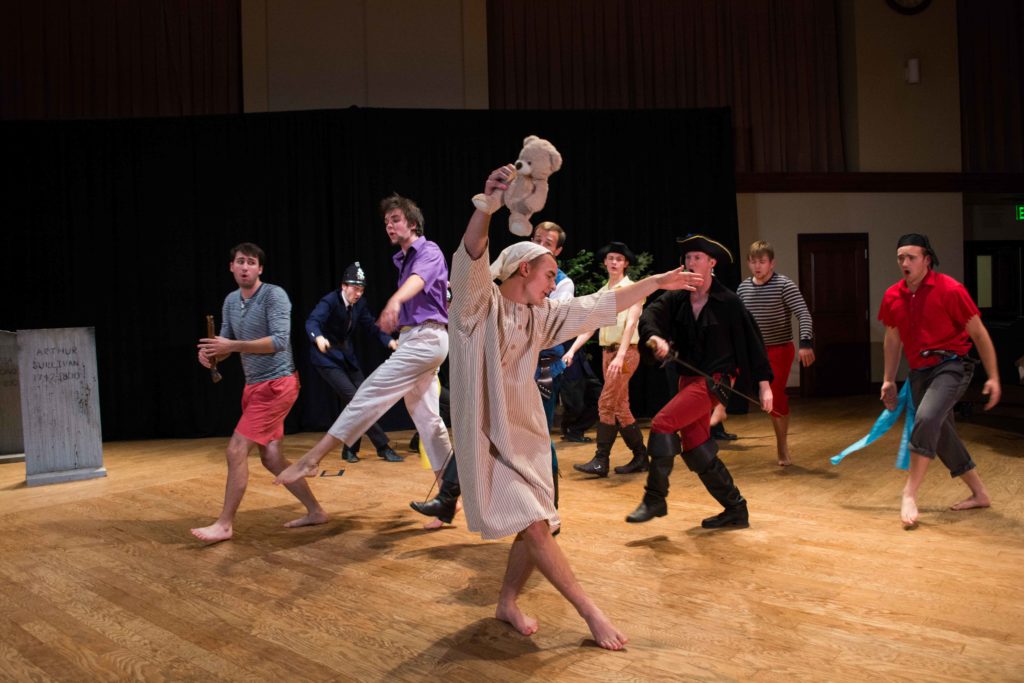

More than 600 people crammed into McNamara Rehearsal Hall Friday, Saturday, and Sunday to watch Gilbert and Sullivan’s “Pirates of Penzance.” Never in my four years here have I seen so many attend Opera Workshop’s annual performance. I would know — I was always performing.
The show attracted audiences in mass, because it’s a classic, but the audience’s uproarious laughter and undistracted attention didn’t hinge on nostalgia. The 23-person cast radiated with energy, and it sang and danced with seemingly effortless precision.
The operetta is wild. As a young pirate goes googly eyed for the daughter of a general, stars cross and hilarity ensues. The general’s nine other daughters squeal as their impassioned Mabel, freshman Julia Salloum, falls for freebooter Frederic, junior Miles Garn. The speed-singing Major General, sophomore Nick Uram, boasts of his gift for strategy in a near-rap. And the Pirate King, sophomore Isaac Johnson, spearheads a deafening sneak attack (“No sound at all,” the crew belted. “We never speak a word!”).
“It’s such a fun show to see — it works in so many different elements,” director Jonathan Henreckson, a senior, told me before “Pirates” opened Friday night. “It has the humor. It has some sadness, some dancing, some recitatives.”
Jonathan didn’t mention the show would double as an ab workout. I started laughing as soon as the pirates took the stage in the first scene, and I rarely quieted to even a chuckle until the performers bent in a final bow. The cast enriched the show as each actor, even those in the chorus, brought a well-developed character to the stage and every song, every scene coursed with a continuous, tangible energy.
The Major General and the Pirate King had me doubled over in painful laughter with their feature numbers. Decked out in military garb, Nick adapted some sort of accent with a speech impediment that reminded me of Dick Van Dyke’s elder Mr. Dawes in “Mary Poppins.” Remember “Fidelity Fiduciary Bank”? Nick must. Even better, he could actually translate this affectation to his singing voice — an notable feat for a young singer.
As Isaac swaggered across the stage, I couldn’t stop thinking about King George of “Hamilton.” The two kings exuded haughtiness and mischief, but where Jonathan Groff, of “Hamilton’s” original Broadway cast, opted for subtlety, Isaac sprung for exaggeration. It worked, especially in Isaac’s physical portrayal of the brash leader.
“A lot of the energy I tried to put into the performance was more athletic, and I tried not to take the role too seriously,” Isaac told me after the show closed.
The Pirate King moved with the grace of a dancer (fittingly, since Isaac does dance) and the stateliness of royalty, but his agility enabled him to bumble and stumble like a drunken sailor.
Miles based much of Frederic on Isaac’s example in rehearsal, he explained to me afterward. Springboarding off Isaac’s natural exuberance, he created the youthful, charming Frederic. The audience roared as bashful Frederic accidentally stumbled upon the Major General’s daughters stripping (off their shoes and stockings) and taking (their toes for) a dip in the sea. Miles’ best moment in the show was with Ruth, freshman Sarah Nolting. Miles and Sarah sing with similar timbres, so their duet blended with a perfection I don’t often hear men and women achieve, especially in college.
None of the leads stole the show, which tells me no one’s talent exceeded another’s by any startling measure. But I really want to know what the coming semesters hold for Julia, who sang opposite Miles for most of the show. As she lofted her voice into the stratosphere, her high notes always sparkled and never stung. She gently serenaded Frederic as she gazed at him with the widest, softest puppydog eyes.
And she hadn’t taken a single voice lesson before she started singing with voice professor Missy Osmond this semester.
“This show was just a completely new experience that helped me grow as a performer and a singer,” Julia said. “Vocally, I’ve learned a lot more about breath support and some more techniques because singing operatically is a whole different playing field than singing jazz or typical musical theater.”
With this much star talent so evident from the beginning of the show, I wondered if the chorus would lack flair. I shouldn’t have worried.
The pirates stomped around in their boots and flexed their muscles as the sisters pranced in floor-length skirts and giggled in bell-like peals of girlish laughter. When Frederic crooned to the sisters, freshman Abbey Bohrer swooned so convincingly that I was ready to dash forward and catch her if she actually keeled over. The towering Sergeant of Police and his short stooges marched like the world’s most clumsy, goose-stepping robots.
Most importantly, the chorus produced a warm and supported sound that allowed the audience to understand the lyrics that often flew by at prestissimo. Save a few messy cutoffs, their work was clean and crisp.
The cast could never have showcased any of this talent without tremendous energy. They unashamedly enjoyed themselves (especially in the more ridiculous moments), and I honestly don’t know how they maintained character through every joke. The pauses for audience response must have agonized them.
Here’s my only critique: I wanted to see this show in the Markel Auditorium. I wanted to see Isaac swing from the masts of a colossal ship as his crew crawled drunkenly out of the bellows. I wanted to see the sisters dance in ornate costumes. But a performance as such is not the point of Opera Workshop. Opera Workshop allows singers and audiences to interact with opera. With a production of this caliber, I’d say we all walked away from the show happier, lighter, and maybe even a little more learned.
